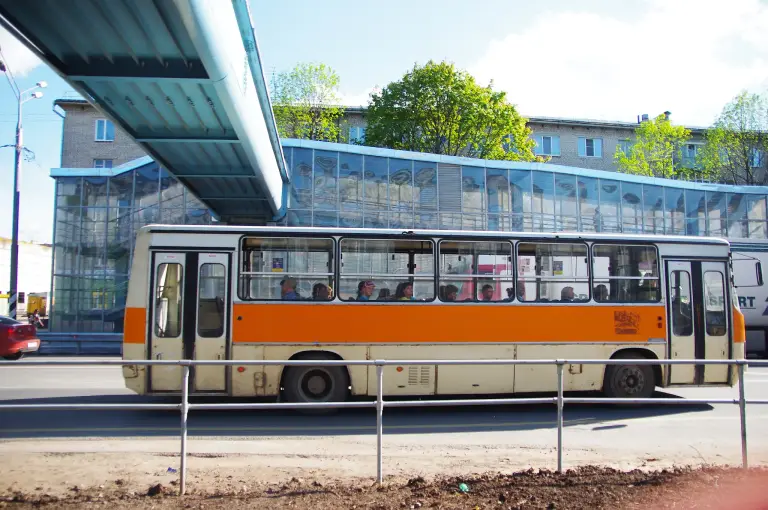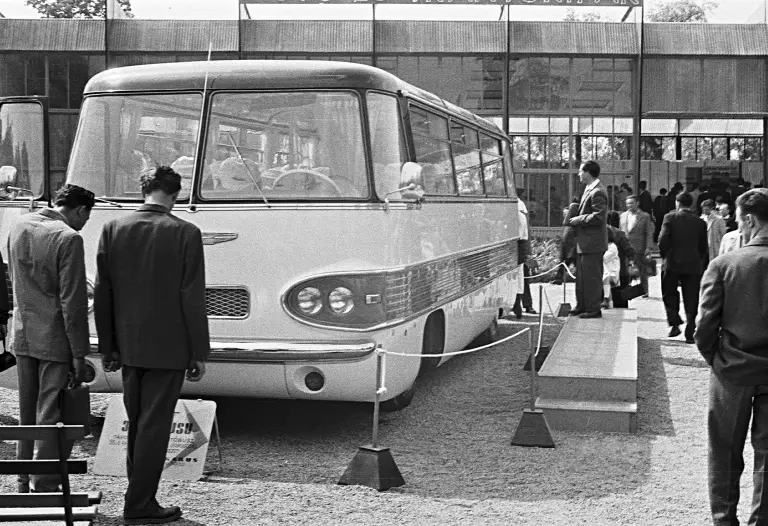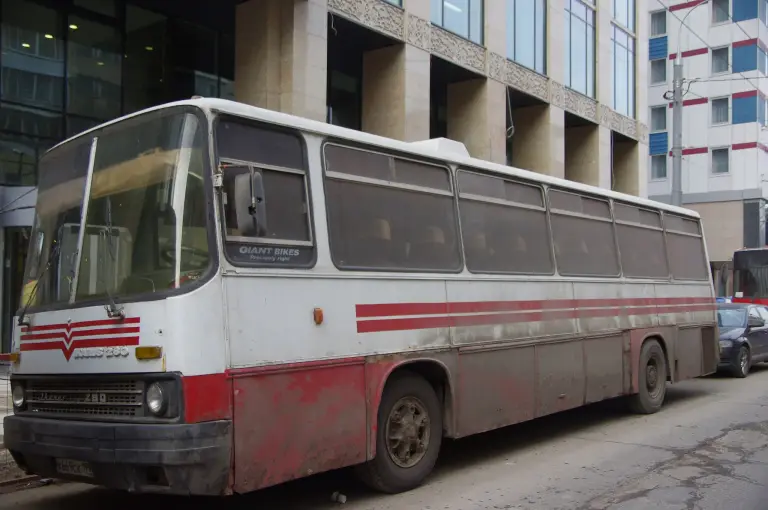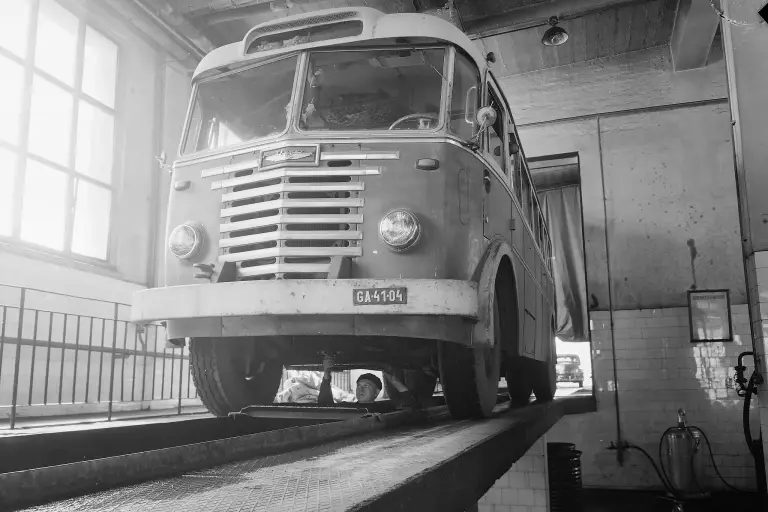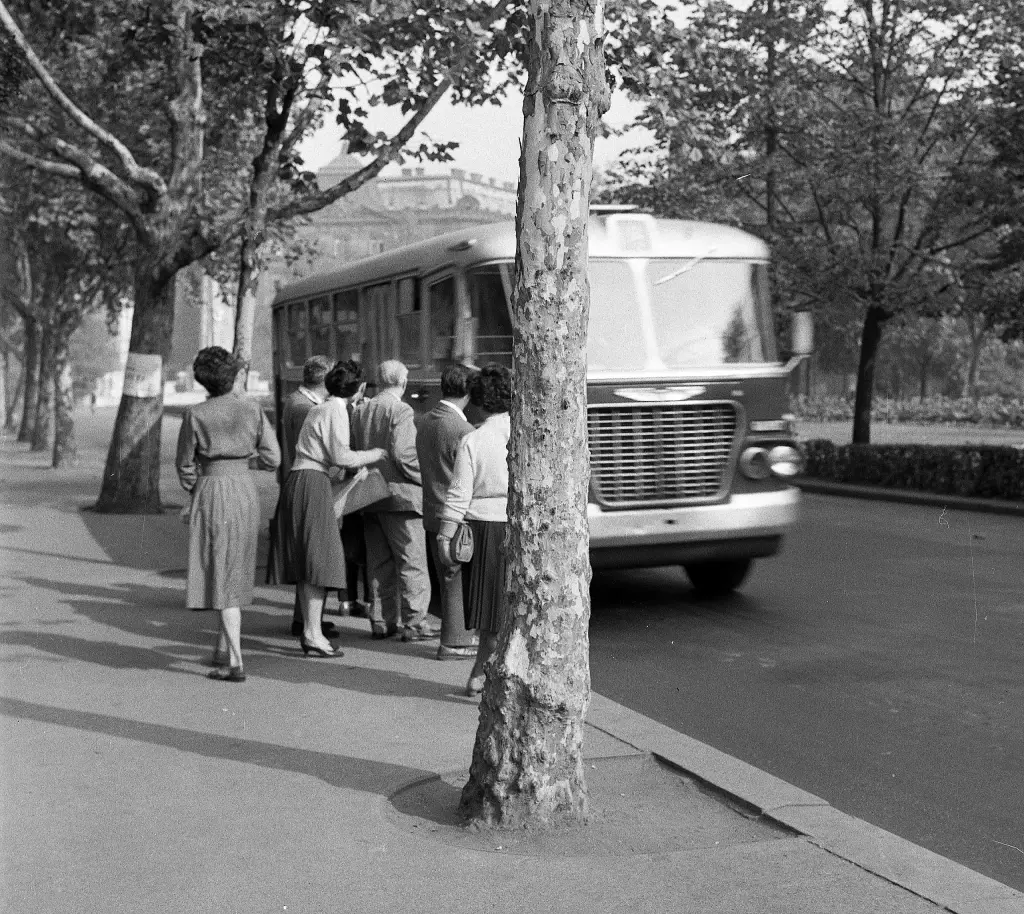
The Ikarus 620 was the medium-capacity city bus of the generation after the Ikarus 60. Built from 1958 to 1972 with a chassis and a front engine, it looked plainer than the rear-engined 55 and 66, but three rows of seats and large standing areas let it carry around eighty passengers — more than the comparable Soviet buses.
Ikarus 620 at a glance
| Maker | Ikarus, Budapest-Mátyásföld |
|---|---|
| Type | medium-capacity city bus |
| Production | 1958–1972 |
| Basis | Ikarus 60; chassis construction with a front engine |
| Built at | Ikarus (standard buses), Mávaut (articulated), Puli (articulated and special) |
| Capacity | about 80 passengers, 20–23 seated |
| Engine | Csepel D-613, 7.99 litres, 125 hp |
| Alternative engine | Csepel D-614, 8.28 litres, 145 hp |
| Gearbox | five-speed, synchronised on II–V |
| Doors | two pneumatic sliding doors, 1,175 mm each |
| Exports | Warsaw Pact countries; from 1959 to the USSR |
Based on one source: the Russian Wikipedia article on the Ikarus 620.
History of the Ikarus 620
The 620 was created on the basis of the Ikarus 60 and kept its frame construction and front-mounted engine, but it looked much plainer than the suburban Ikarus 55 and 66. It was intended mainly for city routes, although it often worked on suburban ones as well. The model was built at three enterprises: Ikarus made the standard buses, Mávaut the articulated ones and Puli the articulated and special vehicles, including sightseeing buses.
For boarding and alighting the bus had two automatic sliding doors with pneumatic operation, each 1,175 mm wide, and the driver’s cab had two doors, for the driver and the conductor, that opened against the direction of travel. Thanks to the three-row layout and the large standing areas, an Ikarus 620 could take about 80 passengers with 20 to 23 seats, which made it considerably better in this respect than the comparable Soviet buses ZIS-155, ZIL-158 and LAZ-695.
Most 620s were fitted with the Csepel D-613 diesel of 7.99 litres and 125 hp, and the bus could also be had with the more powerful 8.28-litre Csepel D-614 of 145 hp. All engines worked with a five-speed mechanical gearbox synchronised on second to fifth, and every 620 had a hydraulically operated clutch and a pneumatic braking system. From the start of production the type was common in Hungary, where it served not only as a city bus but also as a mobile shop. It was exported to many Warsaw Pact countries and used in large capital transport undertakings such as those of Warsaw and Prague. From 1959 it was supplied to the Soviet Union in solo form and, more rarely, as the intercity Ikarus 630, as well as in special vehicles based on it such as mobile X-ray units and dental surgeries. Buses of this type ran in Soviet cities until the end of the 1970s, and some written-off buses were converted by transport companies into lorries and vans.
Design and features
- Three-row seating: about 80 passengers with 20–23 seats and large standing areas.
- Two wide sliding doors: pneumatic doors of 1,175 mm each for quick exchange.
- Two engine options: the Csepel D-613 of 125 hp or the D-614 of 145 hp.
- Separate driver and conductor doors: both opened against the direction of travel.
- Many body types: standard, articulated and special vehicles, including mobile shops and clinics.
Ikarus 620 versions
- Standard bus: built by Ikarus with the Csepel D-613 or D-614 engine.
- Articulated buses: built by Mávaut and Puli.
- Special vehicles: Puli built sightseeing buses and mobile clinics on the 620 basis.
- Ikarus 630: the long-distance version with a slightly different body.
- Converted lorries and vans: made from written-off buses by their operators.
The 620 was based on the Ikarus 60, and its long-distance version was the Ikarus 630. More buses are in the Ikarus collection.
Video: Transporting an Ikarus 620 from Sürgavere to Järva-Jaani, Estonia (2006)
Video by Martin Männik on YouTube.
Sources
- Ikarus 620, Russian Wikipedia: production, layout, capacity, engines, exports