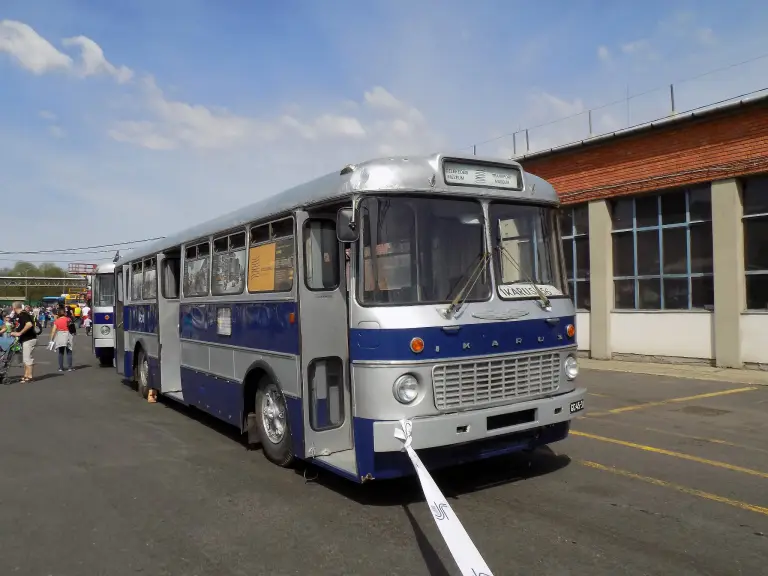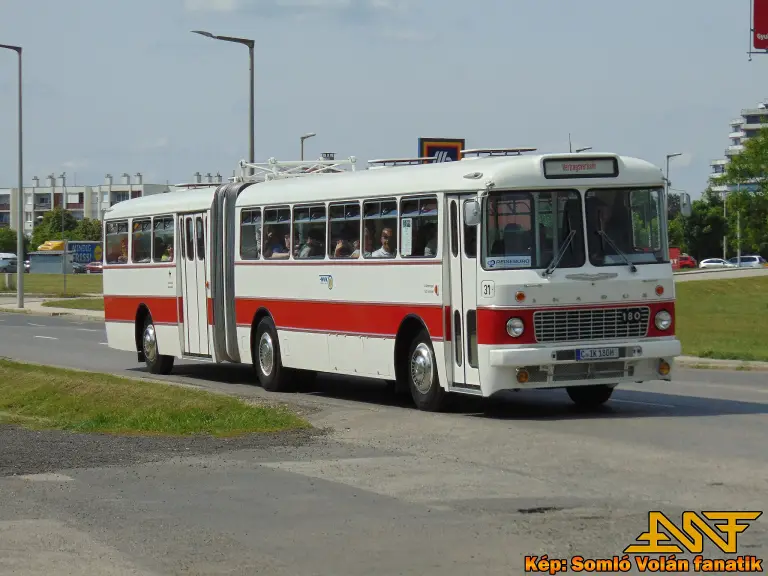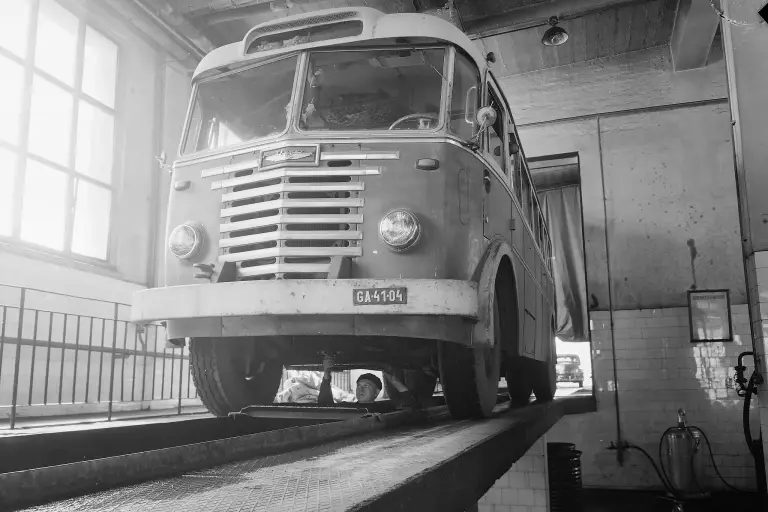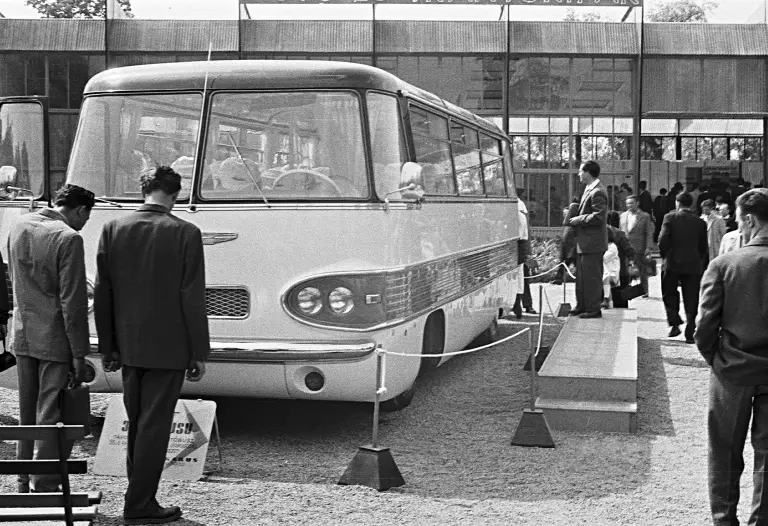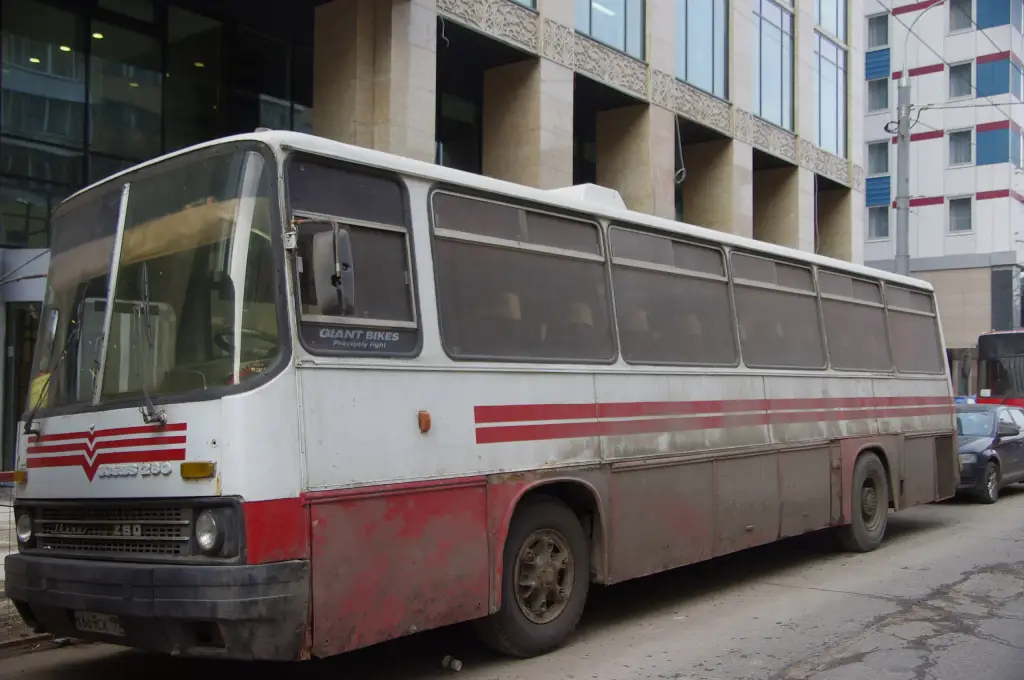
The Ikarus 256 was designed at Székesfehérvár to fill the gap between the plainly equipped, leaf-sprung Ikarus 255 and the Ikarus 250 at the top of the long-distance range. It used the main dimensions of the 255 but air suspension, and from the early 1980s to the mid-1990s it was practically the only long-distance bus on Hungarian routes.
Ikarus 256 at a glance
| Maker | Ikarus, Székesfehérvár |
|---|---|
| Type | interurban and long-distance coach |
| Prototype | shown at the 1973 Budapest International Fair |
| Production | series from 1977 to 1989; over 25 years and more than 23,000 built in total |
| Engine | Rába D2156 HM6U, 10,350 cm³, 141 kW (192 PS) |
| Turbo engine | Rába D2156 HM6UT, 184 kW (250 PS) |
| Gearbox | ASH-75 five-plus-one; ZF S6-90U six-plus-one from 1980 |
| Suspension | air-sprung beam axles |
| Top speed | 106 km/h |
| Seats | up to 45 |
The English article gives 1977–1989 and 45 seats; the Hungarian article gives over 25 years of production and more than 23,000 buses, and adds the later 1990s subtypes.
History of the Ikarus 256
The type was designed by the Székesfehérvár works to fill a gap in the market between the modest, leaf-sprung Ikarus 255 and the Ikarus 250, which counted as the flagship of the long-distance class. The prototype had the main dimensions of the 255 but air suspension, and it was shown at the 1973 Budapest International Fair. Only a few examples were built in the following years; series production began in 1977, with 22 buses going to the Budapest-based Volánbusz that year and more than 1,300 to the Volán companies between 1978 and 1989. Thanks to those numbers the type dominated Hungarian long-distance traffic from the early 1980s to the mid-1990s.
The standard engine was the Rába D2156 HM6U: a direct-injection, liquid-cooled, horizontal six-cylinder diesel of 10,350 cm³ developing 141 kW (192 PS) at 2,100 rpm and 696 N·m at 1,300 rpm. A turbocharged D2156 HM6UT gave 184 kW (250 PS) at 2,200 rpm and 883 N·m at 1,600 rpm, and the D10 UTS offered 241 PS. The engine sat under the floor at the back, as in the rest of the 200 family, driving through a single-disc dry clutch. The gearbox was the five-plus-one ASH-75, replaced from 1980 by the six-plus-one ZF S6-90U; a few buses were built with Renk-Doromat or Voith automatic transmissions.
In mechanical terms the 256 matched the Ikarus 250 described by English sources: a two-axle high-floor coach with a semi-self-supporting body, two air-sprung beam axles with a planetary rear axle, twin rear tyres, hydraulically assisted ball-and-nut steering, and three braking systems — a pneumatic dual-circuit service brake, an exhaust brake and a spring-loaded parking brake. The standard five-speed gearbox gave a top speed of 106 km/h and the coach seated up to 45 passengers. The type was developed further long after the classic years: the 256.44 of 1993 and the 12-metre 256.42 of 1995 came from the urban Ikarus 244 project, and the C56 of 1998 was a modernised 256.42 that was also built with the front and rear panels of the 200 series as the 256.22.
Design and features
- Air suspension: the main difference from the cheaper Ikarus 255, and the reason for its comfort on long runs.
- Rába D2156 engines: naturally aspirated at 192 PS or turbocharged at 250 PS.
- Six-plus-one gearbox from 1980: the ZF S6-90U replaced the earlier ASH-75 five-speed.
- Export versions: separate subtypes for East Germany, the Soviet Union, Poland and Russia.
- Long development life: the body was still being built in modernised form as the C56 in 1998.
Ikarus 256 versions
- 256.50: the classic version, also built as the 256.50V for the Volán companies.
- 256.50VL Volan Lux: quiet rear axle, ventilated seats, extra lighting and more power.
- 256.51: export version for East Germany.
- 256.54: export to the Soviet Union with a simpler interior.
- 256.55 and 256.74: export versions for Poland and Russia.
- 256.42, 256.44 and C56: the 1990s developments from the Ikarus 244 project.
The 256 was the air-sprung answer to the Ikarus 255 and the smaller relative of the Ikarus 250; its city counterpart was the Ikarus 260. More buses are in the Ikarus collection.
Sources
- Ikarus 256, English Wikipedia: technical description, engine, gearbox
- Ikarus 256, Hungarian Wikipedia: history, engines, gearboxes, subtypes