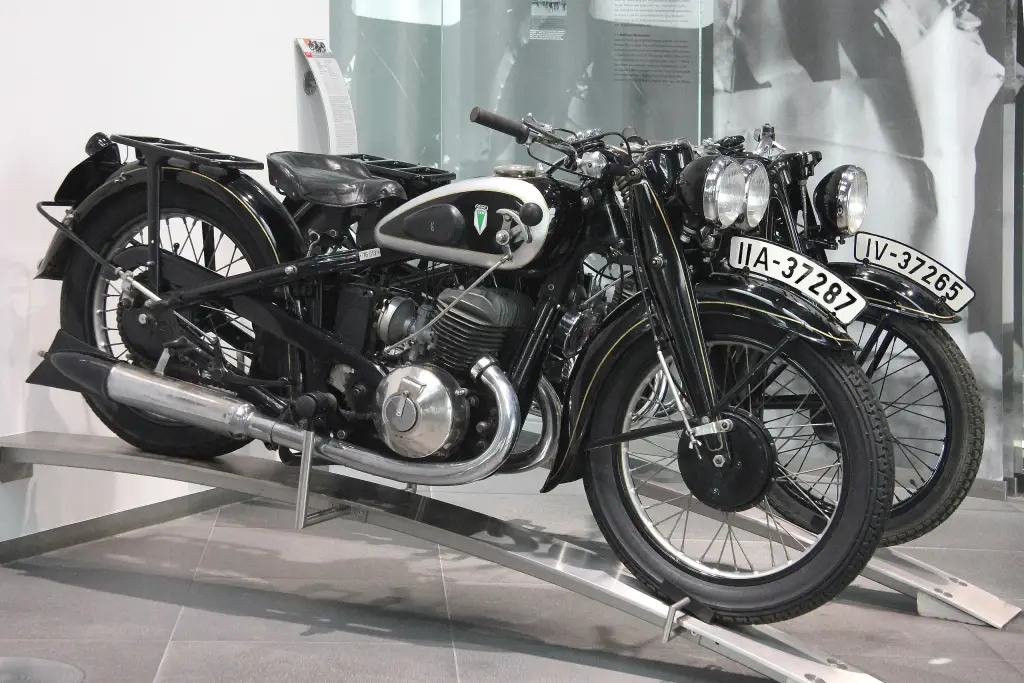
The DKW SB was the motorcycle range that made DKW the biggest motorcycle maker in the world. Introduced in 1934 and built until 1939, it covered five capacity classes from 200 to 500 cc on the same pressed-steel frame, and its biggest model, the SB 500 twin, was the strongest bike DKW had built to that point.
DKW SB at a glance
| Maker | Auto Union AG, Zschopau |
|---|---|
| Production | 1934–1939 |
| Models | SB 200, SB 250, SB 300, SB 350, SB 500 |
| Sport version | DKW Sport 250, close to the SB 250 |
| Frame | nine-piece pressed-steel profile frame, bolted, with sidecar mounts |
| Engines | single-cylinder two-stroke with Schnürle loop scavenging |
| Gearbox | three-speed, unit with the engine |
| SB 500 engine | 494 cc twin, 15 PS at 4,000 rpm |
| SB 500 gearbox | three-speed, hand shift |
| Milestones | the 300,000th DKW in November 1935, the 500,000th in February 1939 |
| Ancestor | developed from the DKW Block |
History of the DKW SB
One frame, five engines
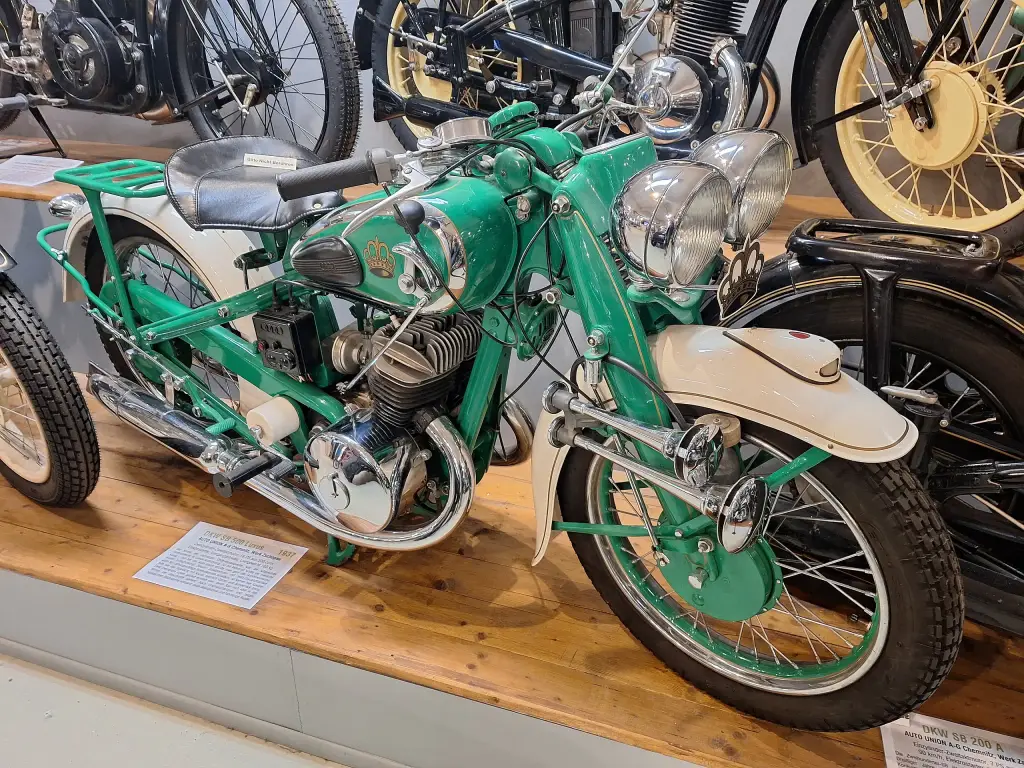
The SB range grew out of the DKW Block and in its first series differed from it only in details such as the handlebar, the hand levers and the drive shock absorber in the engine block, which made pulling away smoother and gear changes more comfortable. Luxury versions of each type came with a Dynastart system, chrome and detachable exhaust silencers, a chromed tank, a speedometer and a clock. The frame was a nine-piece pressed-steel profile frame with an underrun, bolted joints and fittings for a sidecar. There were two versions: a short frame until the 1936 model year and a longer one with a longer wheelbase after it.
Engines and equipment
All models had a single-cylinder two-stroke with Schnürle loop scavenging, licensed to Auto Union, which cut fuel consumption by about 40 per cent against conventional designs and brought it close to four-stroke levels. Power went through spur gears to a three-speed gearbox in a unit with the engine and then by chain to the rear wheel; the hand shift lever ran in a gate on the tank. Every engine had a twin-port exhaust. The long-frame models had larger headlamps, different instrument holders and a bigger tank, and from 1938 the chrome on the tank gave way to polished Hydronalium strips. They also had combined hand and foot gear change. The DKW Sport 250 differed from the SB 250 only in a continuous underrun beneath the engine and gearbox unit and a stronger clutch with three plates instead of two.
The SB 500
The SB 500 was the largest and last of the range, built from 1934 to 1939. Its two-cylinder two-stroke had 494 cc from a 68 mm bore and stroke and made 15 PS at 4,000 rpm. Power reached a hand-shifted three-speed gearbox through spur gears, and the luxury version had an electric Dynastart starter instead of a kick starter. A November 1935 SB 500 in luxury trim was the 300,000th DKW motorcycle, and one built on 6 February 1939 was the 500,000th; that anniversary machine was started by the record rider Walfried Winkler. DKW’s 1935 owner’s manual advised fitting a sidecar only to the two-cylinder machines — meaning the SB 500.
Off-road versions
The SB models, including the Sport 250, were also built in off-road trim for trials and enduro use: raised exhaust with heat shields, deeper-pattern tyres, a shortened front mudguard, a sump guard and combined hand and foot gear change. A second version also had the dynamo, regulator and battery sealed against water and the carburettor intake raised.
Design and features
- Five capacities: one frame and one layout from 200 to 500 cc.
- Pressed-steel frame: nine pieces, bolted, with mounts for a sidecar.
- Schnürle scavenging: about 40 per cent less fuel than earlier two-strokes of the same size.
- SB 500 twin: 494 cc, 15 PS, the strongest model of the range.
- Off-road trim: raised exhaust, sump guard and waterproofed ignition available from the factory.
DKW SB versions
- SB 200, 250, 300 and 350 (1934–1938): single-cylinder models on the shared frame.
- DKW Sport 250: a slightly stronger SB 250 with an Amal sport throttle.
- SB 500 (1934–1939): the 494 cc twin at the top of the range.
- Luxury versions: Dynastart, chrome tank, clock and speedometer.
- Off-road versions: trials and enduro trim with waterproofed electrics.
The SB was replaced by the DKW NZ series; the DKW RT 125 came later in the same Zschopau works. The DKW Z 500 was an earlier twin. More cars and bikes are in the DKW collection.
Video: 1936 DKW SB 500 startup
Video by dekawe500 on YouTube.
Sources
- DKW SB 200/250/300/350, German Wikipedia: frame, engines, equipment, off-road versions
- DKW SB 500, German Wikipedia: SB 500 engine, milestones
- DKW, English Wikipedia: DKW as a motorcycle maker