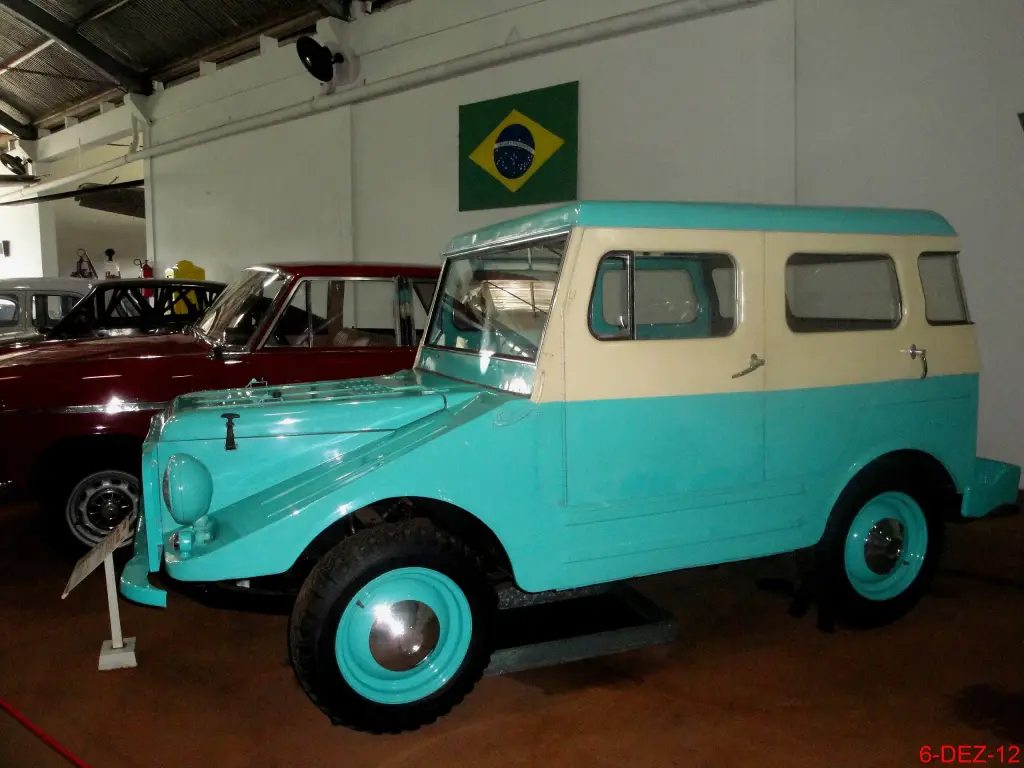
The Candango was the Brazilian-built DKW Munga, and its name honoured the labourers who built the new capital, Brasília. Vemag made it from 1958 to 1963 in four-wheel-drive form as the Candango 4 and, once buyers asked for something cheaper to run, with front-wheel drive as the Candango 2. Production stopped when the military showed no interest in buying it.
DKW-Vemag Candango at a glance
| Maker | Vemag, São Paulo, under DKW licence |
|---|---|
| Production | 1958–1963 |
| Based on | DKW Munga 4 |
| Models | Candango 4 (four-wheel drive), Candango 2 (front-wheel drive) |
| Engine | 900 cc from 1958, 1,000 cc from 1959 |
| Name | after the candangos, the workers who built Brasília |
| Built | 5,607, though some sources say 7,868 or 4,400 |
| German original | 46,750 Mungas built at Ingolstadt |
| Why it ended | the military showed no interest in buying it |
based on Portuguese Wikipedia; production figures differ between sources
History of the DKW-Vemag Candango
A Munga for Brazil
Production of the DKW Munga began at Ingolstadt in October 1956 and the vehicle was launched publicly at the Frankfurt show in 1957. In 1958 Vemag presented its Brazilian range: the saloon known as the Grande DKW-Vemag, the estate, and the Candango jeep derived from the German Munga, all with a high level of local content. The first two used the 900 cc engine, and from 1959 the range moved to 1,000 cc. The Munga was sold to the German police and to the armed forces of several NATO countries and was a success in agriculture and anywhere that needed transport over bad roads, and the same was expected in Brazil.
Two versions
The Candango was a licensed copy of the German Munga 4 and was sold in two forms that differed only in how many wheels were driven. The Candango 4 had permanent four-wheel drive, which gave it worse performance than its rivals on paved roads, so Vemag added the Candango 2 with drive to the front wheels only. In 1961 the saloon and estate were renamed Belcar and Vemaguet and the Candango carried on alongside them.
The end
Production of the Candango stopped in 1963, mainly because the military did not show enough interest to keep it going. The German Munga continued until December 1968 with about 46,750 built, while the Brazilian total is usually given as 5,607, although some sources say 7,868 or 4,400. In September 1967 Volkswagen of Brazil bought Vemag, promising not to end production of its vehicles, and then closed the line in December as two-stroke engines went out of fashion worldwide.
Design and features
- Two versions: the Candango 4 with permanent four-wheel drive and the Candango 2 with front drive only.
- Munga basis: the same body and two-stroke mechanicals as the German military vehicle.
- Local content: built in Brazil with a high proportion of national parts.
- Brazilian name: named after the candangos, the workers who built Brasília.
- Short life: dropped after five years for lack of military orders.
DKW-Vemag Candango versions
- Candango 4 (1958–1963): permanent four-wheel drive, the direct Munga copy.
- Candango 2 (from 1959): front-wheel drive only, cheaper and better on tarmac.
- German Munga (1956–1968): the original, covered in a separate article.
The Candango was the Brazilian form of the DKW Munga and was sold alongside the Belcar. The factory story is on the DKW-Vemag page; more cars are in the DKW collection.
Video: Noiva_de_DKW_Candango
Video by RodaLivreNegocios on YouTube.
Sources
- DKW-Vemag Candango, Portuguese Wikipedia: history, versions, production
- Vemag, Portuguese Wikipedia: factory history and model range