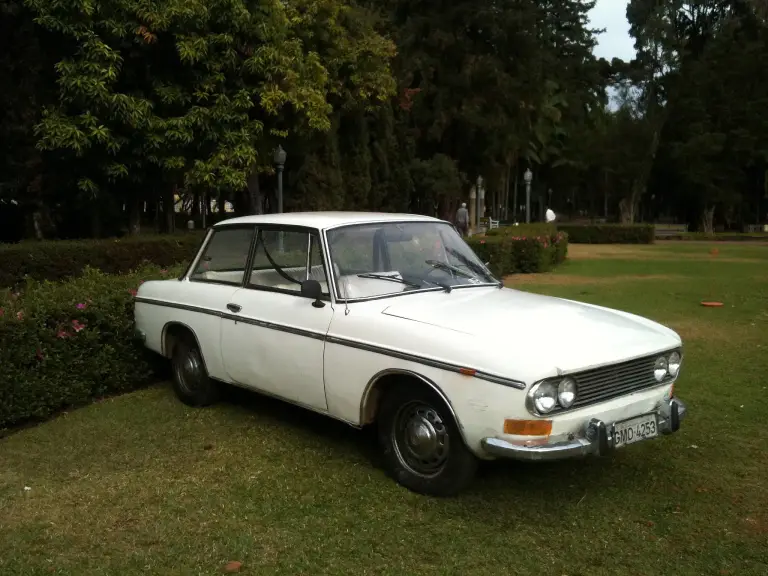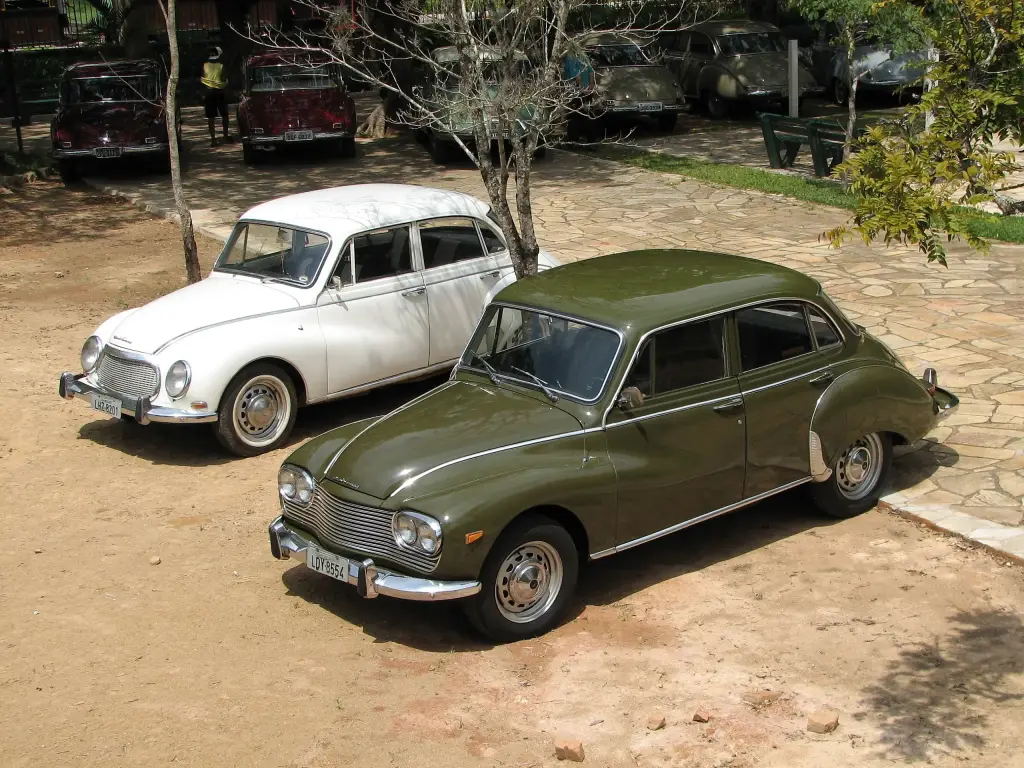
The Belcar was the saloon that carried DKW motoring in Brazil. Derived from the German DKW F94, it was built by Vemag from 1958 to 1967 and was known at first simply as the Grande DKW-Vemag; the name Belcar, from ‘beautiful car’, arrived in 1961. Vemag built 51,072 of them.
DKW-Vemag Belcar at a glance
| Maker | Vemag, São Paulo, under DKW licence |
|---|---|
| Production | 1958–1967 |
| Based on | DKW F94 saloon |
| Built | 51,072 |
| Name | Grande DKW-Vemag until 1961, then Belcar |
| Engine | 981 cc three-cylinder two-stroke, 50 CV SAE at 4,500 rpm |
| Torque | 8.5 kg.m at 2,250 rpm |
| Cooling | water, thermosiphon, no pump |
| Gearbox | four speeds, all synchromesh, freewheel, Saxomat optional |
| Seats | up to six passengers |
| Updates | 1001 series 1964, Rio series 1965, four-headlamp 1967, S engine |
based on Portuguese Wikipedia
History of the DKW-Vemag Belcar
A German design, Brazilian roads
The Belcar came from the German DKW F94 and was produced under Auto Union licence. In its day it was praised for good stability, interior comfort and room for up to six passengers, with mechanicals robust enough for the poor roads of Brazil. It was launched in 1958 together with the restyled estate, and both reached a little over 50 per cent local content by weight that year under the GEIA programme, the government body pushing the car industry; by the end of production almost every part was made in Brazil. It was the first car tested by the magazine Quatro Rodas.
Changes through the years
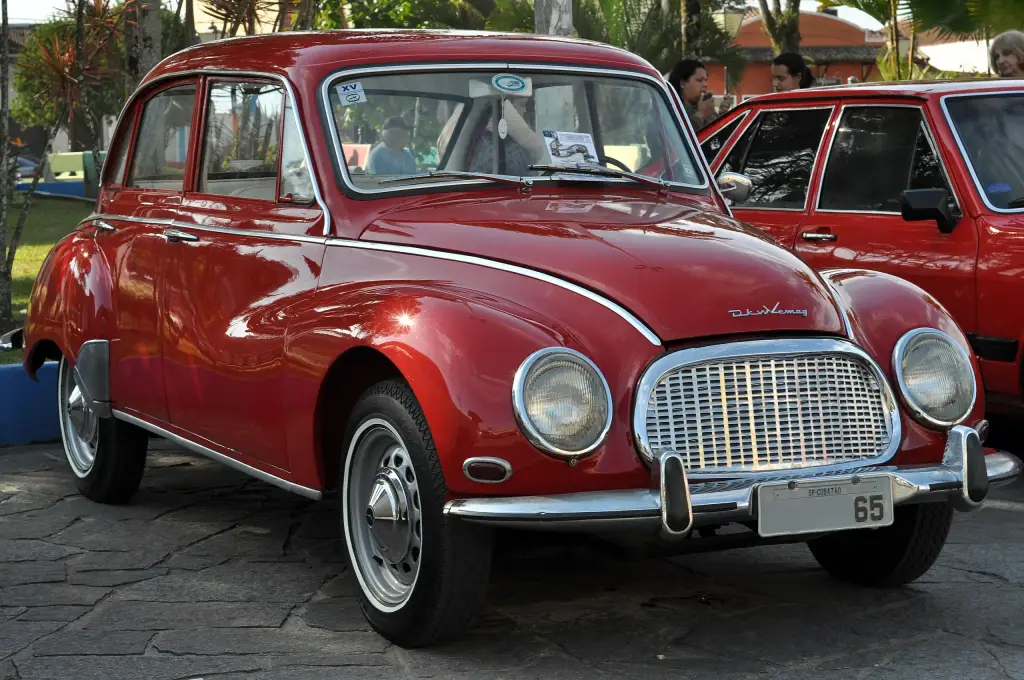
The 900 cc engine of 1958 gave way to a 1,000 cc unit in 1959, and the boot-lid trim strips were dropped while the bumpers and hubcaps were redesigned. In 1964 the wheels gained twelve ventilation holes for the brakes, and the second series, called 1001, switched to conventionally opening doors for safety and gained new door handles. The 1965 Rio series marked four hundred years of the city of Rio de Janeiro and brought the Lubrimat automatic lubrication system to the Belcar and the Vemaguet. For 1967 the car was restyled with four headlamps and a grille running from side to side, the electrical system moved from 6 to 12 volts, and in September came the S series with the Fissore’s engine; production ended in December.
The engine
The 981 cc three-cylinder two-stroke of the Belcar 67 had a 74 mm bore and 76 mm stroke, a compression ratio of 7.1 to 7.3:1, 50 CV SAE at 4,500 rpm and 8.5 kg.m of torque at 2,250 rpm. It was water-cooled by thermosiphon without a pump, fed by a Brosol 40 CIB downdraught carburettor and lubricated by the Lubrimat system. One of its distinctions was the number of moving parts: three pistons, three connecting rods and one crankshaft, seven in all. The gearbox had four synchromesh forward speeds and a reverse with a freewheel that could be disconnected by a cable under the dashboard, and the dry single-plate clutch could be replaced by the semi-automatic Saxomat.
Design and features
- Six seats: more room inside than most of its rivals, with a soft ride suited to Brazilian roads.
- Three-cylinder two-stroke: 981 cc with only seven moving parts and no water pump.
- Synchromesh gearbox: four speeds plus reverse, with freewheel and optional Saxomat.
- Local content: from about half Brazilian by weight in 1958 to almost complete by 1967.
- Steady updates: 1001 series, Rio series, four headlamps and 12-volt electrics for 1967.
DKW-Vemag Belcar versions
- Grande DKW-Vemag (1958–1961): the original name, with the 900 cc then 1,000 cc engine.
- Belcar (1961–1967): the renamed standard saloon.
- Series 1001 (1964): conventional door opening and new handles.
- Rio series (1965): anniversary edition with Lubrimat.
- Belcar 67 and S series: four headlamps, 12-volt electrics and the S engine.
The Belcar shared its platform with the Vemaguet estate and took its S engine from the Fissore. The factory story is on the DKW-Vemag page, and more cars are in the DKW collection.
Video: Dkw Belcar 1962 original
Video by VagnerBretz2603 on YouTube.
Sources
- DKW-Vemag Belcar, Portuguese Wikipedia: history, specifications, series
- Vemag, Portuguese Wikipedia: factory history and model range