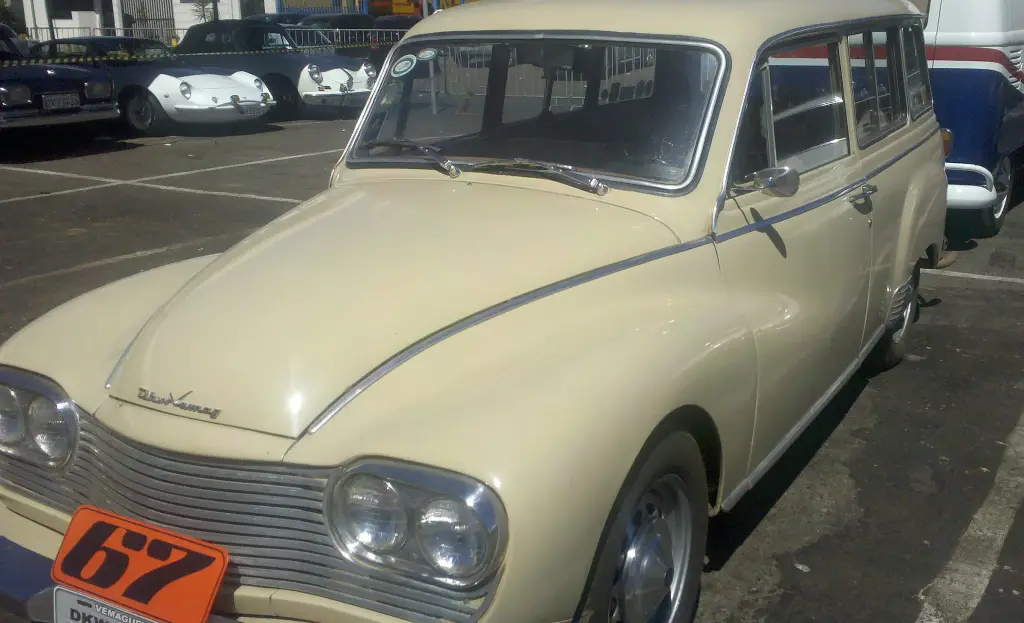
The Vemaguet was the estate version of the Brazilian DKW saloon, and for a while it had no name at all: Vemag sold it as the Camioneta or Perua DKW-Vemag until 1961, when it became the Vemaguet. Between 1958 and 1967 the car and its two cheaper derivatives accounted for 55,692 sales.
DKW-Vemag Vemaguet at a glance
| Maker | Vemag, São Paulo, under DKW licence |
|---|---|
| Production | 1958–1967 |
| Based on | DKW F94 Universal estate |
| Sold in total | 55,692 including derivatives |
| Vemaguet | 47,769 units |
| Caiçara | 1,173 units, 1963–1965 |
| Pracinha | 6,750 units, 1965–1966 |
| Engine | 981 cc three-cylinder two-stroke |
| Doors | front-hinged ‘suicide’ doors until 1964 |
| Predecessor | DKW F-91 Universal assembled from 1956 |
based on Portuguese Wikipedia
History of the DKW-Vemag Vemaguet
Before the name
On 19 November 1956 Vemag put the DKW F-91 Universal estate on the market, derived from the German F-91 saloon and its wood-bodied estate but assembled in Brazil from imported parts. In 1957 the tailgate changed from opening vertically at the sides to a two-piece arrangement with one leaf opening up and one down. In the second half of 1958 the estate derived from the German F-94 appeared, with a high level of local content and the 900 cc engine; from the third quarter of 1959 it had the 1,000 cc unit.
The Vemaguet years
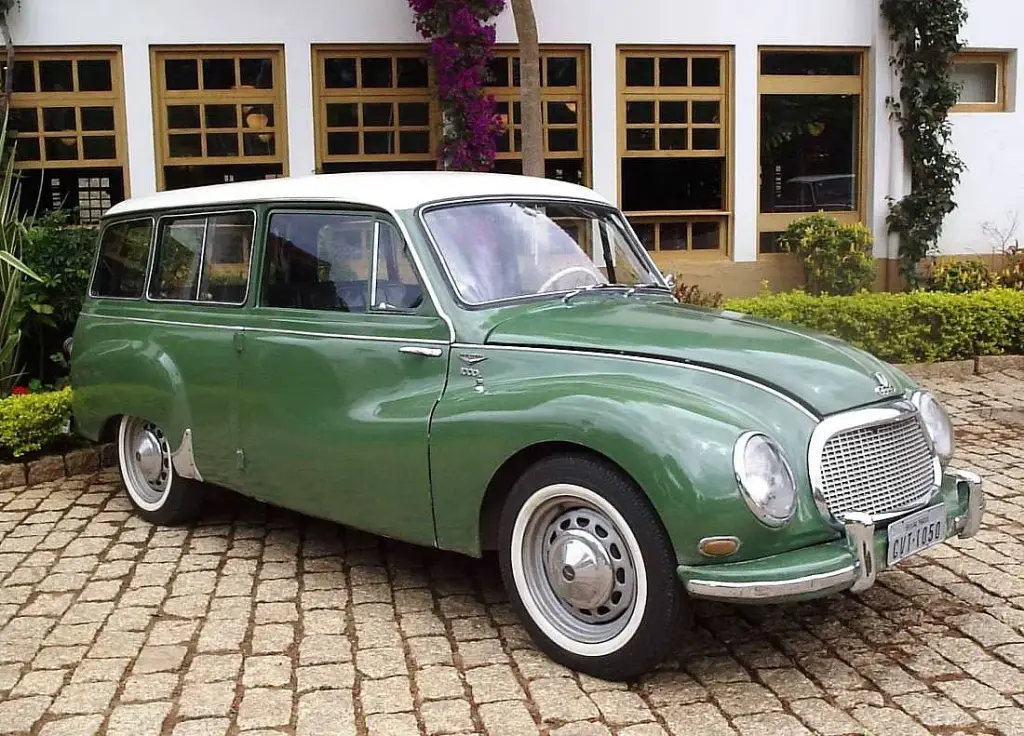
In 1961 the Perua DKW-Vemag became the Vemaguet, with new bumpers and hubcap shapes, and the wheels had gained eight holes in 1960 because the brakes were hard worked — partly a consequence of the freewheel. Until 1963 the front doors opened from the front backwards, the arrangement Americans called suicide doors and Brazilians, for less polite reasons, dechavê. In 1964 they were changed to conventional opening in the interest of safety. In 1965 the Rio series marked the four hundredth anniversary of Rio de Janeiro, and the Lubrimat automatic lubrication arrived.
Caiçara and Pracinha
In 1963 came the Caiçara, a cheap version of the Vemaguet with a single-piece tailgate opening to the left; 1,173 were built before it was replaced in 1965 by the Pracinha, which differed mainly in having doors that opened the conventional way. The Pracinha lasted until 1966 and accounted for 6,750 cars. When Auto Union lost interest in the Brazilian market, the badge on the bonnet of Vemag products was changed to a simpler hand-written ‘DKW-Vemag’ script.
The engine
The engine was a front-mounted, water-cooled 1,000 cc three-cylinder two-stroke running on a petrol-oil mixture, with one coil per cylinder and electric starting. Roller bearings were used instead of bushes and shells in the moving parts, which gave the car durability well above the norm for its time. The estate was also one of the models that received the Lubrimat system, which took the oil from a separate tank and mixed it automatically.
Design and features
- Estate body: the practical version of the Brazilian DKW, with a two-piece tailgate from 1957.
- Three-cylinder two-stroke: 981 cc, water-cooled, with electric starting and a coil per cylinder.
- Roller bearings: in place of bushes and shells, for unusual durability.
- Suicide doors: front-hinged until the 1964 change to conventional doors.
- Cheap derivatives: the Caiçara and Pracinha widened the range downwards.
DKW-Vemag Vemaguet versions
- DKW F-91 Universal (1956–1958): assembled from German parts, vertical tailgate until 1957.
- Perua DKW-Vemag (1958–1961): the F94-derived estate, 900 cc then 1,000 cc.
- Vemaguet (1961–1967): the named estate, 47,769 built.
- Caiçara (1963–1965): cheap version with a single-piece tailgate, 1,173 built.
- Pracinha (1965–1966): its replacement with conventional doors, 6,750 built.
The Vemaguet shared its platform with the Belcar saloon, and the Fissore was the upmarket model above it. The factory story is on the DKW-Vemag page; more cars are in the DKW collection.
Video: Subindo a serra de DKW Vemaguet 1967
Video by Zathenrique on YouTube.
Sources
- DKW-Vemag Vemaguet, Portuguese Wikipedia: history, derivatives, production figures
- Vemag, Portuguese Wikipedia: factory history and model range