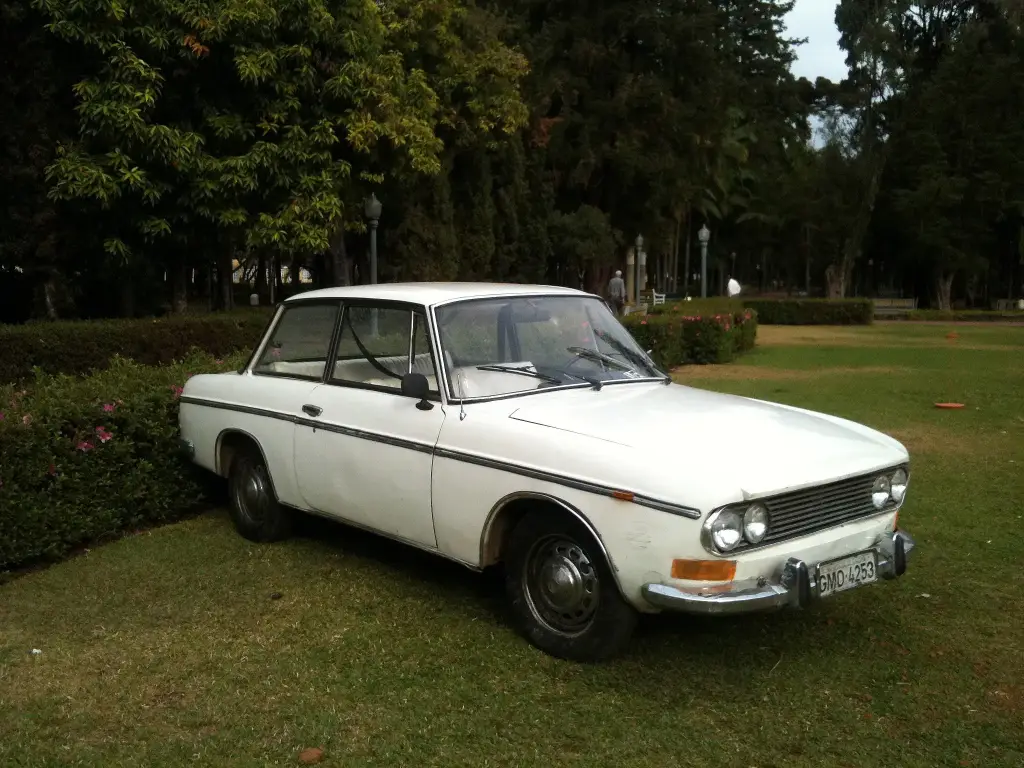
The DKW-Vemag Fissore was Vemag’s attempt to move upmarket. The chassis and two-stroke engine came from the Belcar, but the body was a completely new two-door three-box design by the Italian studio Fissore, drawn by Franco Maina. It went on sale in 1964, cost about 25 per cent more than the Belcar and stayed in production until 1967.
DKW-Vemag Fissore at a glance
| Maker | Vemag, São Paulo, under DKW licence |
|---|---|
| Production | 1964–1967 |
| Body | two-door saloon, designed by Fissore (Franco Maina) |
| Chassis | DKW box-section frame with outriggers |
| Engine | 981 cc three-cylinder two-stroke, 74 × 76 mm |
| Carburettor | Brosol 40 CIB |
| Lubrication | Lubrimat fresh-oil system |
| Gearbox | four-speed, fully synchromesh, with freewheel; Saxomat optional |
| Power | 60 SAE PS claimed, 54–56 PS in practice |
| Price | about 25 per cent more than the Belcar |
based on German and Portuguese Wikipedia
History of the DKW-Vemag Fissore
Why a new model
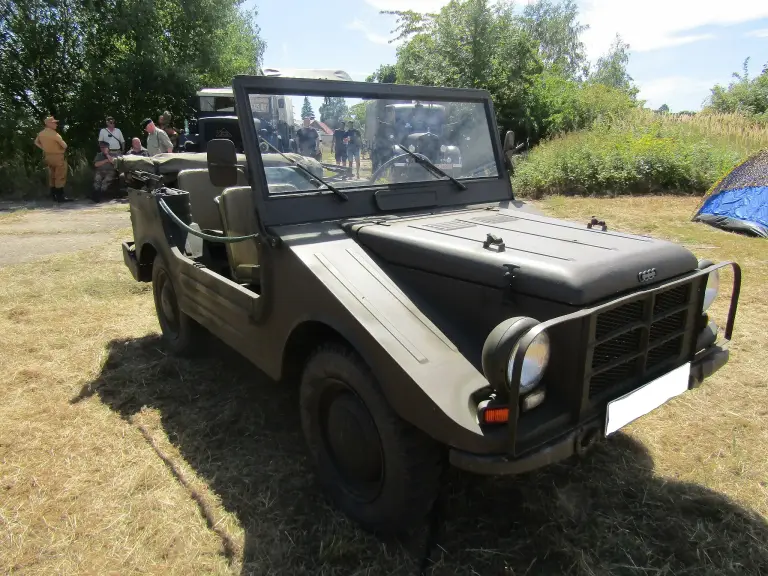
Vemag was founded in São Paulo in 1945 and began as an assembly plant for American Studebakers. Once the German Auto Union had taken a stake, it started building DKW models in 1956, at first from parts shipped from Germany: the DKW F 91 Universal estate and the Candango, a version of the Munga. In 1958 Vemag began complete production under DKW licence, starting with the four-door DKW F 94, sold in Brazil almost unchanged as the Grande DKW-Vemag and later as the Belcar.
The Italian connection
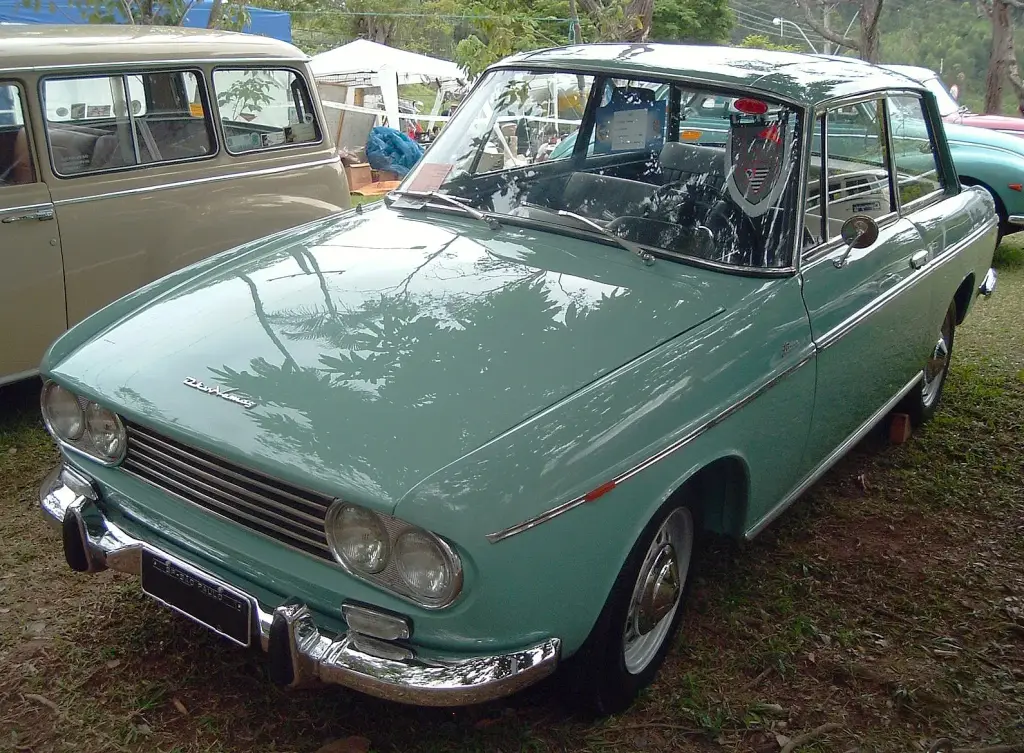
From 1961 Vemag developed a model to sit above the Belcar and take the company into a higher market. The result was the DKW-Vemag Fissore, which combined the Belcar’s mechanicals with a completely new, contemporary body designed in Italy; the design studio gave the car its name. After Fissore built the first prototypes in Italy in 1962, Vemag put the series car, built at home, on the market in 1964. The Fissore stayed in the range alongside the Belcar until 1967 and was about 25 per cent more expensive, but it was built only in small numbers and did not meet expectations. Production ended in 1967, after Volkswagen had taken over Vemag.
The body
The body was designed by Franco Maina for Carrozzeria Fissore. It was available only as a two-door notchback saloon, and unlike the older DKW models it followed three-box styling, with the engine, cabin and luggage compartments clearly separated. The waistline ran level, with a broad trim strip across the upper third of the flanks, and the pillars were steep and very thin, as on other contemporary Fissore designs, which allowed large glass areas and good all-round visibility. The front had oval-framed round twin headlamps and a grille of horizontal chrome bars; the tail lamps were set into the rear wings and reached into the flanks.
Mechanicals
The chassis was a box-section tube frame with outriggers bent outwards, the fishtail frame normal for DKW at the time. Front wheels hung on lower wishbones with an upper transverse leaf spring, and at the back there was a rigid axle on trailing arms with a high-mounted transverse leaf spring; telescopic dampers were fitted all round. The 981 cc three-cylinder two-stroke had a 74 mm bore and 76 mm stroke, 8:1 compression, a Brosol 40 CIB carburettor and Lubrimat lubrication. Its ‘S’ version was claimed at 60 SAE PS, about 10 PS more than the cheaper Vemag models, but in fact the engines were identical: during quality control, those expected to be stronger were set aside and fitted to the Fissore, and most produced 54 to 56 PS rather than the claimed figure. A fully synchromesh four-speed gearbox with freewheel was standard and the Saxomat semi-automatic was optional.
Design and features
- Fissore body: a clean three-box two-door design by Franco Maina, quite unlike the older DKW shape.
- Thin pillars, big glass: generous glazing and good visibility, a Fissore trademark.
- 981 cc two-stroke: with Lubrimat lubrication and a Brosol 40 CIB carburettor.
- ‘S’ engine: selected at the factory, claimed 60 PS but usually 54–56 PS.
- Rare and expensive: about 25 per cent above the Belcar and built in small numbers.
DKW-Vemag Fissore versions
- Fissore (1964–1967): the only body style, a two-door saloon with the ‘S’ engine.
- Saxomat version: semi-automatic clutch offered at extra cost.
- Belcar S (1967): the cheaper saloon that later received the same engine.
The Fissore was the upmarket model above the Belcar and Vemaguet; the factory story is on the DKW-Vemag page. More cars are in the DKW collection.
Video: Auto Esporte – DKW Fissori ’60 & BMW 2002 Tii ’70
Video by HorsePowerBrasil on YouTube.
Sources
- DKW-Vemag Fissore, German Wikipedia: history, body, chassis, engine
- Vemag, Portuguese Wikipedia: factory history and model range