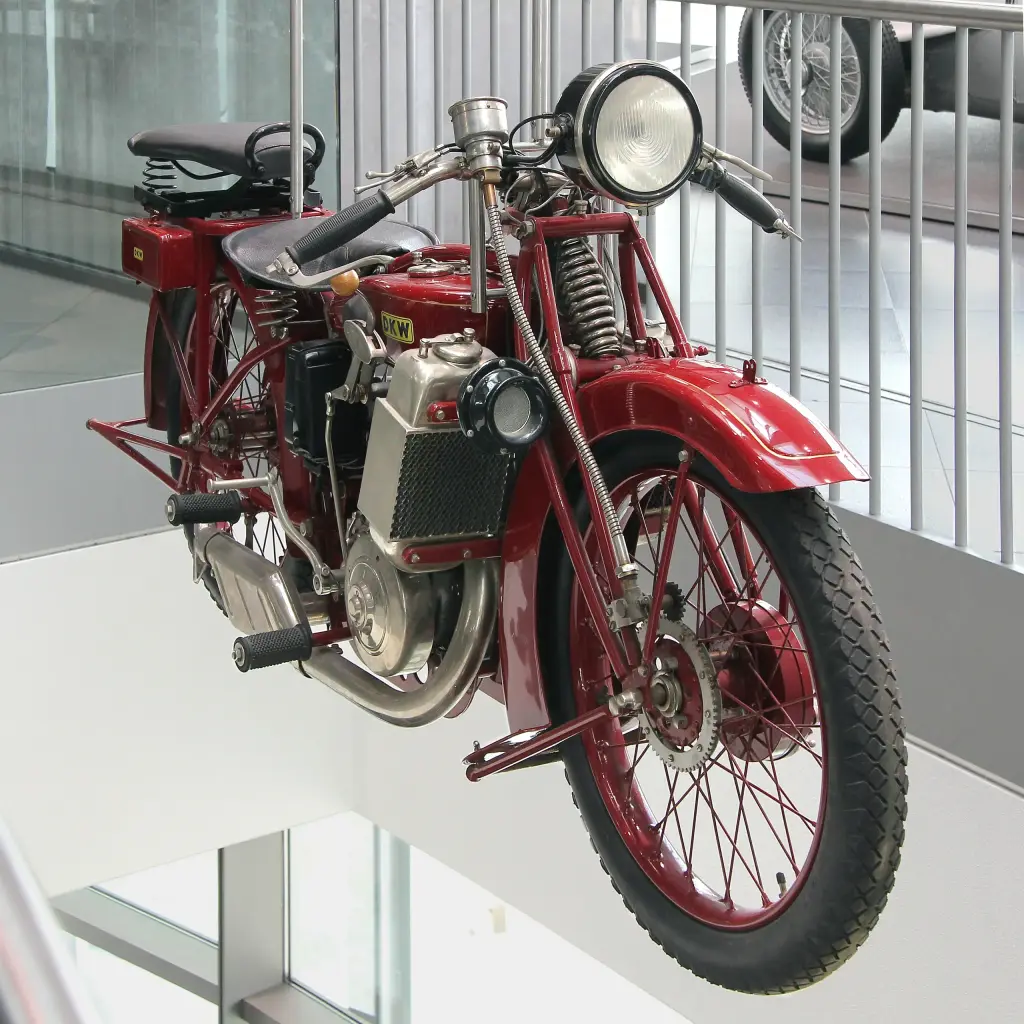
The DKW Z 500 was the first motorcycle the Zschopau works built with a two-cylinder engine, and it spent most of its life fighting heat. Air from a fan on the dynamo side reached the far cylinder already warmed by its neighbour, pistons seized, and DKW tried one cooling fix after another until the water-cooled ZSW 500 of 1929.
DKW Z 500 at a glance
| Maker | Zschopauer Motorenwerke J. S. Rasmussen |
|---|---|
| Model | Z 500, water-cooled version ZSW 500 |
| Significance | DKW’s first two-cylinder motorcycle |
| Frame | as the DKW E models, but with two top tubes carrying the tank |
| Cooling, early | fan on the dynamo side |
| Cooling from 1927 | airflow, with longer mudguards and leg shields |
| Cooling from 1929 | water, without a pump, two radiators |
| Price, last year | 1,285 Reichsmark |
| Built | about 1,000 |
| Race derivative | DKW PRe 500, 1928–1932 |
based on German Wikipedia only
History of the DKW Z 500
An engine too big for the cooling
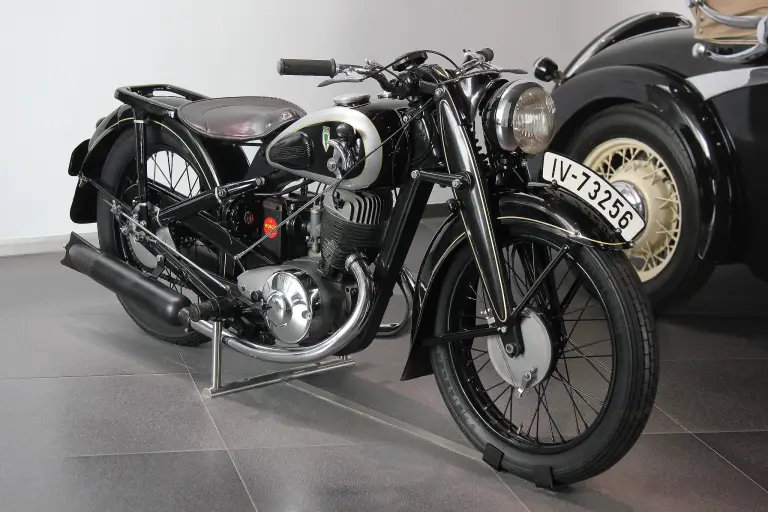
The Z 500’s frame followed the DKW E models but had two top tubes with the tank sitting between them. At the start of production the two-cylinder engine was cooled by a fan mounted on the dynamo side. The arrangement had a built-in fault: the cylinder on the clutch side was swept by air that had already passed over the cylinder facing the fan, so it ran hotter. Piston seizures on that side became frequent enough that from 1927 DKW switched to airflow cooling, which also brought longer mudguards, different silencers and leg shields — shields meant as accessories that later served as air deflectors for the cylinders.
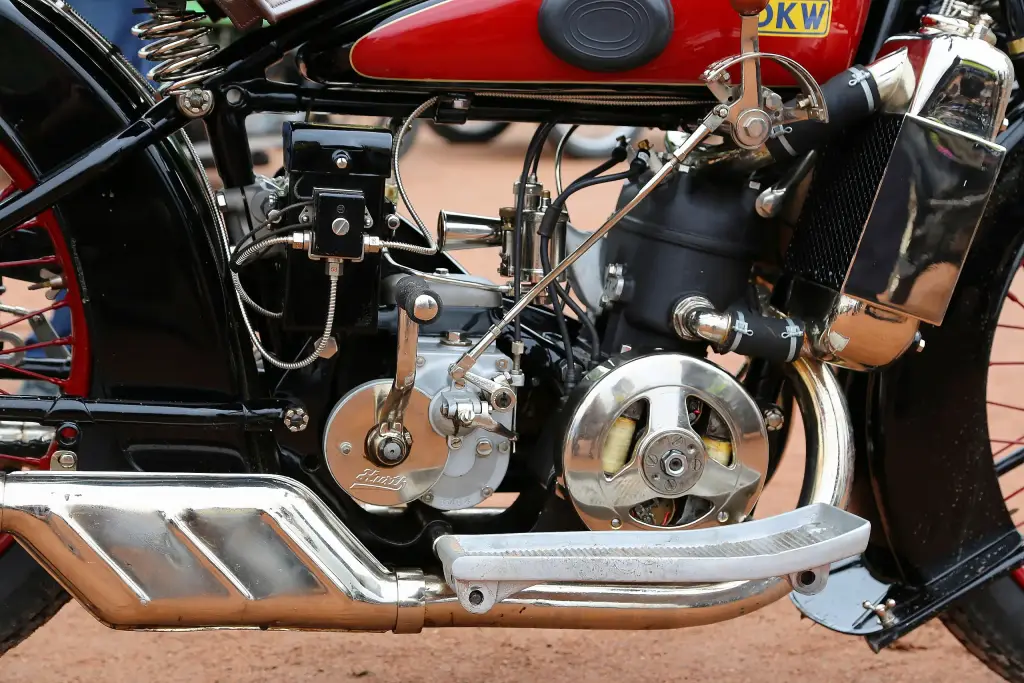
Water at last
The overheating problem, above all on the clutch-side cylinder, was still not solved satisfactorily. From 1929 the models therefore received water cooling without a pump, which required new cylinders, and the water-cooled version was called ZSW 500. Space in the frame was so fully used that two separate radiators, one per cylinder, were mounted on either side of the front frame tube. The bikes came with generous equipment for the time: a speedometer, a mirror, an electric horn and knee pads on the tank. Originally the frames were painted black; the ZSW models were mostly red with gold pinstripes. In its last year the ZSW 500 cost 1,285 Reichsmark, and total production is given as about 1,000 machines.
The racing version
Between 1928 and 1932, using the same frame and the two-cylinder two-stroke engine with an added double-acting piston charging pump, DKW built the PRe 500 for its works riders only.
Design and features
- First DKW twin: the two-cylinder engine that opened a new line for the Zschopau works.
- Cooling experiments: fan, then airflow, then pump-less water cooling with two radiators.
- Two top tubes: a frame change from the E models to carry the tank between the tubes.
- Well equipped: speedometer, mirror, electric horn and knee pads were available.
- Racing link: the same layout underpinned the PRe 500 works racer of 1928–1932.
DKW Z 500 versions
- Z 500 with fan cooling (to 1927): the first production form.
- Z 500 with airflow cooling (1927–1929): leg shields, longer mudguards, new silencers.
- ZSW 500 (1929–): water-cooled, two radiators, mostly red with gold stripes.
- DKW PRe 500 (1928–1932): works racing machine on the same basis.
DKW went on to build the DKW SB and then the DKW NZ twins. More cars and bikes are in the DKW collection.
Video: DKW ZSW 500 1929
Video by Harald Huppertz on YouTube.
Sources
- DKW Z 500, German Wikipedia: frame, cooling, equipment, production