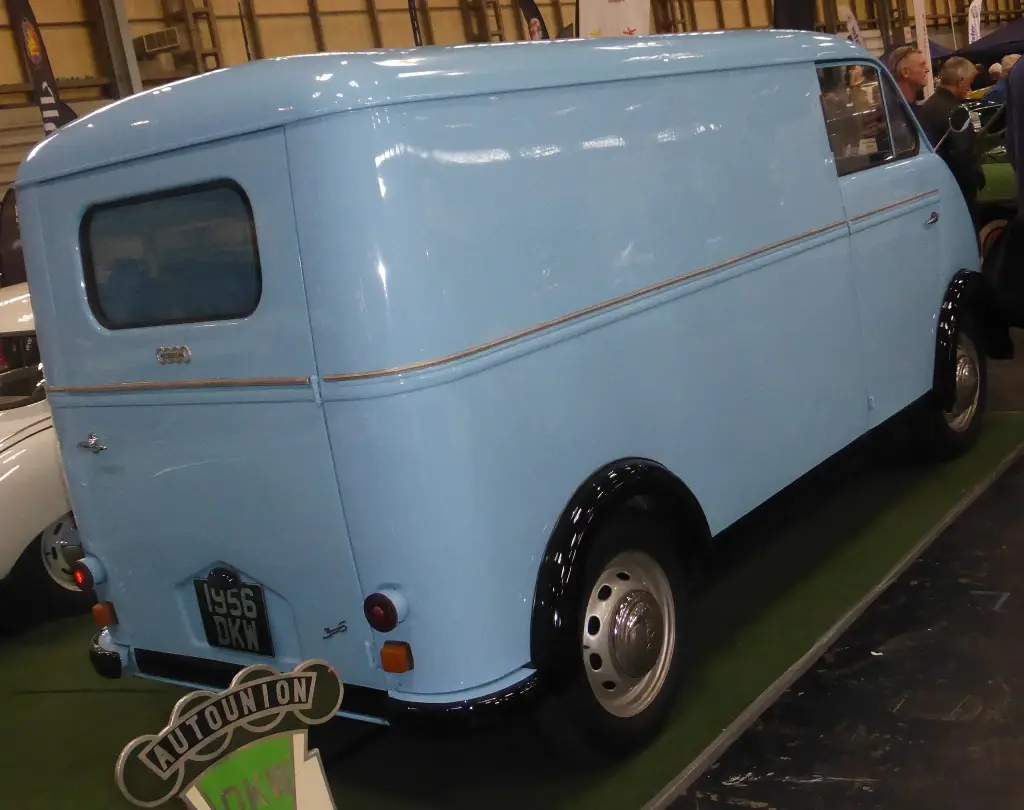
The DKW Schnellaster was the first vehicle the re-founded Auto Union put on the road in West Germany, a year before its first passenger car. Its name means Rapid Transporter, and its layout — one box, front-wheel drive, engine at the front, flat floor all the way through — made it an ancestor of the modern minivan.
DKW Schnellaster at a glance
| Maker | Auto Union, Ingolstadt |
|---|---|
| Also known as | DKW F89 L |
| Production | 1949–1962 |
| Layout | one-box van, front-wheel drive, transverse engine on early two-cylinder cars |
| Load floor | flat, 40 cm above the ground |
| Rear door | single large door, hinged on the right |
| Engine, early | 700 cc two-cylinder two-stroke, 20 hp, 22 hp after 1952 |
| Engine, from 1955 | 900 cc three-cylinder, 32 hp (24 kW), Typ 3 |
| Rear suspension | trailing arms with springs in the cross bar |
| Also built | Spain by IMOSA from 1954, Argentina from 1960 |
History of the DKW Schnellaster
The layout
The Schnellaster put the front wheels forward in the passenger cabin, under a short sloping bonnet, and drove them through an engine mounted transversely on the early two-cylinder models. The load floor ran flat from the driver’s seat to the rear doors and could be arranged for passengers or cargo, with the floor only 40 cm off the ground. A single large rear door hinged on the right-hand side gave access. The rear wheels hung on trailing arms with the springs built into the cross bar. The same set of ideas — front drive, a one-box body, a low flat floor and a transverse engine — is what later made the Renault Espace and the Chrysler Voyager what they are, and, mechanically, what the Mini and almost every modern car use.
Engines
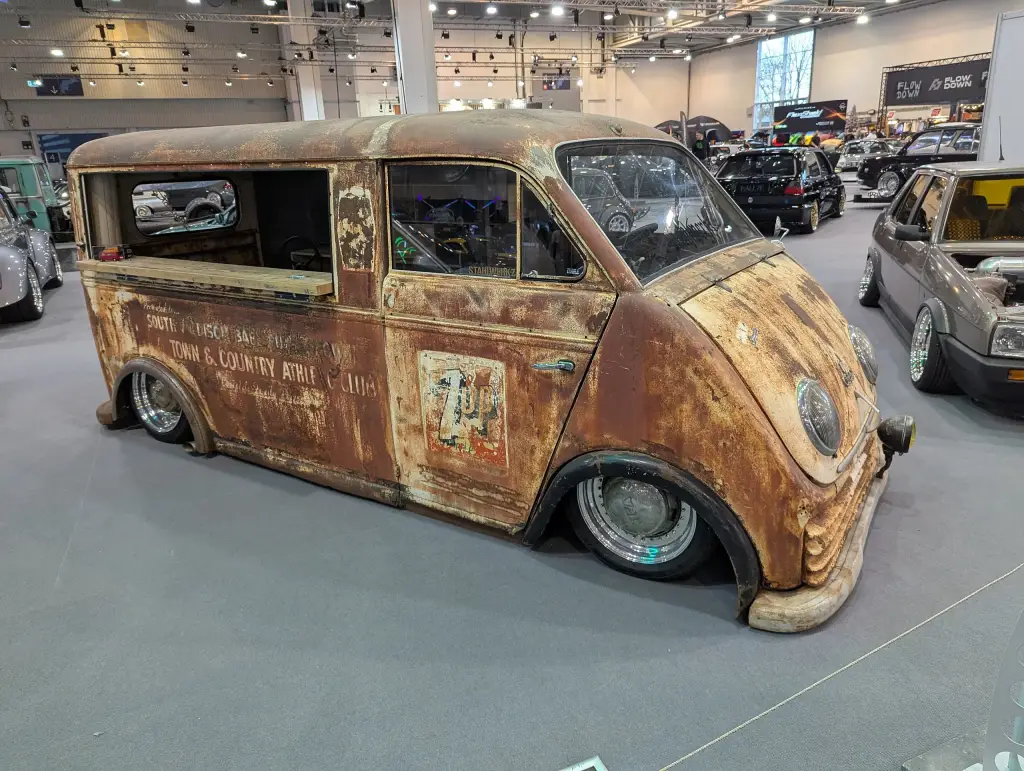
The van started with the pre-war two-cylinder 700 cc two-stroke of the DKW F8, rated at 20 hp and raised to 22 hp after 1952. In 1955 the Typ 3 received the three-cylinder 900 cc unit of the DKW F9, good for 32 hp (24 kW).
Spain
From 1954 the van was also built at Vitoria in Spain by the subsidiary Industrias del Motor S.A., IMOSA. In Spain the word DKW became a general term for any van and is still used that way. The Spanish subsidiary went on to build a modern successor with all-new bodywork, the DKW F1000 L of 1963, which started with the 981 cc three-cylinder two-stroke, later took a Mercedes-Benz diesel and was finally renamed a Mercedes-Benz in 1975.
Finland and Argentina
The Finnish heavy vehicle maker Suomen Autoteollisuus assembled ten Schnellasters at Karis around November 1956 under the Donau-Sisu brand, welding the bodies in Finland with fixtures sent from West Germany; a complete body took two hours to weld. Larger production was planned but never started, because the technically archaic vehicle did not suit Finnish buyers, and one repairable Donau-Sisu was saved by enthusiasts at the end of 2011. From 1960 to 1969 the van was built under licence in Argentina by Industrias Automotriz de Santa Fe as the Auto Union Combi, Pickup, Furgón and Ambulance. After that factory closed, Industrias Mecánicas del Estado kept the DKW F1000 L alive as the Rastrojero Frontalito until 1979.
Design and features
- One-box layout: front wheels in the cabin, short sloping bonnet, flat floor throughout.
- Low loading floor: only 40 cm from the ground, with a single large rear door.
- Front-wheel drive: with a transverse engine on the early two-cylinder models.
- Two-stroke engines: 700 cc twin at first, then the 900 cc three-cylinder from 1955.
- Built in four countries: Germany, Spain, Finland and Argentina.
DKW Schnellaster versions
- F89 L with 700 cc two-cylinder (1949–1955): the original van, 20 hp and 22 hp after 1952.
- Typ 3 with 900 cc three-cylinder (from 1955): 32 hp.
- Donau-Sisu (1956): ten vans assembled in Finland.
- Auto Union Combi, Pickup, Furgón and Ambulance (1960–1969): Argentine production.
- DKW F1000 L and Rastrojero Frontalito: Spanish and Argentine successors built into the 1970s.
The Schnellaster shared its chassis and engine package with the DKW F89 and supplied the running gear for the DKW Munga. More cars are in the DKW collection.
Sources
- DKW Schnellaster, English Wikipedia: layout, engines, Spain, Finland, Argentina
- DKW Schnellaster, German Wikipedia: model history