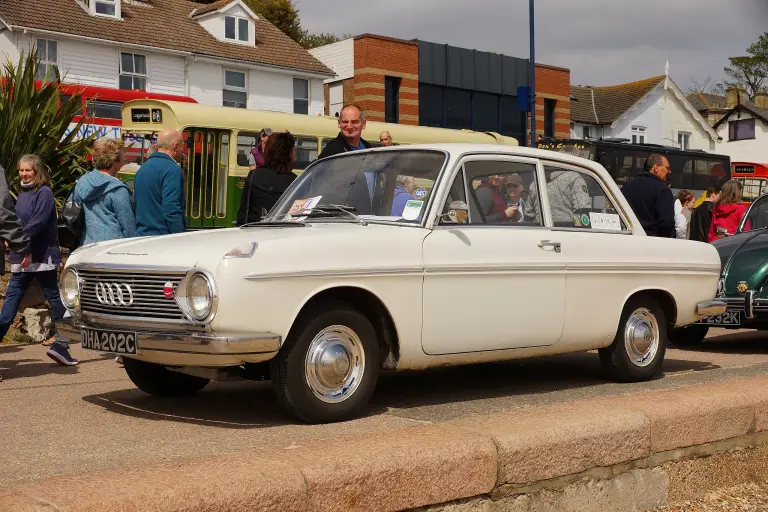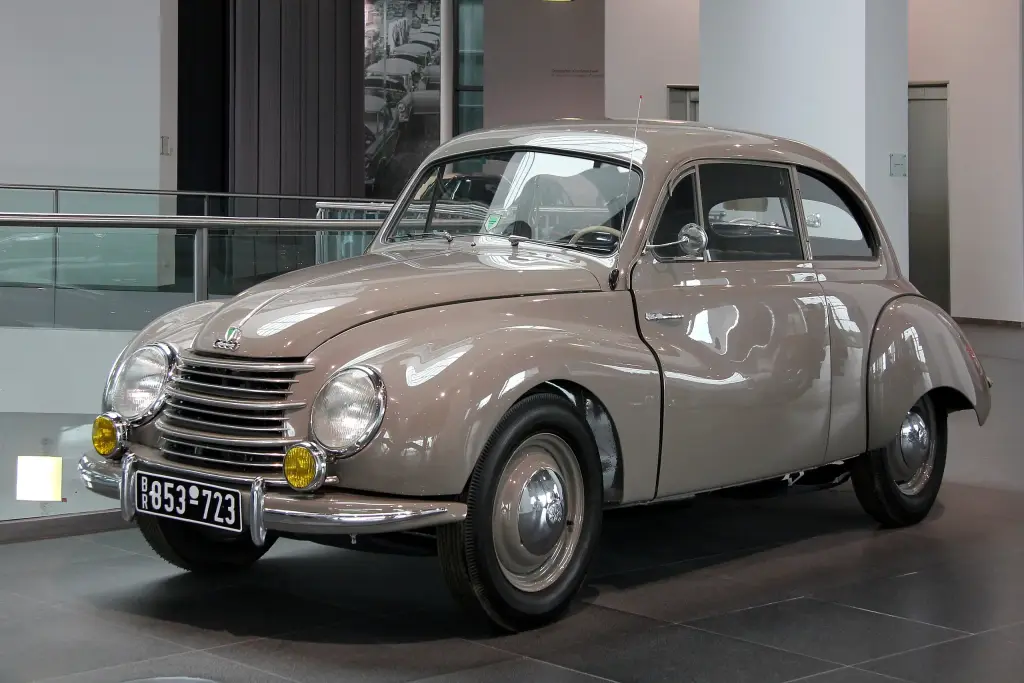
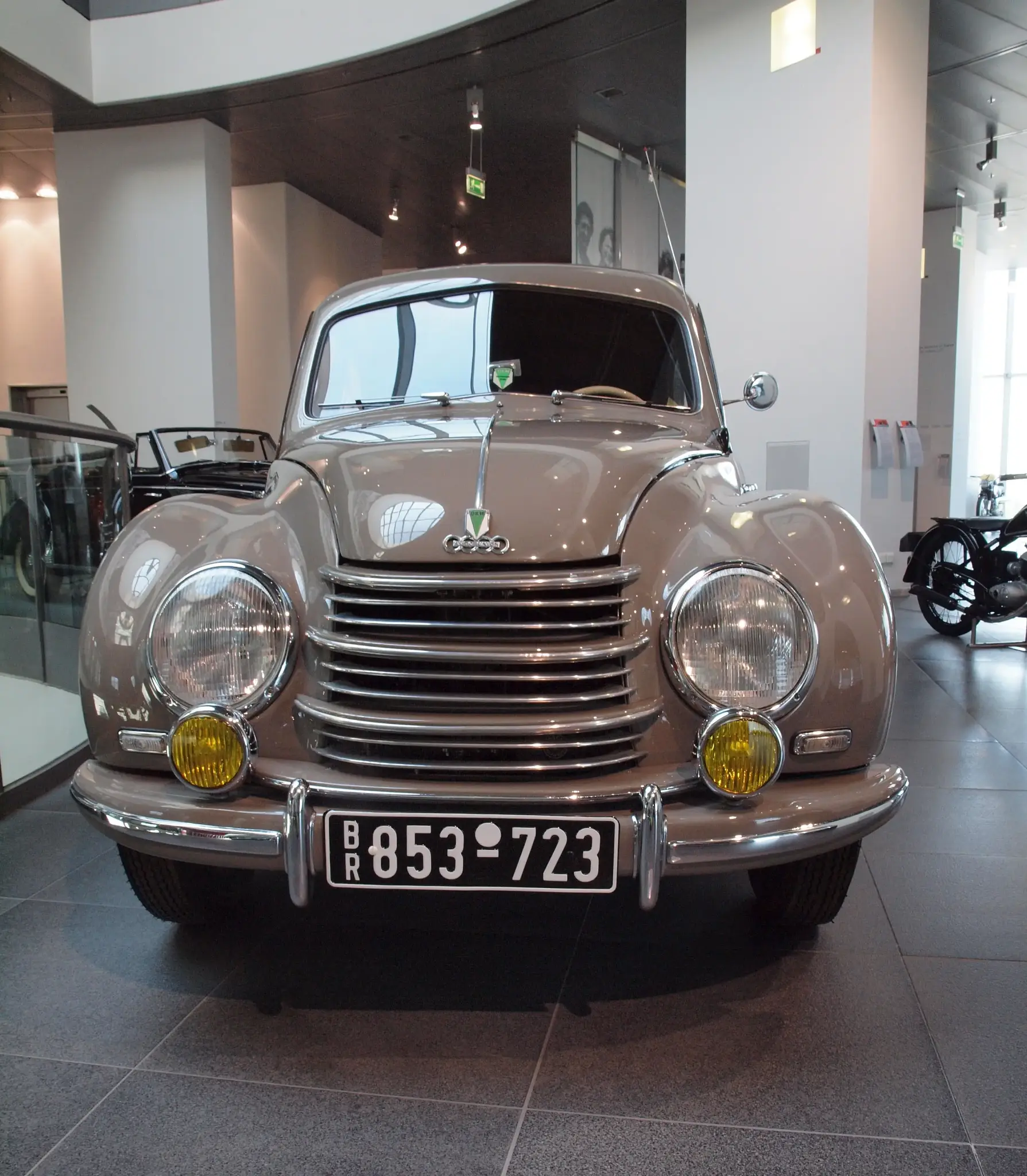
The DKW F89 was the first car the re-founded Auto Union built in West Germany. Sold as the Meisterklasse, it put a modern steel body on the chassis of the pre-war F8 and used the water-cooled 684 cc two-stroke that had powered small DKWs since the 1930s. It was made from 1950 to 1954 and was replaced by the 3=6.
DKW F89 Meisterklasse at a glance
| Maker | Auto Union GmbH, Düsseldorf |
|---|---|
| Production | 1950–1954 |
| Also known as | DKW Meisterklasse |
| Engine | 684 cc two-stroke two-cylinder, 23 bhp |
| Cooling | water, thermosiphon, no pump |
| Gearbox | three-speed manual, four-speed late in the run |
| Top speed | 100 km/h saloon, 95 km/h Universal |
| Bodies | two-door saloon, Hebmüller hardtop coupé, Universal estate |
| Built at | a former Rheinmetall-Borsig plant in Düsseldorf |
| Successor | DKW 3=6 |
History of the DKW F89 Meisterklasse
Starting again in the west
Before the war Auto Union’s car plants stood in Saxony, at Zwickau, Chemnitz and Zschopau, and apart from the old DKW works at Berlin-Spandau they were all out of reach after 1945, in the Soviet zone. The first postwar DKWs were therefore built under contract in a refurbished plant of Rheinmetall-Borsig in Düsseldorf, and the F89 was the first passenger car to come out of it.
Old chassis, new body
The F89 shared its underpinnings with the pre-war F8 Meisterklasse of 1939–1942, but wore a steel body based on that of the DKW F9, the prototype that would have replaced the F8 in 1940 had the war not intervened. Zwickau’s new controllers built their own version of the F9 too, and the eastern car went into production as the IFA F9, probably shortly before the Düsseldorf F89 appeared. The saloon’s shape followed the F9 closely but with more streamlining, and DKW made much of its low wind resistance.
The range
The saloon was joined in 1951 by a two-seater hardtop coupé bodied by Hebmüller of Wuppertal, and in October 1951 by a three-door estate using a body conversion with a lot of timber in it. That estate was replaced in March 1953 by an all-steel version, and the F89 estate, like its steel-bodied successors, was sold as the Universal. The F89 was not the first vehicle the new company built: that was the F89 L Schnelllaster, a light van on the same chassis and with the same engine, introduced in 1949.
Under the bonnet
The engine was a two-cylinder two-stroke of 684 cc, quoted at 23 bhp when the car was launched. It was water-cooled without a pump, relying on a thermosiphon system, and drove the front wheels through a three-speed gearbox worked by a dashboard-mounted lever of the kind later familiar from the Citroën 2CV and Renault 4. Towards the end of the run a four-speed gearbox was offered.
Design and features
- Steel body: the F9 shape in steel instead of the pre-war timber-and-fabric construction.
- Thermosiphon cooling: water cooling without a pump, a DKW two-stroke tradition.
- Dashboard gear lever: the three-speed box was worked by a Krückstockschaltung lever on the dash.
- Three bodies: saloon, Hebmüller hardtop coupé and the timber-framed Universal estate.
- Schnelllaster connection: the same chassis and engine package served the F89 L van of 1949.
DKW F89 Meisterklasse versions
- Saloon (1950–1954): the standard two-door, 100 km/h claimed.
- Hebmüller coupé (1951): two-seater hardtop from Wuppertal.
- Universal estate (1951–1953): timber-framed, then all-steel from March 1953, 95 km/h.
- F89 L Schnelllaster (1949): the van that came before the car.
The F89 was built on the DKW F8 chassis and was replaced by the DKW 3=6. The DKW Schnellaster van shared its mechanical package. More cars are in the DKW collection.
Sources
- DKW F89, English Wikipedia: factory, origins, bodies, engine
- DKW F 89, German Wikipedia: model history