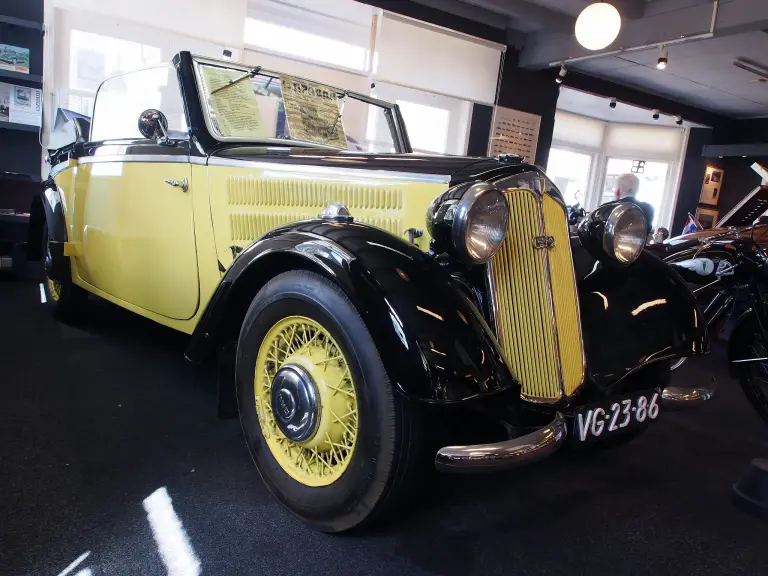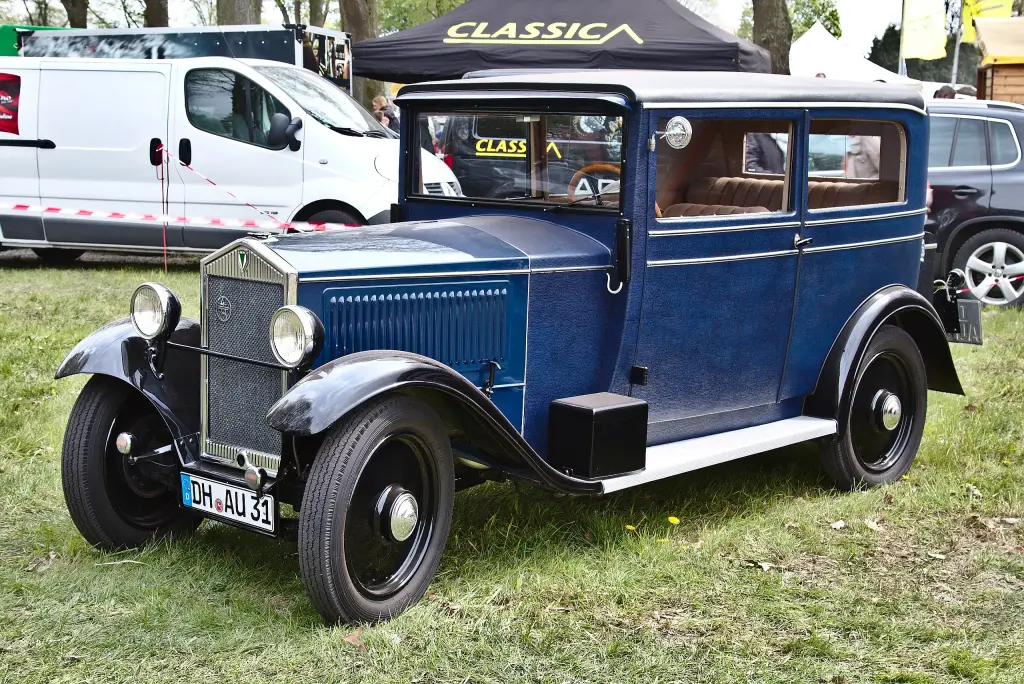
The DKW Typ 4=8 was the other DKW: while Zwickau built small front-wheel-drive cars, the Spandau works turned out a bigger, rear-wheel-drive model with a two-stroke V4. Launched at the Berlin show in 1929, it stayed in production until 1940 and was sold under three different names, the last of them Schwebeklasse.
DKW Typ 4=8 at a glance
| Maker | DKW, later Auto Union, Berlin-Spandau |
|---|---|
| Production | 1929–1940 |
| Launched | Berlin Motor Show, 1929 |
| Predecessor | DKW Typ P |
| Engine | two-stroke V4, from 782 cc to 1,054 cc |
| Drive | rear-wheel drive |
| Gearbox | three-speed manual, floor lever |
| Suspension | rigid axles on transverse leaf springs |
| Names | 4=8, Sonderklasse, Schwebeklasse |
| Built | about 24,000 |
History of the DKW Typ 4=8
What the name meant
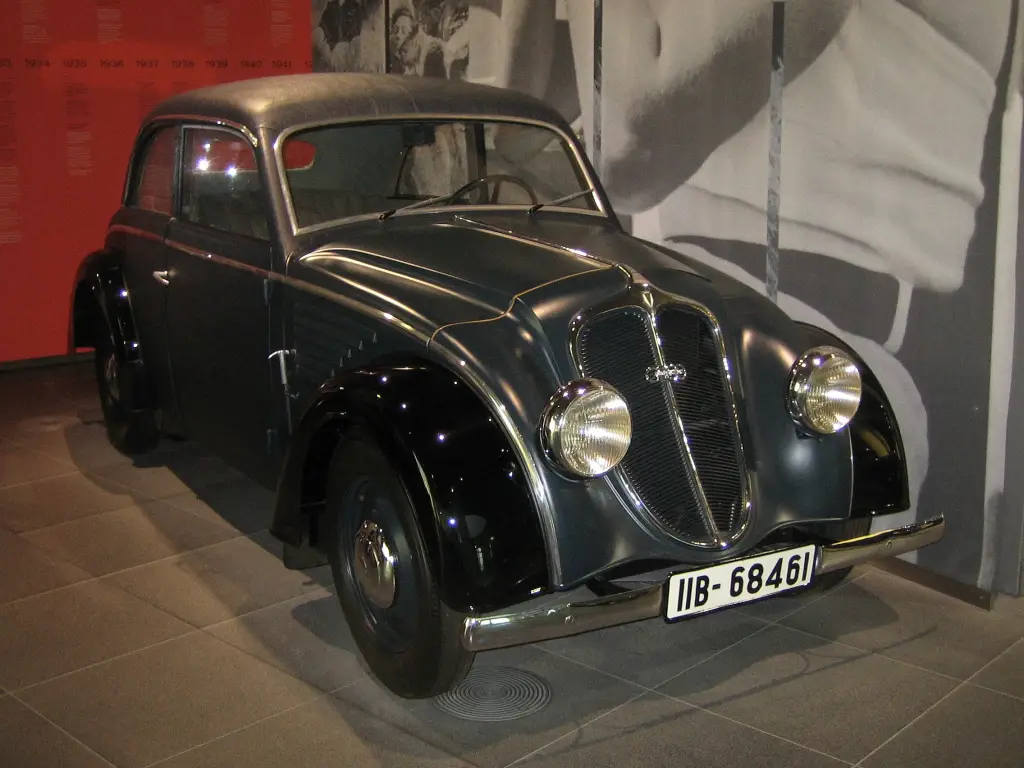
The name 4=8 described the engine rather than the car. In a two-stroke every downward stroke of the piston is driven by a combustion, while in a four-stroke only every second one is, so DKW argued that its little V4 did the work of a four-stroke V8. The name was used for several versions between 1929 and 1932. From 1932 to 1934 the car was called Sonderklasse, but the name became tied to unlucky publicity after a series of body failures and was dropped in 1934; it came back in 1937. Schwebeklasse, used for the models of 1934–1937, referred to the car’s ‘floating’ axle, part of a suspension advertised as giving better handling.
From Typ P25 to V 1000
The car launched in 1929 had a 980 cc V4 at the front fed by two fuel pumps, 25 PS (18 kW), a three-speed gearbox with a floor lever and rigid axles on transverse leaf springs. Like its smaller predecessor it had a timber-framed body covered in synthetic leather, and at first only a two-door four-seat saloon was offered. It had been hoped that four smaller cylinders would cure the heavy fuel consumption and constant spark plug changes of the earlier car; when they did not, the V 800 of 1930 arrived with a smaller 782 cc engine and only 20 PS. Performance fell but consumption did not, the engine overheated even in cold weather and ran jerkily. In 1931 capacity went back up to 990 cc and power to 25 PS as the Typ V 1000; that year the mechanical brakes gave way to hydraulic ones, and the timber body could be had as a four-seat saloon, a four-seat cabrio-limousine or a two-seat cabriolet, all two-door and all at 3,300 Marks.
The Sonderklasse and Schwebeklasse years
An interim replacement in 1932, the Sonderklasse Typ 432, was distinguished mainly by reshaped front wheel arches and tidier front bodywork. More thorough changes followed under the Schwebeklasse name, and the car kept the same V4 two-stroke and the same place in the market until production ended in 1940, by then as the 1,054 cc DKW Sonderklasse.
In the shadow of the F1
About 24,000 Typ 4=8s were built between 1929 and 1940, against some 218,000 of the smaller front-wheel-drive F1 and its successors at Zwickau between 1931 and 1942. In retrospect the rear-driven car tends to be overlooked beside its front-wheel-drive sibling, but in the 1930s it was a serious participant in the growing German market.
Design and features
- Two-stroke V4: an unusual layout, from 782 cc up to 1,054 cc over the model’s life.
- Rear-wheel drive: the opposite of the small Zwickau DKWs, and built in a different factory.
- Floating axle: the Schwebeklasse name came from the suspension’s advertised ‘floating’ action.
- Timber body: a frame covered in synthetic leather, as on the smaller DKWs.
- Hydraulic brakes: fitted from 1931, when most rivals still used mechanical brakes.
DKW Typ 4=8 versions
- Typ P25 (1929): 980 cc, 25 PS, saloon only.
- Typ V 800 (1930–1931): 782 cc and 20 PS, an attempt to cut fuel use.
- Typ V 1000 (1931–1932): 990 cc, 25 PS, hydraulic brakes and three body styles.
- Sonderklasse Typ 432 (1932): reshaped arches and revised front bodywork.
- Schwebeklasse (1934–1937): the name used for the ‘floating’ axle models.
- Sonderklasse 1,054 cc (to 1940): the final version of the car.
The Typ 4=8 was the rear-driven alternative to the front-wheel-drive DKW F2 and the later DKW F8. More cars are in the DKW collection.
Video: DKWSchwebeklasse1934.flv
Video by Harald Huppertz on YouTube.
Sources
- DKW Typ 4=8, English Wikipedia: names, versions, production
- DKW 4=8, German Wikipedia: model history