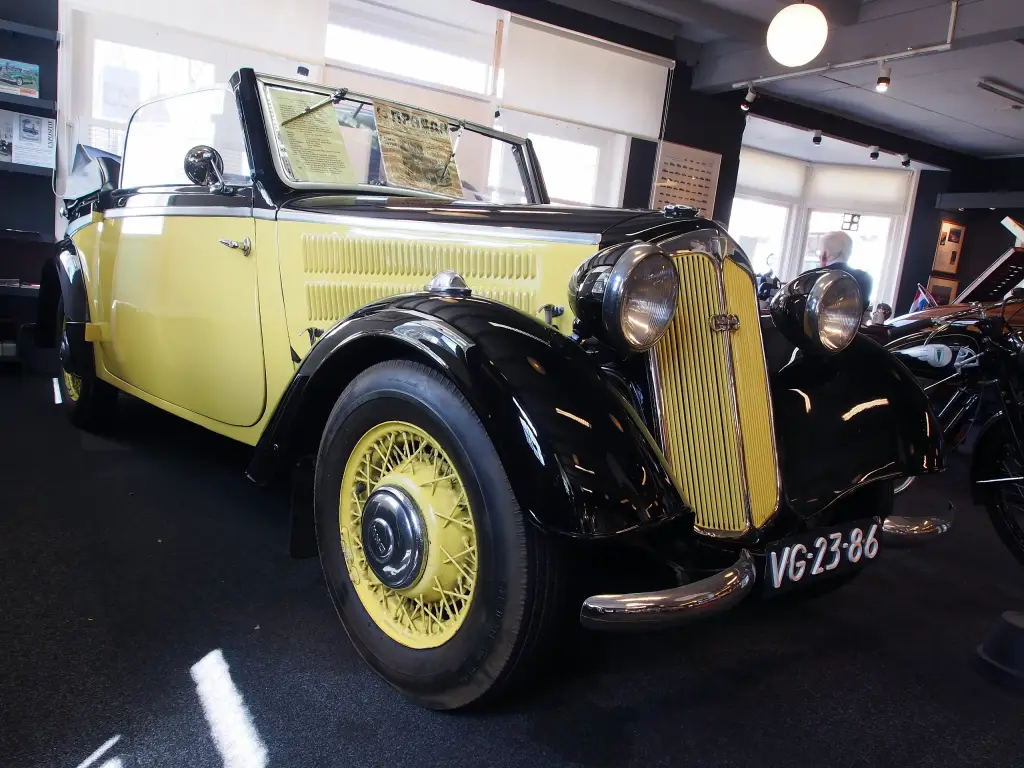
The DKW F8 arrived in 1939 as a slightly shorter car on a marginally longer wheelbase, and it was the last small DKW to be built before the war stopped passenger car production at Zwickau. After 1945 the same design returned as the IFA F8, and it stayed in production in East Germany until about 1955.
DKW F8 at a glance
| Maker | Auto Union, Zwickau |
|---|---|
| Production | 1939–1940 (Reichsklasse), until 1942 (Meisterklasse) |
| Predecessor | DKW F7 |
| Engine, Reichsklasse | 589 cc two-stroke two-cylinder, 18 PS |
| Engine, Meisterklasse | 692 cc two-stroke two-cylinder, 20 PS |
| Top speed | 80 km/h and 85 km/h |
| Gearbox | three-speed manual with lockable freewheel |
| Starting | Dynastart starter-generator |
| Bodies | saloon and cabriolet, plus Holka bodies in Switzerland |
| Postwar | IFA F8 from 1949, 26,267 built by 1955 |
History of the DKW F8
A short step from the F7
The F8 was introduced in 1939, slightly shorter than the F7 despite a marginally longer wheelbase. In the company’s own 1939 publicity it was simply the ‘DKW Front’, the F standing for front-wheel drive; only later did it become the F8, to tell it apart from the F7 before and the F9 that was meant to replace it.
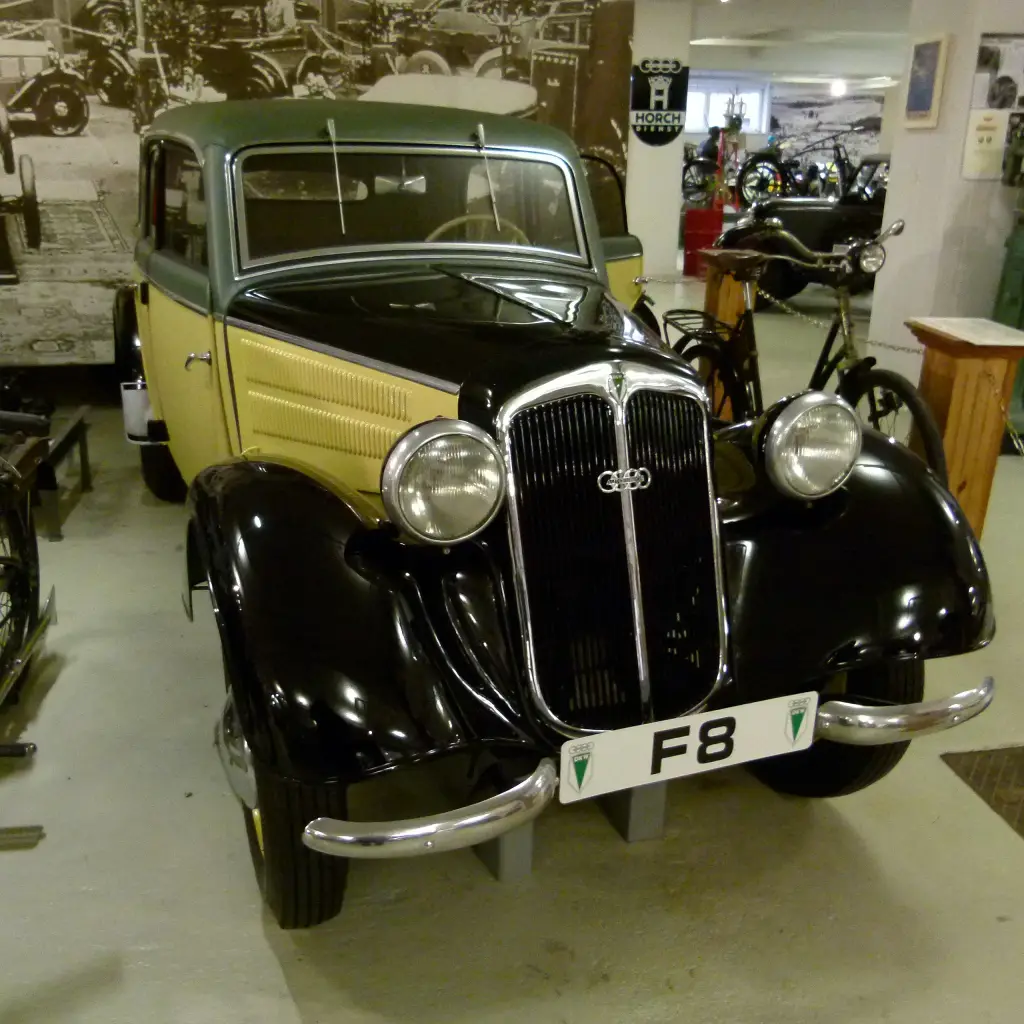
Engines
The base Reichsklasse kept the twin-cylinder two-stroke of its predecessor, fractionally bored out to 589 cc and still claiming 18 PS (13.2 kW) and 80 km/h. The Meisterklasse used the 692 cc engine with 20 PS (14.7 kW) and 85 km/h. Power went to the front wheels through a three-speed gearbox with a lockable freewheel on all three ratios, and the engine was started by a Dynastart unit that doubled as starter and generator.
Body and chassis
The body sat on a box frame chassis, which made it easy to fit other bodies — the light vans and trucks of the IFA period used the same idea. The outer skin combined steel panels with a fabric-covered timber frame in the middle. The Swiss coachbuilder Holka built its own bodies on imported F8 chassis from 1939 until 1944, including a cabriolet of its own design in 1944; the last Holka-bodied car was finished in January 1945.
War and after
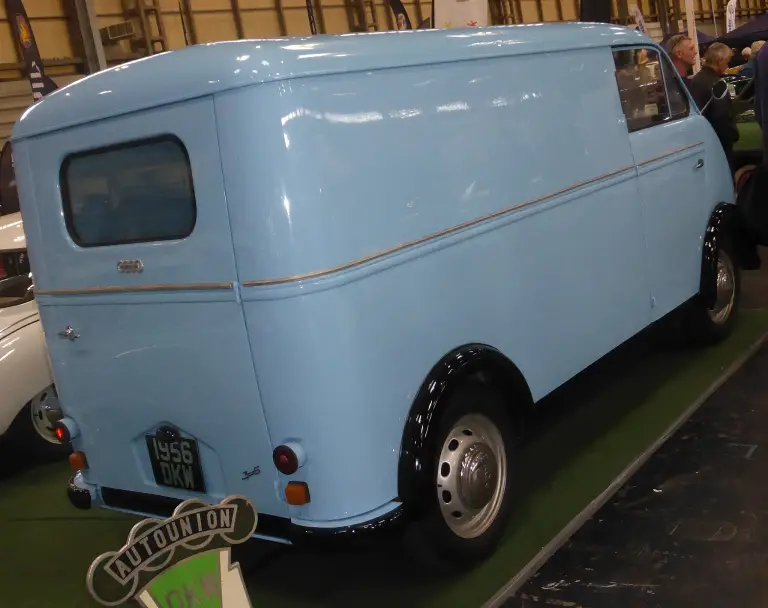
Production of the Reichsklasse and cabriolet ended in 1940, the Meisterklasse carried on until 1942, and by then about 50,000 F8s had been built. The car reappeared at the 1947 Leipzig Fair as the DKW-IFA F8, and from 1949 the Zwickau works, now the state-owned VEB Automobilwerke Zwickau, built it without DKW badges. Postwar bodies included a panel van and an estate, key panels were made of Duroplast after 1953, and by 1955 another 26,267 had been built. Under an inter-zone trade agreement about 1,000 were exported to West Germany in 1950–51.
Design and features
- Two engines: 589 cc with 18 PS in the Reichsklasse, 692 cc with 20 PS in the Meisterklasse.
- Lockable freewheel: fitted to all three ratios of the three-speed gearbox.
- Dynastart: a combined starter and generator, typical of small two-stroke cars of the period.
- Box frame chassis: allowed vans, estates and coachbuilt bodies to be built on the same base.
- Long afterlife: continued as the IFA F8 in East Germany until about 1955.
DKW F8 versions
- Reichsklasse (1939–1940): 589 cc, the cheaper model.
- Meisterklasse (1939–1942): 692 cc, built until passenger car production ended.
- Cabriolet: factory open body, dropped in 1940.
- Holka bodies (1939–1945): Swiss coachbuilt versions, including a 1944 cabriolet.
- IFA F8 (1949–1955): East German production with saloon, cabriolet, panel van and estate bodies.
The F8 followed the DKW F5 and was the model on which the postwar DKW F89 was based. More cars are in the DKW collection.
Video: Dkw / IFA F8 Erika der erzter start
Video by on YouTube.
Sources
- DKW F8, English Wikipedia: engines, body, production, IFA period
- DKW F 8, German Wikipedia: model history