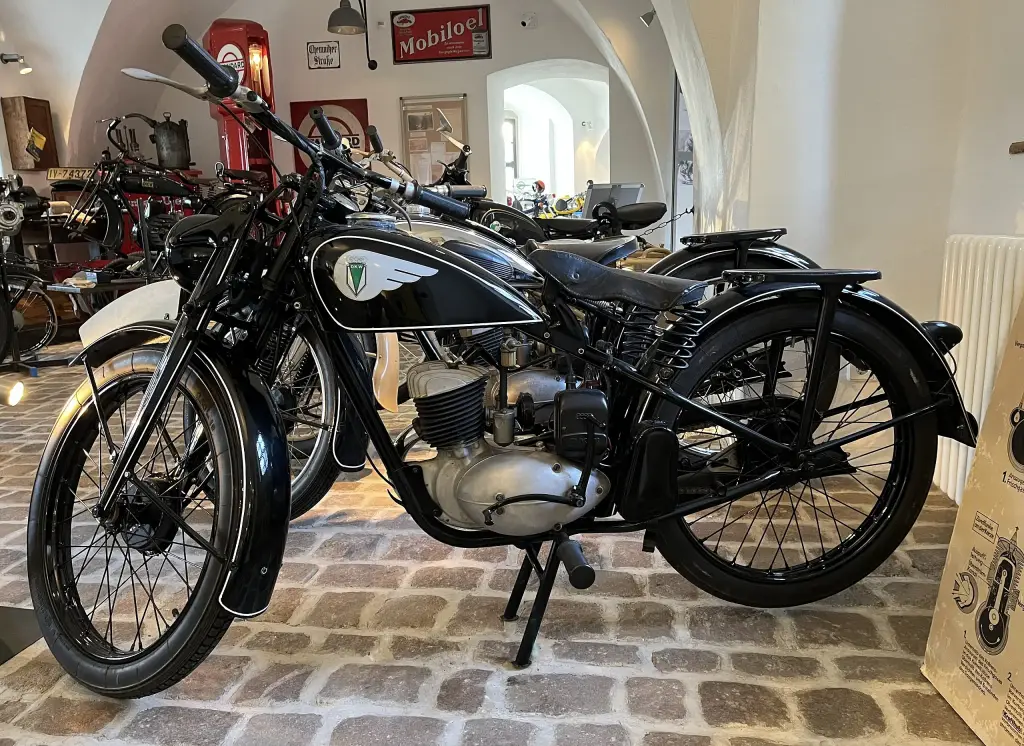
The DKW RT 125 is probably the most copied motorcycle ever built. Its plans went to the Soviet Union, Poland, Britain and the United States as war reparations and were reverse-engineered in Japan, so the same design reappeared as the Moskva M1A, the SHL 125, the BSA Bantam, the Harley-Davidson Hummer and the first Yamaha. DKW built it at Zschopau from 1939 and again in Ingolstadt from 1949.
DKW RT 125 at a glance
| Maker | DKW, Zschopau; later Auto Union, Ingolstadt |
|---|---|
| First production | 1939 |
| Name | RT stands for Reichstyp, realm type |
| Engine | single-cylinder two-stroke, 125 cc |
| Key features | Schnürle loop scavenging, flat-top piston, efficient transfer ports |
| Copied in | USSR, Poland, United Kingdom, USA, Japan |
| Soviet copies | M1A Moskva, K-125 |
| Polish version | SHL 125 and Sokół 125 |
| British version | BSA Bantam |
| American version | Harley-Davidson Hummer |
| Japanese version | Yamaha YA-1, from 1955 |
| Postwar DKW | RT 125 W built in Ingolstadt from 1949 |
History of the DKW RT 125
What made it good
The RT 125 was a small two-stroke built by DKW at Zschopau in the 1930s. Its importance lay in two technical ideas: Schnürle loop scavenging, which DKW pioneered so that the engine could do without a deflector piston and burn more efficiently, and a very effective arrangement of transfer ports. Both were built into the RT 125 to great commercial advantage. Rivals such as Adler and TWN copied the flat-topped piston and tried to match the porting without infringing DKW’s patent.
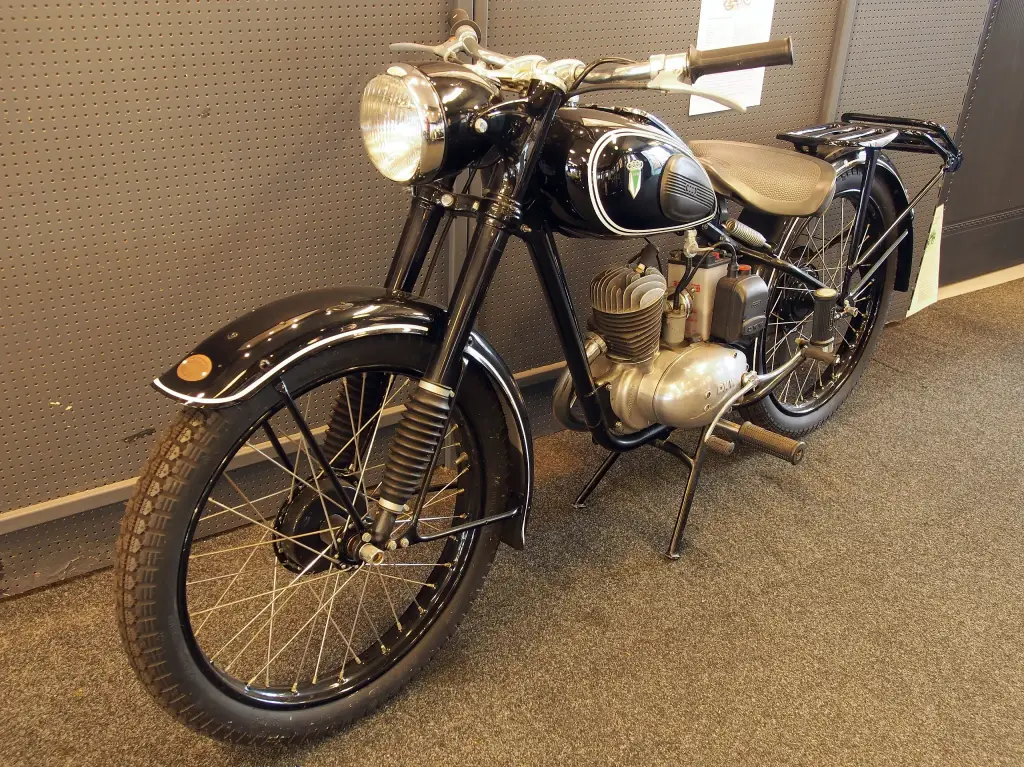
War reparations
After the Second World War the Soviet Union took the plans, the tooling and even several dozen of the people to Moscow — later moved on to MMVZ and SMZ — and to a factory at Kovrov, where the design was built as the M1A Moskva and the K-125. WFM of Poland made a modified version under the SHL 125 and Sokół 125 names and developed it into a 125/175 cc family that stayed in production until 1985. Plans also reached Britain, where they became the BSA Bantam, and the United States, where they formed the basis of the Harley-Davidson Hummer.
After the war in Germany
DKW’s Zschopau factory lay in the Soviet occupation zone and passed to the East German state, where production of the RT 125 continued under the MZ name into the 1950s. DKW itself had reorganised at Ingolstadt and began building the RT 125 W — W for West — in 1949. Variants of the RT 125 W, usually with larger engines, were made throughout the 1950s.
Yamaha
In the 1950s Nippon Gakki, having re-established itself as a musical instrument maker, decided to use its wartime machine tools to build motorcycles. The copyright on the RT 125 had been voided by the Allies, so the company reverse-engineered it as the basis of its first bike. Nippon Gakki set up Yamaha Motor in 1955 to build the copy as the Yamaha YA-1, made from 1955 to 1958 and nicknamed Aka-tombo, the red dragonfly, for its slim body and chestnut-brown tank.
Design and features
- Schnürle scavenging: loop scavenging without a deflector piston, the idea that made the RT 125 famous.
- Transfer ports: a highly efficient port layout that competitors tried to copy around DKW’s patent.
- Simple and light: a 125 cc two-stroke that was cheap to build and easy to repair.
- Copied everywhere: at least eight manufacturers in six countries built versions of it.
- Long life: built at Zschopau from 1939, at Ingolstadt as the RT 125 W from 1949 and at MZ into the 1950s.
DKW RT 125 versions
- RT 125 (1939–1945): the original Zschopau machine.
- RT 125 W (1949–): the West German postwar version from Ingolstadt.
- M1A Moskva and K-125: Soviet copies built from reparations tooling.
- SHL 125 and Sokół 125: Polish versions, developed into a family built until 1985.
- BSA Bantam and Harley-Davidson Hummer: British and American derivatives.
- Yamaha YA-1 (1955–1958): the Japanese copy that started Yamaha Motor.
The RT 125 followed the pre-war DKW SB and DKW NZ series and was developed further as the DKW RT 175 after the war. More cars and bikes are in the DKW collection.
Video: Restauration DKW RT 125 Top!
Video by T Römer on YouTube.
Sources
- DKW RT 125, English Wikipedia: design, copies, postwar production, Yamaha
- DKW RT 125, German Wikipedia: German production history