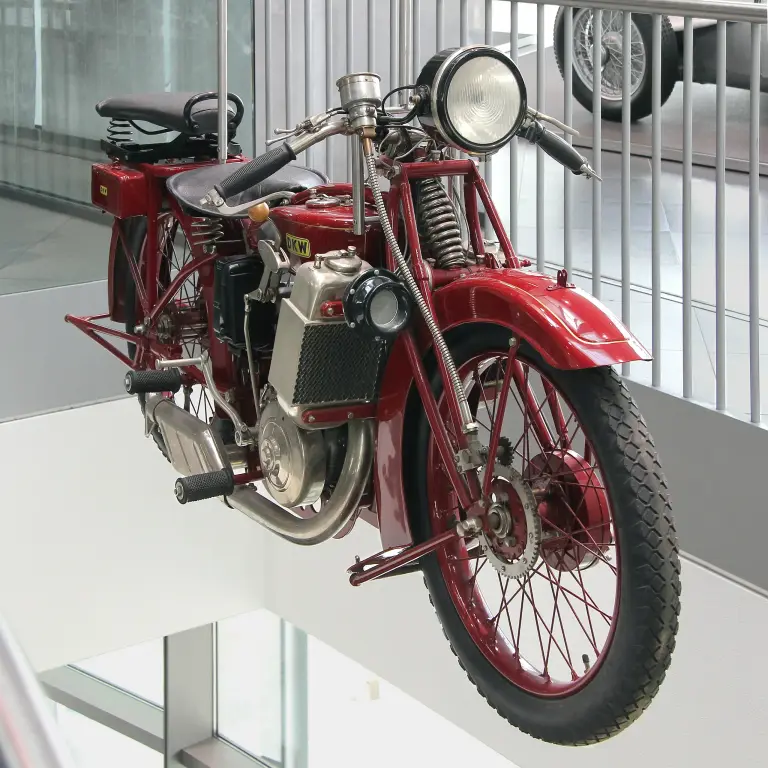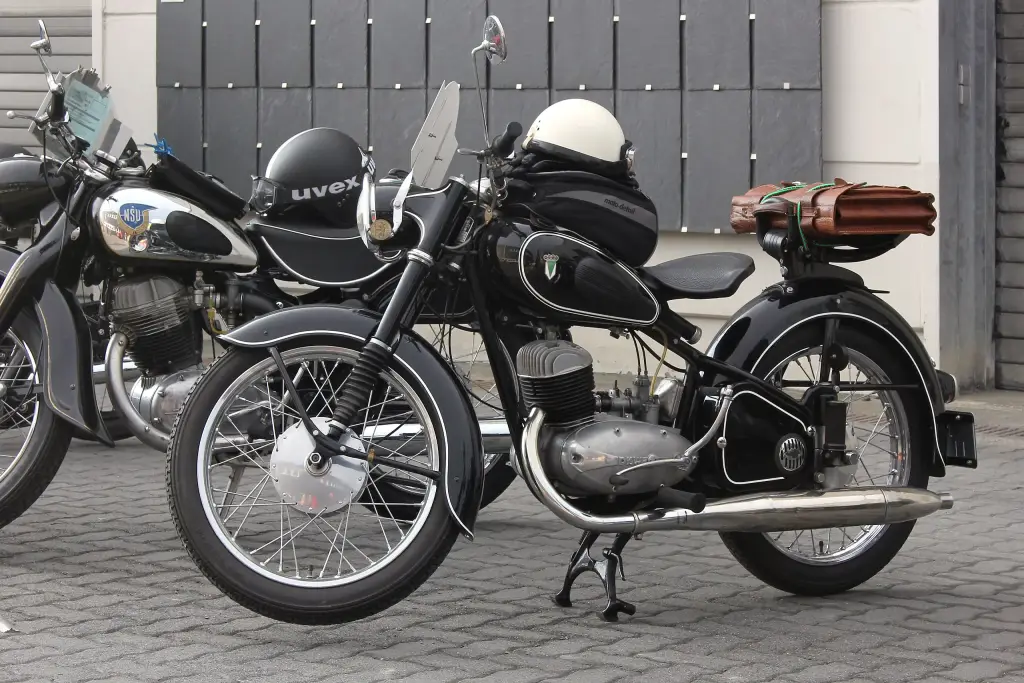
The DKW RT 175 was the middle of the three 175 cc models Auto Union built at Ingolstadt between 1953 and 1958. Shown at the Frankfurt motorcycle show in autumn 1953, it was robust, cheap to run and easy to ride, and by the middle of the 1950s every second motorcycle sold in Germany in the class up to 175 cc was an RT 175.
DKW RT 175 at a glance
| Maker | Auto Union GmbH, Ingolstadt |
|---|---|
| Production | 1953–1958 |
| Shown | International motorcycle show, Frankfurt, autumn 1953 |
| Engine | 174 cc single-cylinder two-stroke, 9.6 PS |
| Bore and stroke | 62 × 58 mm, a short-stroke design |
| Gearbox | four-speed, in a unit with engine and clutch |
| Fuel consumption | 2.8 litres per 100 km |
| Acceleration | 0–40 km/h in 4 s, 0–75 km/h in 13 s |
| Frame | telescopic fork, straight-path rear suspension, closed chain case |
| Successor | RT 175 S from September 1955 |
History of the DKW RT 175
A postwar Reichstyp
RT stands for Reichstyp, realm type, and links the postwar bikes to the pre-war DKW RT 100 and RT 125. After the war Auto Union first built the RT 125, RT 200 and RT 250, then added the RT 175 and the two-cylinder RT 350. The RT 175 was presented at the International Motorcycle Exhibition in Frankfurt in autumn 1953 together with the larger RT 250/2.
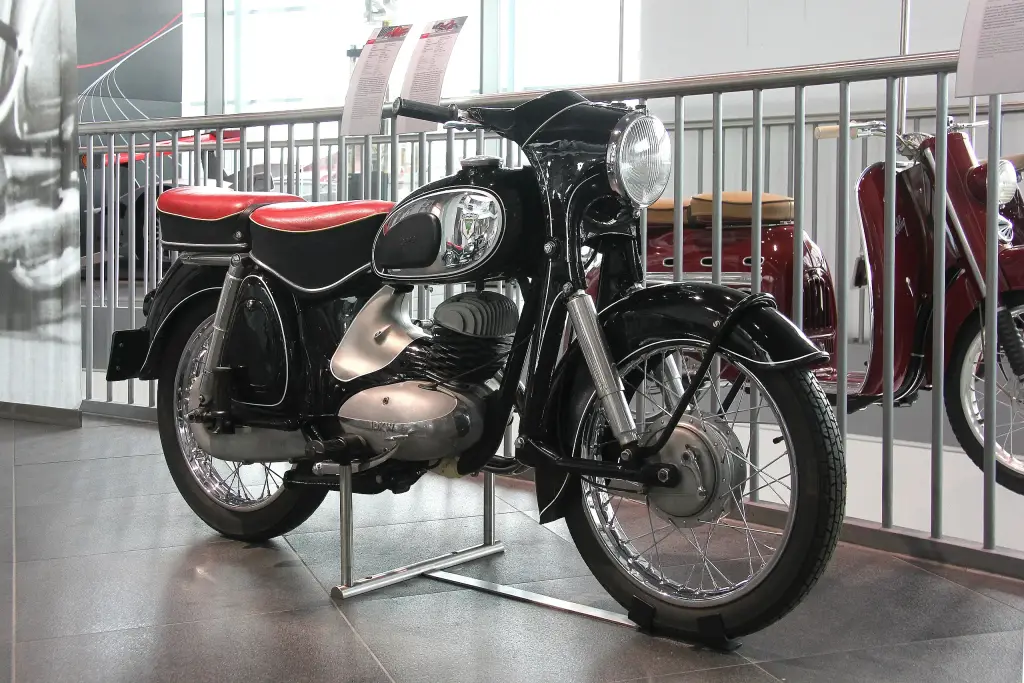
The engine
The new single-cylinder two-stroke had DKW loop scavenging, 174 cc from a 62 mm bore and 58 mm stroke — a short-stroke design — and a flat torque curve over a wide speed range. Engine, clutch and four-speed gearbox were combined in one closed unit. The same cylinder dimensions were used by the sidecar-capable two-cylinder RT 350, which was shown from 1953 but only sold in 1955 and 1956. The RT 175 had a closed chain case, a telescopic fork, straight-path rear suspension and a cowled carburettor whose cover also acted as an intake silencer. The full-hub brake at the rear was only simulated: the real brake sat at the side of the chain case. There was no brake light as standard. Average fuel consumption was 2.8 litres per 100 km, and the bike reached 40 km/h in four seconds and 75 km/h in thirteen. It was not designed to pull a sidecar. In autumn 1954 it gained four-slit cooling fins and a new fork with the rubber gaiters moved to the top.
In competition
The RT 175 was used in trials and six-day events. At the DMV two-day trial of 27–28 March 1954, with 215 starters and 41 gold and 43 silver medals awarded, Gerhard Bodmer and Udo Feser of Ingolstadt won a gold and a silver; all three medal winners rode RT 175s with straight-path rear suspension. Auto Union finished the ADAC three-day trial of 21–23 June 1954 as one of the two best factory teams, and the report singled out the simple rear suspension as ‘a small miracle of responsiveness’. Bodmer also took a gold medal on the International Austrian Alpine Run in June, and DKW riders finished the 29th International Six Days Trial at Llandrindod Wells in September, an event in which 34 per cent of the entrants retired.
The RT 175 S
In September 1955 came the RT 175 S, the S standing for swinging frame: the rear wheel now hung on a swingarm, a trend of the time. Swingarm and shock absorbers ran in silent blocks, needed no maintenance and could be adjusted for solo or pillion use, with a rubber stop to prevent bottoming. The shocks were hydraulic and the fork air-damped. The S was also restyled, with a 15-litre buffalo tank and two side boxes that made it look rounder, although overall length barely changed. A sprung saddle gave way to a cushion for the rider, with a pillion cushion or a bench available on request, and the rear brake became a true full-hub unit with a larger braking surface. Power stayed at 9.6 PS (7.1 kW) because Auto Union concentrated on durability, improving crankshaft bearing lubrication and fitting the spiky-finned cylinder that earned the nickname porcupine.
Design and features
- 174 cc short-stroke: 62 × 58 mm, with a flat torque curve and 9.6 PS.
- Unit construction: engine, clutch and four-speed gearbox in one closed block.
- Economical: 2.8 litres per 100 km and 0–75 km/h in 13 seconds.
- Closed chain case: and a cowled carburettor that doubled as an intake silencer.
- RT 175 S from 1955: swingarm rear suspension, bigger tank and a real full-hub rear brake.
DKW RT 175 versions
- RT 175 (1953–1955): straight-path rear suspension and the original bodywork.
- RT 175 (late 1954): four-slit cooling fins and a revised fork.
- RT 175 S (1955–1958): swingarm rear end, 15-litre tank, full-hub rear brake.
The RT 175 grew out of the DKW RT 125 and its engine dimensions were shared with the RT 350. More cars and bikes are in the DKW collection.
Video: MOTORRAD Klassiker: DKW RT 175
Video by MOTORRAD on YouTube.
Sources
- DKW RT 175, German Wikipedia: engine, chassis, competition, RT 175 S
- DKW, English Wikipedia: place of the RT models in the range