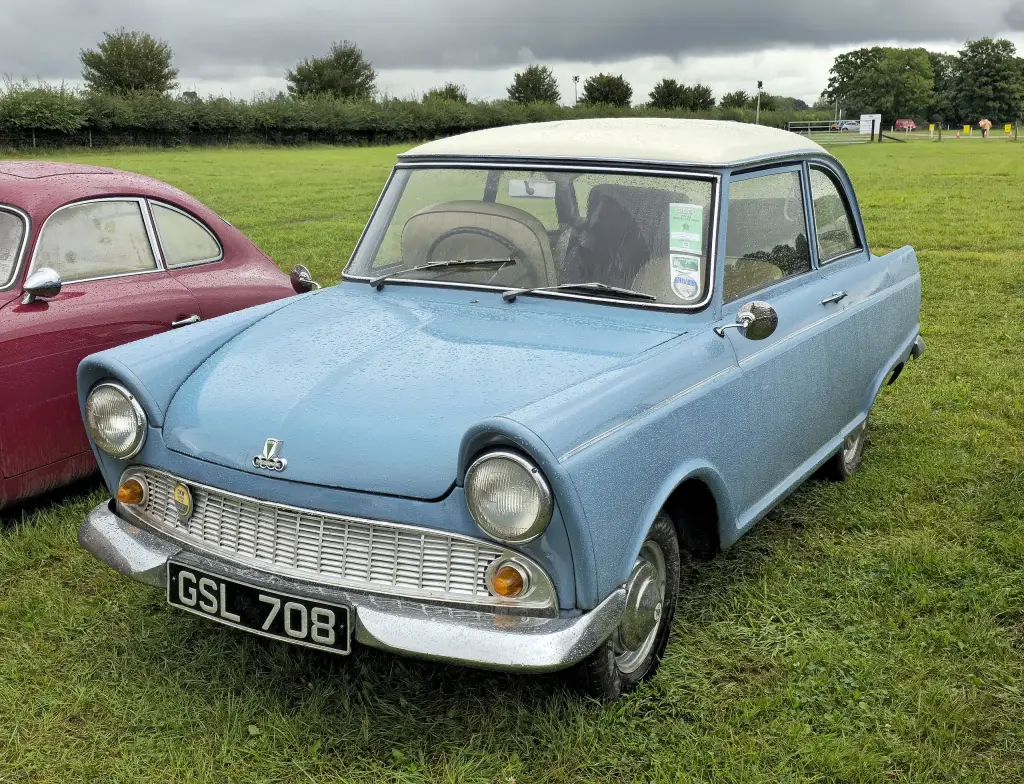
The DKW Junior was the car that kept the DKW name alive while the rest of the range turned into Auto Union. Shown at Frankfurt in March 1957 as the DKW 600 with a two-cylinder engine, it reached production in 1959 as a three-cylinder 750, by which time it had been given the name Junior. Between its launch and August 1963 it was the only car sold with a DKW badge.
DKW Junior at a glance
| Maker | Auto Union, Ingolstadt |
|---|---|
| Shown | Frankfurt Motor Show, March 1957, as the DKW 600 |
| Production | 1959–1962, de Luxe to 1963 |
| Engine | 741 cc three-cylinder two-stroke, 34 bhp |
| Gearbox | four-speed, column-mounted lever |
| Body | two-door saloon on a separate chassis |
| Price, 1961 | DM 4,790, heater DM 160 extra |
| Top speed | 114 km/h, 116 km/h for the de Luxe |
| Predecessor class | DKW F89 Meisterklasse |
| Successor | DKW F12 |
History of the DKW Junior
A modern small car
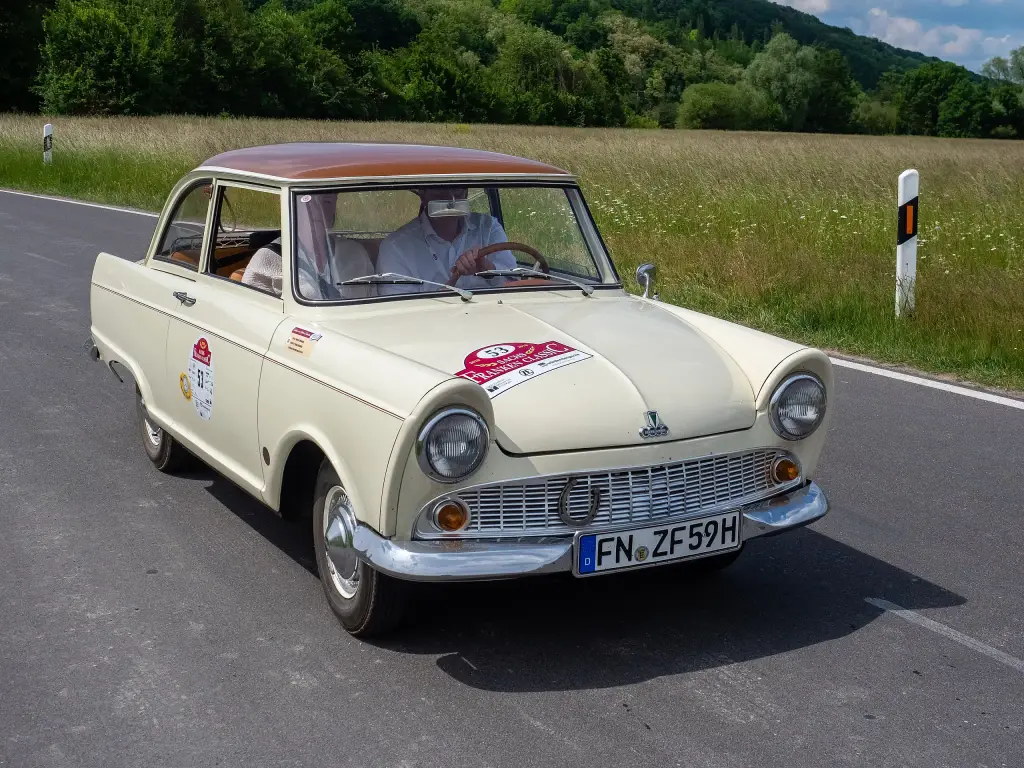
The Auto Union 1000 still looked like the 1938 prototype it came from. The Junior was the opposite: an uncompromising modern ponton three-box shape, filled out to the corners and with small tail fins of the kind just beginning to appear on fashionable European cars. Under the modern skin, however, the body still sat on a separate chassis. The prototype shown in 1957 had a two-cylinder 660 cc engine like the one last used in the F89 Meisterklasse, and 34 bhp (25 kW) was claimed.
Ingolstadt
A new plant was built at Ingolstadt for the Junior, since DKWs had been assembled at Düsseldorf since the war. By the time production began the prototype’s engine had been replaced by a three-cylinder two-stroke of 741 cc, and the four-speed gearbox was worked through a cable linkage by a column-mounted lever. In 1961 the Junior cost DM 4,790 in Germany. It offered more luggage space and a wider cabin than the class-leading Volkswagen Beetle, and the optional heater, at DM 160, gave owners a car that warmed up far faster in winter than the air-cooled Volkswagen.
Junior de Luxe
The Junior de Luxe arrived in 1961 and it is not clear whether it was meant to replace or to complement the original Junior, which was withdrawn in 1962. The de Luxe had its cylinders bored out to 796 cc; power was unchanged but torque rose slightly and the wheels grew from 12 to 13 inches, taking the claimed top speed from 114 to 116 km/h. In January 1963 the de Luxe was replaced by the F12.
Why it mattered
Two-stroke cars were losing ground as the industry standardised on four-stroke four-cylinder engines, which were getting cheaper to build. Buyers began to see two-strokes as rough and noisy, and the Junior was fighting that image with a modern body and a keen price. In the range it sat just below the Auto Union 1000, which had itself been renamed from DKW in 1957 — which is why the small car was the only DKW left.
Design and features
- Modern shape: ponton three-box styling with small tail fins, a clean break from the 1938-derived 1000.
- 741 cc three-cylinder: 34 bhp from a two-stroke, driving through a four-speed column-change gearbox.
- Room for the class: more luggage space and a wider cabin than the Volkswagen Beetle.
- Quick heater: the optional water-heated car warmed up much faster than the air-cooled Beetle.
- Cheap to buy: DM 4,790 in 1961.
DKW Junior versions
- Prototype (1957): shown as the DKW 600 with a 660 cc two-cylinder engine.
- Junior (1959–1962): 741 cc, 34 bhp, 114 km/h.
- Junior de Luxe (1961–1963): 796 cc, 13-inch wheels, 116 km/h.
- Later F11 and F12: the same line developed further, covered in a separate article.
The Junior sat below the Auto Union 1000 and was developed into the DKW F11 and F12, the last small two-stroke DKWs. More cars are in the DKW collection.
Video: DKW Junior de Luxe vm 1960 museo auto museum car
Video by Movielunatic on YouTube.
Sources
- DKW Junior, English Wikipedia: design, chronology, prices
- DKW Junior, German Wikipedia: model history