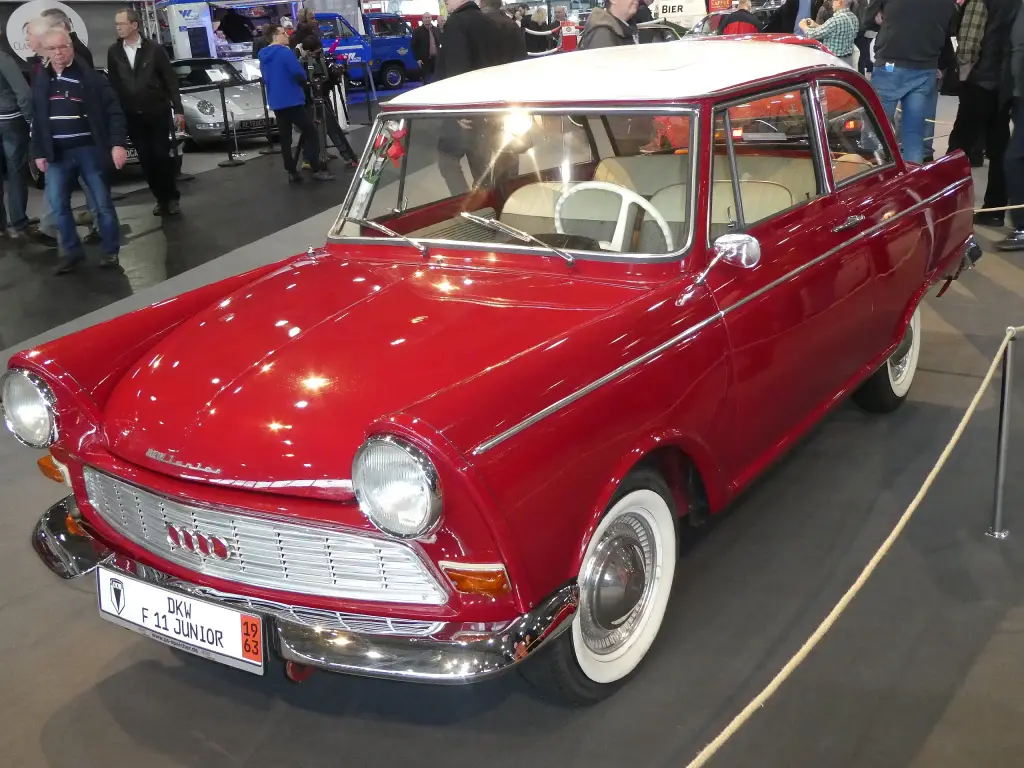
The DKW F12 was the last version of the Junior line and the most advanced small DKW yet: an 889 cc three-cylinder two-stroke and, for the first time in its class, front disc brakes. The cheaper F11 followed a few months later with the old 796 cc engine, and both disappeared when Volkswagen took over Auto Union in 1965.
DKW F11 and F12 at a glance
| Maker | Auto Union, Ingolstadt |
|---|---|
| F12 in production | from January 1963 |
| F11 in production | from August 1963 |
| Predecessor | DKW Junior de Luxe |
| F12 engine | 889 cc three-cylinder two-stroke, 40 bhp |
| F11 engine | 796 cc three-cylinder two-stroke |
| F12 Roadster | 1964, 45 bhp from the same 889 cc engine |
| Brakes | front discs on the F12, a first in this class |
| Gearbox | four-speed manual, column-mounted lever |
| Prices, New Zealand 1965 | £998 for the F11, £1,198 for the F12 |
History of the DKW F11 and F12
From Junior to F12
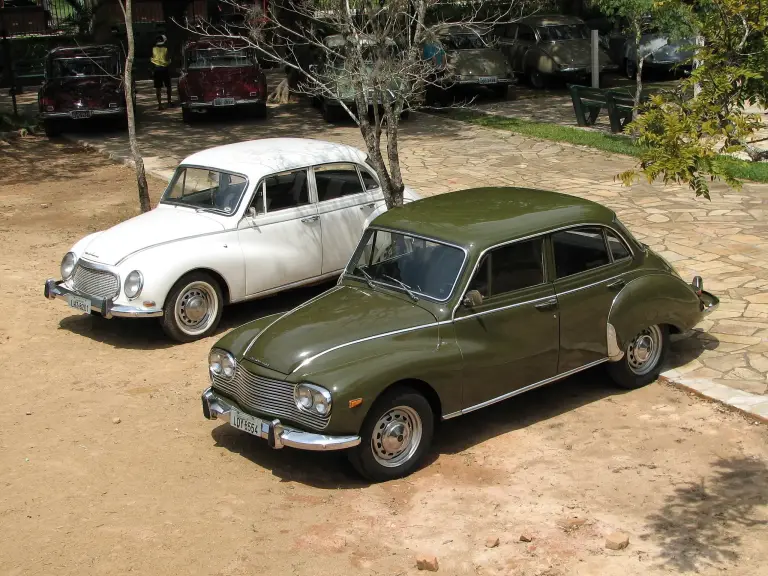
The Junior had been the only DKW-badged car on sale since 1957, and in January 1963 its de Luxe version was replaced by the DKW F12. Outwardly little changed: the C pillar became more angular. Under the bonnet the engine grew to 889 cc and the claimed output rose to 40 bhp (30 kW). The bigger news was the brakes — the F12 was the first car in its class with front disc brakes. The motoring press liked it, though high import duties held sales back in some markets: in July 1965 the F11 and F12 cost £998 and £1,198 in New Zealand.
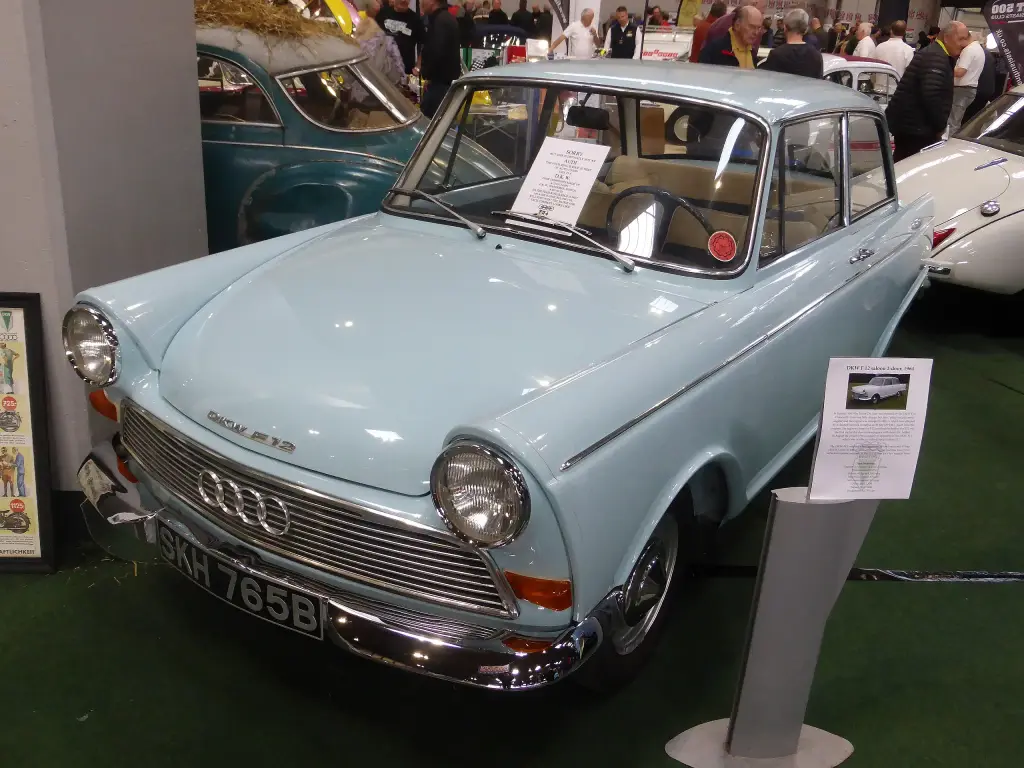
The cheaper F11
In August 1963 the Junior’s 796 cc engine reappeared in the DKW F11, in effect a reduced-specification F12. It sold alongside the more expensive car until production of the two-stroke DKWs was wound down after Volkswagen bought Auto Union from Daimler-Benz in the summer of 1965.
The Roadster
A cabriolet had been part of the Junior story from the start, and in 1964 the F12 Roadster arrived with 45 bhp (34 kW) from its 889 cc three-cylinder. That more powerful engine was also offered in the F12 saloon for a few months from February 1965. Contemporary road tests were kind: a New Zealand magazine called the F12 ‘a pleasant car offering quiet and comfortable motoring with excellent amenities’, rapid for its size and reliable over long distances, while a South African journal thought the subtle changes to the Junior had produced something of an aristocrat among light cars.
Design and features
- 889 cc engine: the largest three-cylinder fitted to the Junior line, with 40 bhp in the F12.
- Front disc brakes: the F12 was the first car in its class to have them.
- Roadster: a 45 bhp open version arrived in 1964.
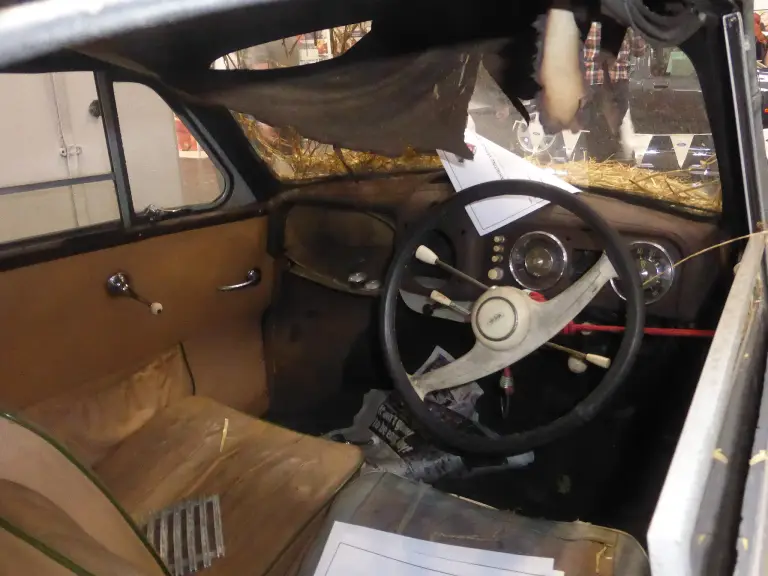
- Column gear lever: the four-speed gearbox was worked by a lever on the steering column.
- Two levels of trim: the cheaper F11 kept the 796 cc engine of the Junior de Luxe.
DKW F11 and F12 versions
- F12 saloon (1963–1965): 889 cc, 40 bhp, front disc brakes.
- F11 (1963–1965): reduced specification with the 796 cc engine.
- F12 Roadster (1964): cabriolet with 45 bhp.
- Late F12 saloon (1965): the Roadster’s 45 bhp engine offered for a few months.
The F11 and F12 followed the DKW Junior and were the last small two-stroke DKWs before the DKW F102. More cars are in the DKW collection.
Sources
- DKW Junior, English Wikipedia: F11 and F12 development, prices, road tests
- DKW F 11/F 12, German Wikipedia: model history