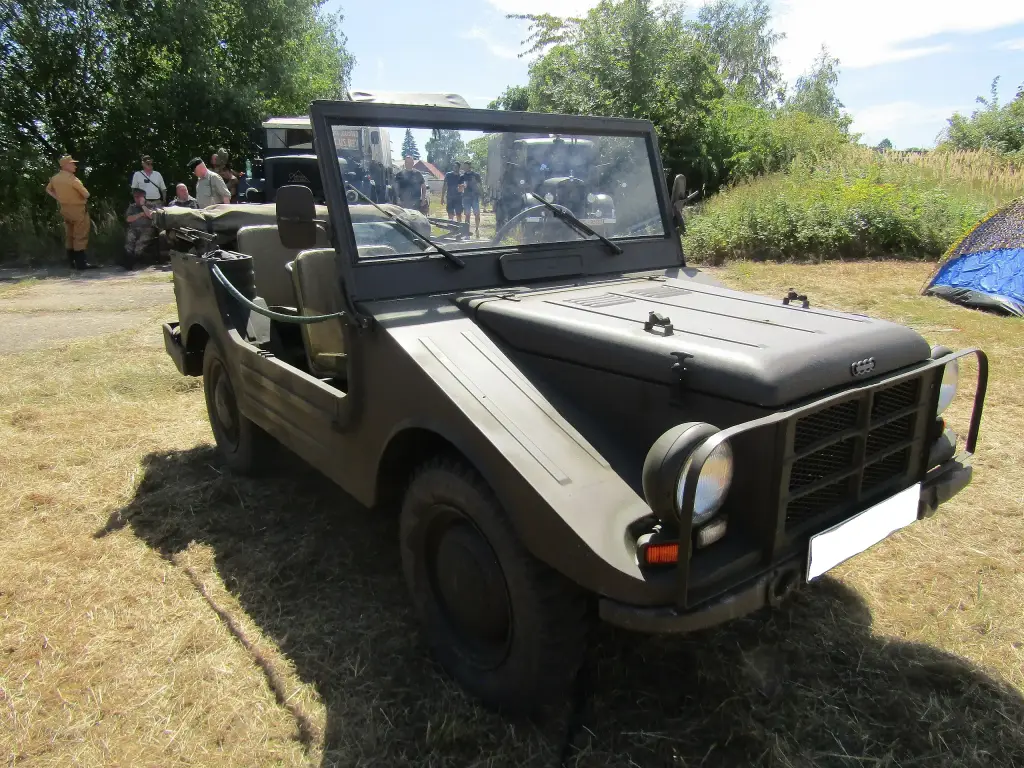
The DKW Munga was the little two-stroke off-roader that won the West German army’s contract. Its name abbreviates Mehrzweck Universal Geländewagen mit Allradantrieb — multi-purpose universal off-road car with all-wheel drive. Built from 1956 to 1968, it served the Bundeswehr, the border police and several NATO armies, and was also made in Brazil as the DKW Candango.
DKW Munga at a glance
| Maker | Auto Union, Ingolstadt |
|---|---|
| Production | October 1956–December 1968 |
| Purpose | border police, then the Bundeswehr from 1955 |
| Layout | four-wheel drive, two-stroke engine |
| Basis | DKW 3=6 engine and DKW Schnellaster van |
| Bodies | Munga 4 four-seat, Munga 6 pick-up, Munga 8 long pick-up |
| Also built | Brazil as the DKW Candango, 1958–1963 |
| Built | 46,750 |
History of the DKW Munga
How it started
In 1953 German authorities asked for vehicles for the border police and for the army that would be founded on 12 November 1955. DKW developed its answer around the two-stroke engine of the DKW 3=6 and the running gear of the Schnellaster van, and won the tender against the so-called Jagdwagen — the hunter’s cars — such as the Goliath Typ 31 and the Porsche 597. The name was also close to Mungo, the German word for mongoose, and came well before the Volkswagen Iltis.
In service
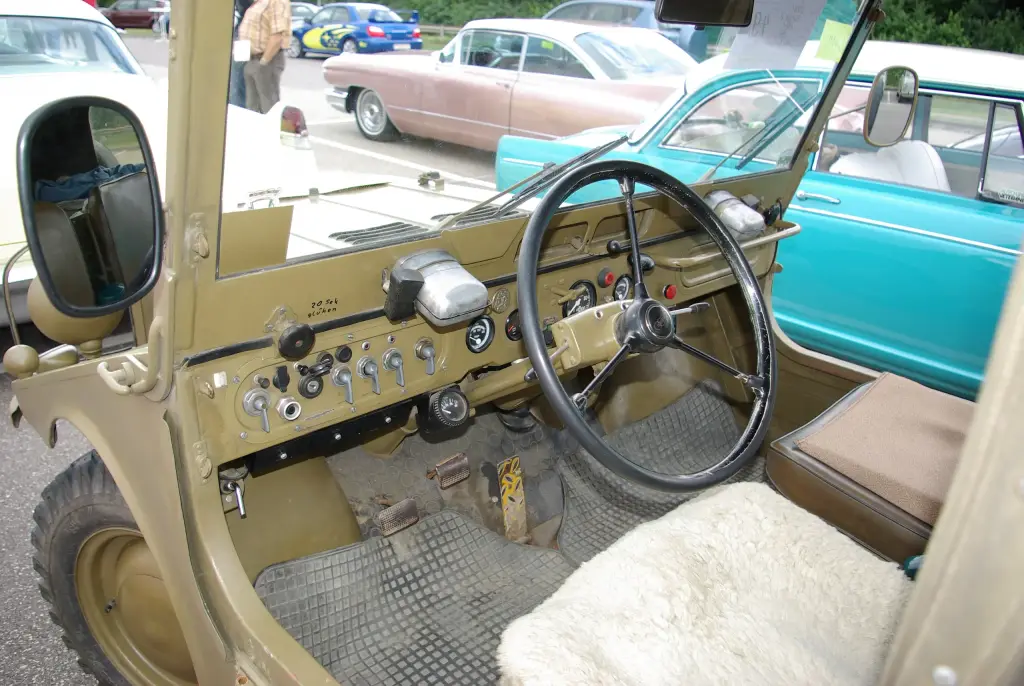
Production began in October 1956 and ended in December 1968, during which 46,750 cars were built. The Munga was launched to the public around the Frankfurt show in autumn 1957. Its stamina made it a natural choice for the Bundeswehr, where it was unique in its class, and large numbers went to the German border police and to foreign NATO formations. Around 2,000 were delivered to the Royal Netherlands Army, many of which were shipped to Britain in the late 1970s. The Dutch had meant the Munga to replace their 1956 M38A1 Nekaf Jeep, but it caused so many problems that it was withdrawn from front-line service early, in 1970, and the stored Nekaf Jeeps were reissued in its place.
Body types
From the end of 1956 the Munga was offered with a four-seat steel sheet body or with a six- or eight-seat platform body. The three versions were sold as Munga 4, Munga 6 pick-up and Munga 8 long pick-up.
Civilian use and Brazil
The civilian Munga was widely bought in West Germany for farm and forestry work, and abroad above all in countries where poor roads demanded a go-anywhere vehicle, such as large parts of South America and South Africa. From 1958 to 1963 it was also built in São Paulo by DKW-Vemag as the DKW Candango, in both four- and two-wheel-drive form.
Design and features
- All-wheel drive: the first purpose-built DKW off-roader, designed for police and military use.
- Two-stroke power: the engine came from the 3=6 road car, the chassis ideas from the Schnellaster van.
- Three bodies: four-seat, pick-up and long pick-up versions of the same vehicle.
- Army issue: bought by the Bundeswehr, the border police and several NATO armies.
- Brazilian cousin: the DKW Candango was the same concept built in São Paulo.
DKW Munga versions
- Munga 4: four-seat steel-sheet body.
- Munga 6: pick-up with six seats.
- Munga 8: long pick-up with eight seats.
- DKW Candango (1958–1963): Brazilian production in 4×4 and 4×2 form.
The Munga shared its engine with the DKW 3=6 and its chassis thinking with the DKW Schnellaster. Its Brazilian version is described with the DKW-Vemag Candango. More cars are in the DKW collection.
Video: DKW Munga 4 – 29.12.2009
Video by rockhell70 on YouTube.
Sources
- DKW Munga, English Wikipedia: development, production, operators, Brazil
- DKW Munga, German Wikipedia: model history and body types