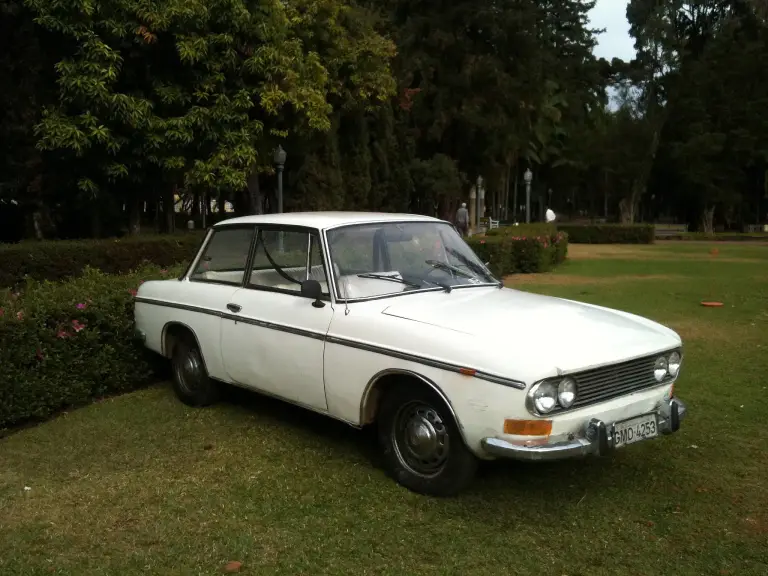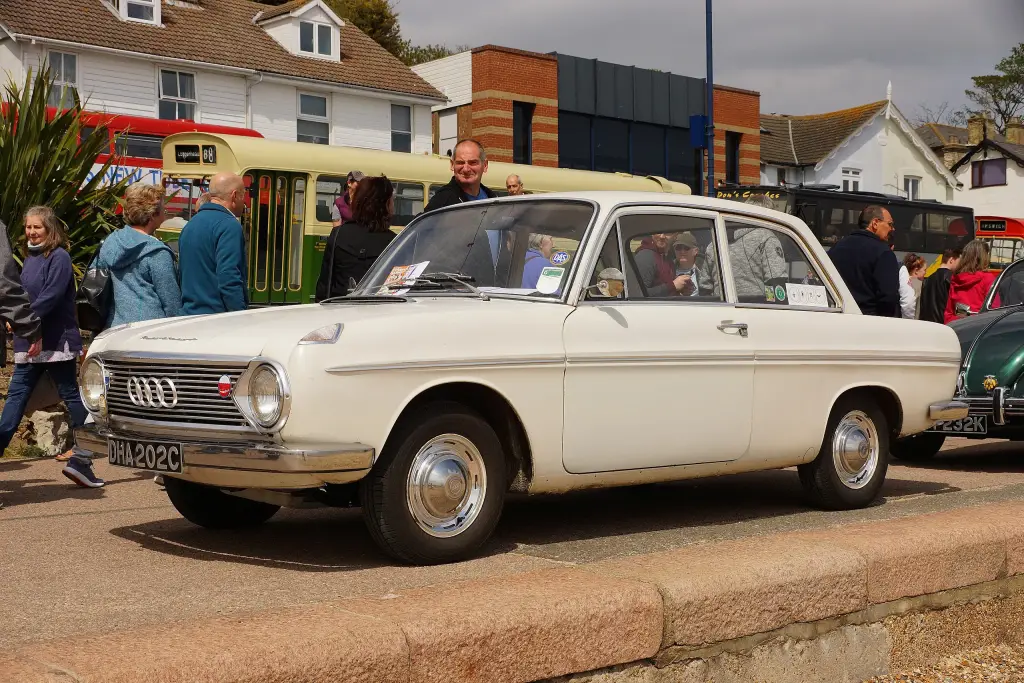
The DKW F102 was meant to give DKW a modern car at last. The body was new, with a unibody shell, large glass areas and very little chrome; the engine was the familiar three-cylinder two-stroke. It went on sale in 1964 and by the time production ended in 1966 DKW had disappeared from the car market, its factory passing to Volkswagen.
DKW F102 at a glance
| Maker | Auto Union, Ingolstadt |
|---|---|
| Production | August 1963–1966 |
| Predecessor | Auto Union 1000 |
| Successor | Audi F103 |
| Body | two-door saloon from March 1964, four-door from January 1965 |
| Engine | three-cylinder two-stroke, 400 cc per cylinder |
| Lubrication | fresh-oil system developed with Bosch, separate oil tank |
| Front suspension | double wishbones with torsion bars |
| Rear suspension | rigid axle on trailing arms, transverse torsion bar, Panhard rod |
| Price | DM 7,200 for the two-door |
| Built | 52,753 (possibly 53,053) |
History of the DKW F102
A new body
The last European Auto Union 1000 and 1000S were built in July 1963 and the F102 was presented in September as their replacement. The two-door saloon reached dealers in March 1964 and a four-door joined it in January 1965. Unlike its predecessor, whose shape went back to the late 1930s, the F102 was a new design with a unibody and the large glass surfaces and restrained chrome of the period. It cost DM 7,200.
Chassis
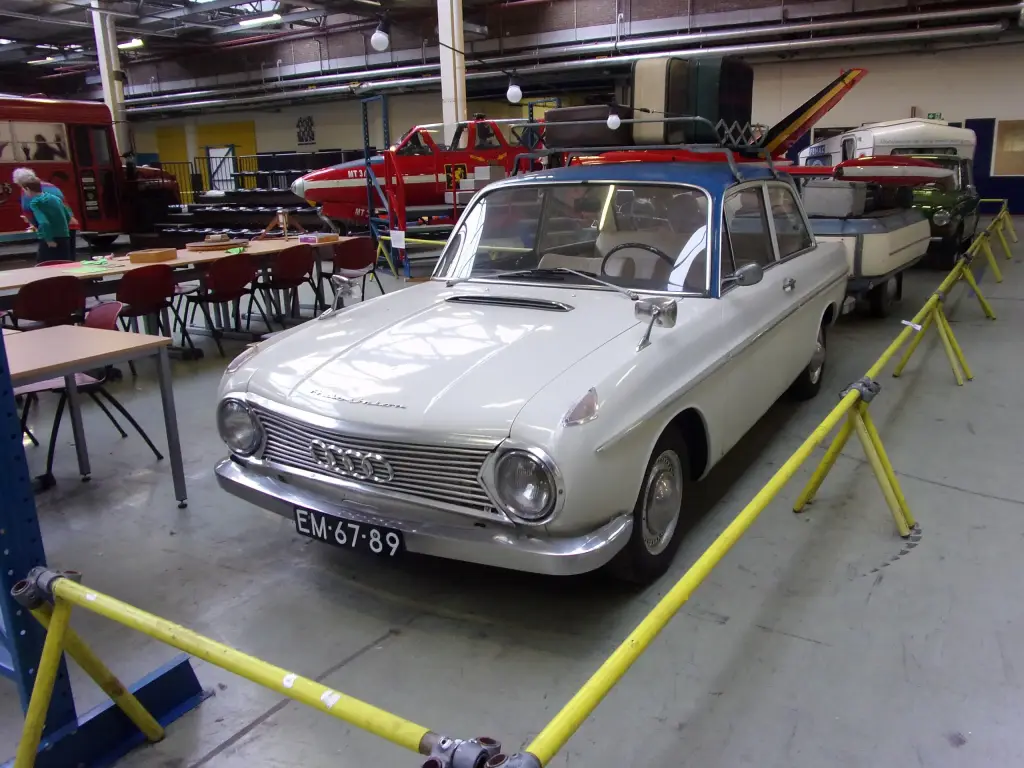
The front wheels hung on double wishbones with torsion bars. At the back a rigid axle sat on trailing arms and was sprung by a transverse torsion bar; when the load was uneven the axle beam twisted and worked as a stabiliser, and a Panhard rod located it sideways. The axle took up so much room that the fuel tank went behind it in the floor of the boot, with the spare wheel behind the rear seat back.
The fresh-oil system
Like its predecessors the F102 used a three-cylinder two-stroke. The mixture was prepared by a fresh-oil system developed with Bosch, which metered lubricant from a separate tank in the engine compartment into the petrol, so the driver could fill up with plain fuel. In practice the system caused trouble: after a cold winter night the oil was so thick that the engine could not be lubricated, and the same happened during long coasting downhill. Many engines were damaged by piston seizures, and the warranty claims ate into both the balance sheet and customer confidence.
The end of the two-stroke
Customers were also turning against two-stroke engines in general, which the F102 could not fix: the three-cylinder had reached the end of its development and larger two-stroke car engines never caught on. To cut fuel consumption DKW added a strong pressure point to the accelerator pedal so that the driver could feel how much power was being asked for — a trick later used on the Trabant 601. An attempt to develop a two-stroke V6 came to nothing, and the F102 was the last two-stroke car built in West Germany apart from the Goggomobil. It was also the last model developed by Auto Union before the Volkswagen takeover, and under Volkswagen its floorpan and layout formed the basis of the Audi F103, which brought the Audi name back.
Design and features
- Modern body: a unibody shell with large glass areas and little chrome, a clean break from the 1930s-derived 1000.
- Fresh-oil lubrication: oil from a separate tank mixed automatically, though it seized engines in cold weather.
- Torsion-bar chassis: double wishbones in front, a twisting-beam rear axle located by a Panhard rod.
- Packaging: fuel tank behind the rear axle in the boot floor and the spare wheel behind the back seat.
- Pressure-point throttle: a heavy spot in the pedal travel to discourage heavy fuel use.
DKW F102 versions
- Two-door saloon (from March 1964): the original body, DM 7,200.
- Four-door saloon (from January 1965): added a year into production.
- V6 prototype: Hans Müller’s 1,288 cc two-stroke V6 fitted to an F102 for tests, never produced.
The F102 replaced the Auto Union 1000 and was the last DKW; the smaller DKW Junior had already gone out of production. More cars are in the DKW collection.
Sources
- DKW F102, English Wikipedia: production, chassis, fresh-oil system, V6
- DKW F 102, German Wikipedia: model history and production figures