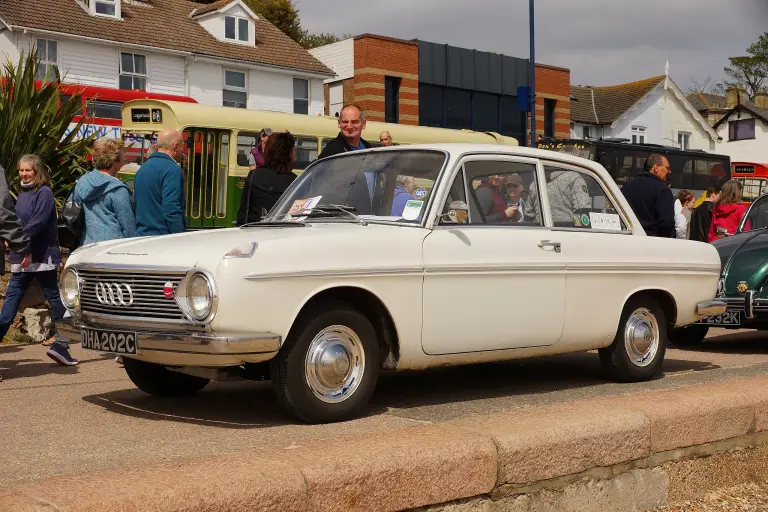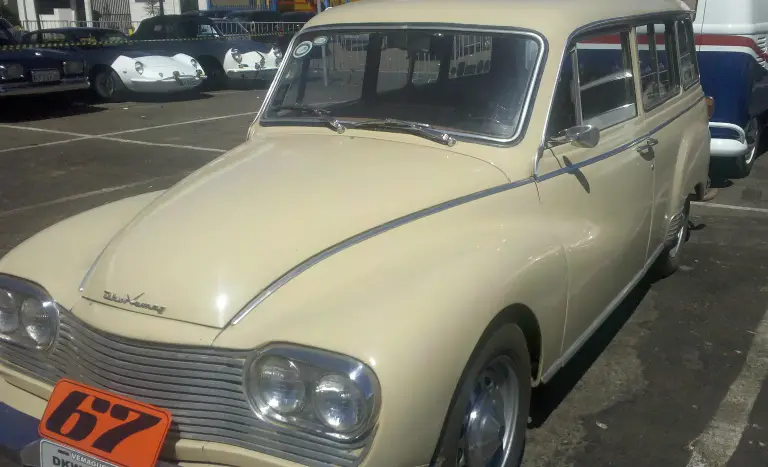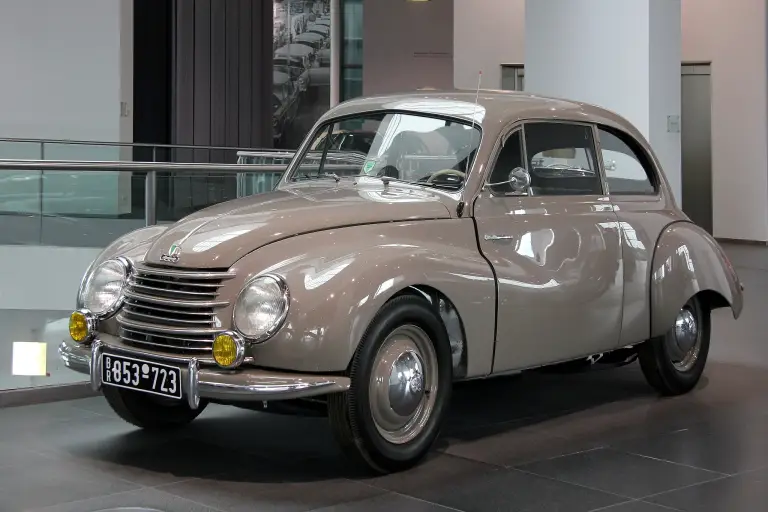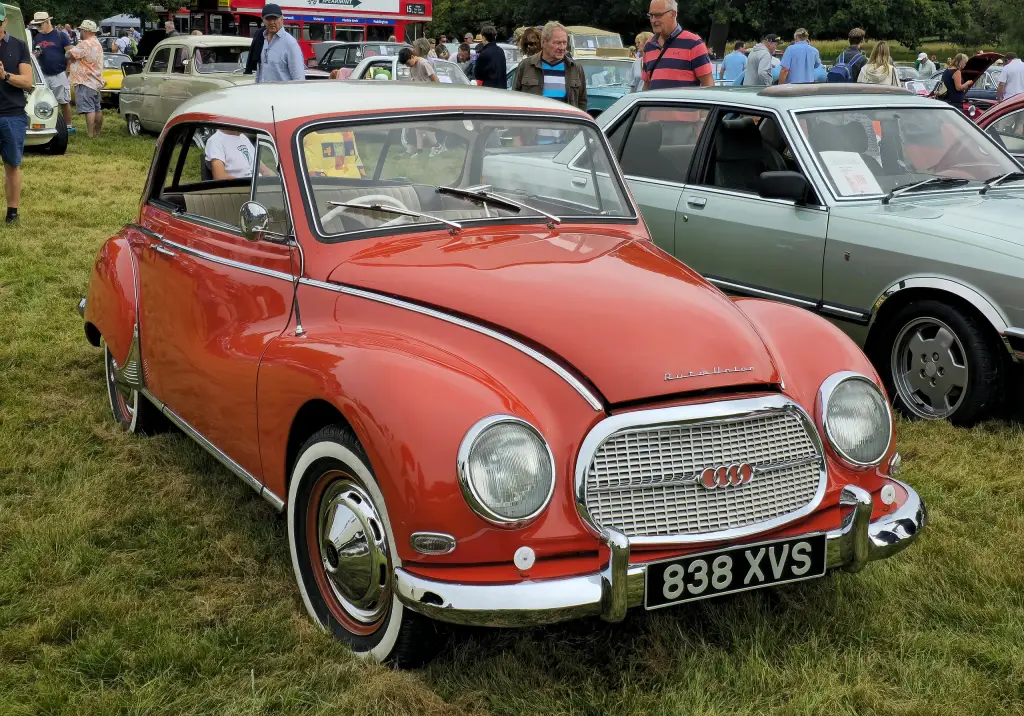
The Auto Union 1000 was the car with which DKW’s western half said goodbye to the badge that had made it famous. Launched for 1958, it was the DKW 3=6 with a bored-out 981 cc three-cylinder two-stroke engine and the four-ring Auto Union emblem across the grille. It stayed in production until 1965 and was the last model the company sold under its own name before the F102.
Auto Union 1000 at a glance
| Maker | Auto Union GmbH, Düsseldorf and Ingolstadt |
|---|---|
| Production | 1958–1965 |
| Predecessor | DKW 3=6 (F93/F94) |
| Successor | DKW F102 |
| Engine | 981 cc two-stroke three-cylinder |
| Power | 44 PS (32 kW) in the 1000, 55 PS in the 1000 Sp |
| Series | model 58 (1958–59), model 60 (1959–61), model 62 (1961–62) |
| Bodies | two- and four-door saloons, pillarless coupé, three-door Universal estate |
| Badge | four-ring Auto Union instead of DKW |
| Rally win | 1959 Acropolis Rally |
| Also built | Argentina, by IASF, 1960–1969 |
History of the Auto Union 1000
From the 3=6
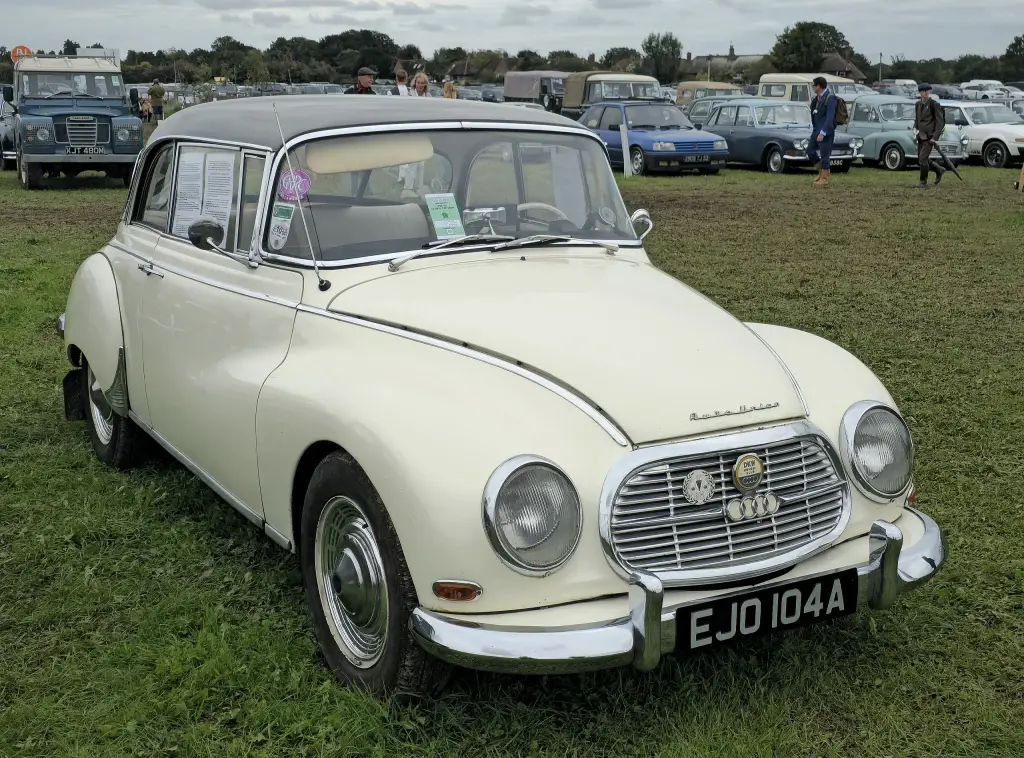
The 1000 was an evolution of the DKW F93, F94 and F94U of the 3=6 series rather than an all-new car. Its engine was enlarged to 981 cc, which raised output by between 10 and 37 per cent depending on the version: the base model now claimed 44 PS (32 kW). The visual changes were the point of the exercise. Instead of the DKW badge, the nose carried the old four-ring Auto Union emblem with the company name above it, and the boot lid was smoothed off.
Three series
The European range went through three series. The first, known as model 58 or AU1000/58, was offered only as a 1000 Coupe de Luxe with the 44 PS engine and was built for 1958 and 1959. The model 60 followed, and in two-door form it was the first of the line with the panoramic wrap-around windscreen; the first car of this series, a 1000S Coupé, was completed at Düsseldorf on 27 July 1959 after 25 pre-production cars. The model 60 gained four-door and Universal versions, and on 29 September 1961 production switched to the model 62, which brought front disc brakes, the Lubrimat automatic lubrication system, a wider rear track and a larger boot.
Bodies
Besides the two- and four-door saloons there was a pillarless coupé that shared the saloon profile apart from the missing B pillar, and from 1959 a three-door estate sold as the 1000 Universal — in effect an updated DKW F94U, offered with right-hand drive only in 1959, 1960 and 1961. Under the skin the body and most of the mechanical layout still descended from the Zwickau-developed DKW F9 prototype of 1938, which in its day had been a modern design but by the early 1960s looked old beside ponton-shaped rivals.
The 1000 Sp
In 1958 came the Auto Union 1000 Sp, a low two-seater built for Auto Union by Baur of Stuttgart, with tail fins that earned it the nickname ‘baby Thunderbird’. Its compression ratio was raised and it claimed 55 PS (40 kW) and 140 km/h, which made it the fastest car in the range. A cabriolet joined in 1961, and the Sp was the company’s last open car until the Audi 80 cabriolet of 1994.
Rallying and Argentina
The 1000 won outright events in the late 1950s and early 1960s, among them the 1959 Acropolis Rally for Wolfgang Levy and Hans Wenscher, the South African national rally championship in 1961, 1962 and 1963, and a class win on the 1960 Monte Carlo Rally; cars were still being rallied in Sri Lanka, Brazil and South Africa into the 1970s. From 1960 to 1969 the 1000 was also built under licence in Argentina by Industrias Automotriz de Santa Fe at Sauce Viejo, as two- and four-door saloons, the Universal estate and the Fissore-designed 1000 SE coupé and spyder.
Design and features
- Bigger two-stroke: the 981 cc three-cylinder gave 44 PS in the saloon, a clear step up from the 896 cc 3=6.
- Auto Union badge: the four rings replaced the DKW name on the grille, a marketing move rather than a technical one.
- Panoramic windscreen: from August 1959 the two-door cars had a wrap-around screen with a vertical strip speedometer.
- Model 62 refinements: front disc brakes, Lubrimat, wider rear track and a bigger boot from late 1961.
- Rally record: outright wins including the 1959 Acropolis and three South African titles.
Auto Union 1000 versions
- 1000 (1958–1965): the standard saloon with 44 PS, two or four doors.
- 1000S: the coupé and four-door versions under the new decade’s name.
- 1000 Universal: three-door estate built 1959–1962, the last one finished on 31 October 1962.
- 1000 Sp: Baur-built two-seater with 55 PS, fixed head from 1958 and cabriolet from 1961.
- Argentine 1000 SE: Fissore-bodied coupé and spyder made by IASF from 1960.
The 1000 replaced the DKW 3=6 and was itself replaced by the DKW F102, the last car to wear the DKW badge. The smaller DKW Junior sat below it in the range. More cars are in the DKW collection.
Video: DKW AU 1000 S from the 1960:s in the BCCC drives rally in Karlshamn
Video by Sebastian George on YouTube.
Sources
- Auto Union 1000, English Wikipedia: series, bodies, 1000 Sp, motorsport, Argentina
- Auto Union 1000, German Wikipedia: model history
- Auto Union 1000, Portuguese Wikipedia: place in the DKW range