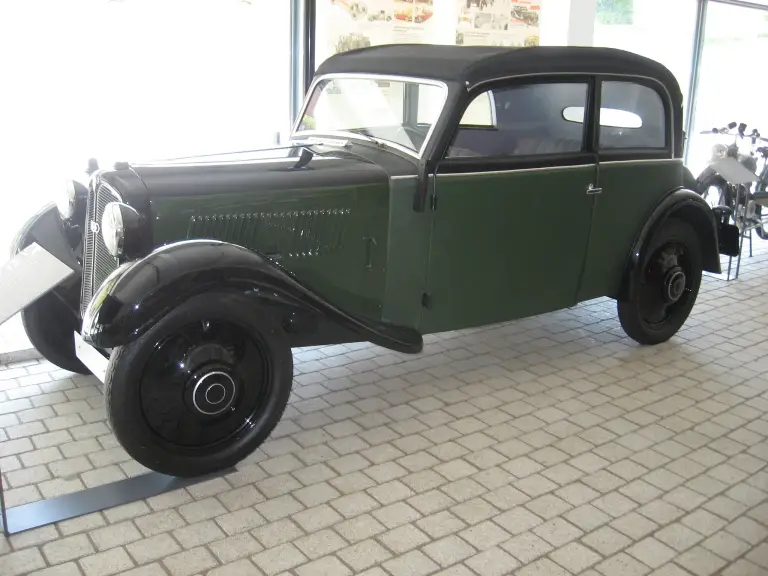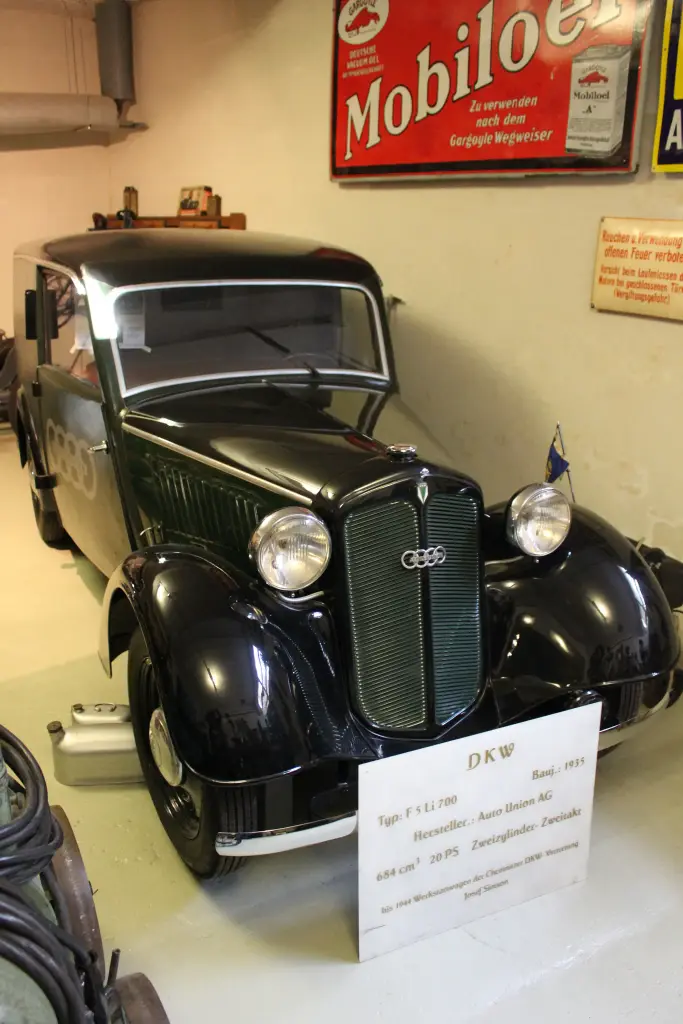
The DKW F5 was a quiet step forward rather than a new car. It replaced both the F2 (Reichsklasse) and the F4 (Meisterklasse) in 1935, looked much the same as either of them, and hid its main change under the skin: the timber frame of the central body was replaced by steel. About 60,000 were built before the F7 took over in 1937.
DKW F5 at a glance
| Maker | Auto Union, Zwickau |
|---|---|
| Production | 1935–1936, cabriolets until 1937 |
| Predecessors | DKW F2 and DKW F4 |
| Successor | DKW F7 |
| Body | steel frame with fabric outer skin on plywood |
| Saloons | Reichsklasse 584 cc, Meisterklasse 692 cc |
| Top speed | 80 km/h Reichsklasse, 85 km/h Meisterklasse |
| Cabriolets | two-seat versions of both, plus the Front Luxus Sport |
| Gearbox | three-speed manual |
| Built | about 60,000 |
History of the DKW F5
The same shape, a new frame
Little of the F5’s appearance differed from the F2 and F4 it replaced. The change was in the middle of the body: the timber-frame construction gave way to a steel frame, while the outer skin stayed fabric over plywood. There were two broadly similar saloons, sold as the Reichsklasse and the Meisterklasse. They shared track and wheelbase, but the Meisterklasse was 3.5 cm longer.
Engines and bodies
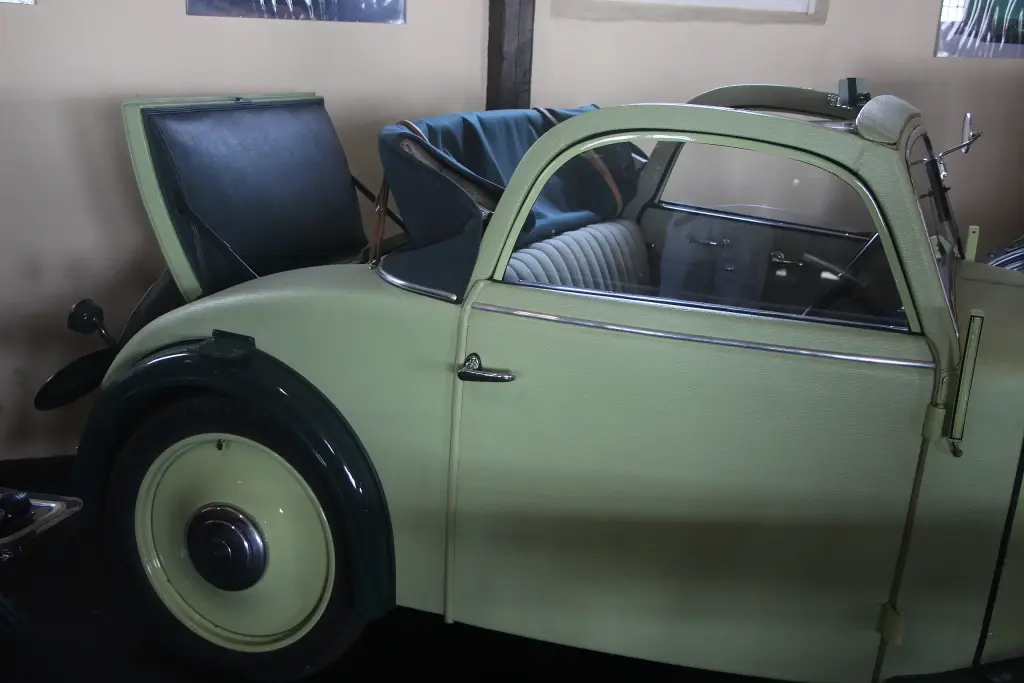
Both cars used the two-cylinder two-stroke engines of their predecessors, of 584 cc and 692 cc. Claimed top speeds were 80 km/h for the smaller car and 85 km/h for the larger. Two-seater cabriolets were offered of each, and there was also a lighter-bodied Front Luxus Sport cabriolet for which 90 km/h was claimed.
Sales and replacement
Production of the F5 saloons ended in 1936, but the 20 bhp cabriolet versions carried on for another year. By then roughly 60,000 F5s had been built, which made it one of Germany’s best selling cars. Front-wheel drive was by that time no longer new for DKW — the company had been building small front-driven saloons since 1931 — but it was still a striking feature against the rest of the market. The F7 replaced it in 1937.
Design and features
- Steel-framed body: the central timber frame of the F2 was replaced by steel, while the skin stayed fabric on plywood.
- Two trim levels: Reichsklasse with 584 cc and Meisterklasse with 692 cc, the latter 3.5 cm longer.
- Front Luxus Sport: a lighter cabriolet claiming 90 km/h against 80–85 km/h for the saloons.
- Front-wheel drive: still unusual across the market in the mid-1930s.
- Big seller: about 60,000 cars in two years.
DKW F5 versions
- Reichsklasse saloon (1935–1936): 584 cc.
- Meisterklasse saloon (1935–1936): 692 cc and a longer body.
- Two-seat cabriolets: one for each engine, built until 1937.
- Front Luxus Sport cabriolet: light body, 90 km/h claimed.
The F5 replaced the DKW F2 and was followed by the DKW F8. More cars are in the DKW collection.
Video: DKW F 5 Bj. 1936
Video by Quaaak03 on YouTube.
Sources
- DKW F5, English Wikipedia: body, engines, production
- DKW F 5, German Wikipedia: model history