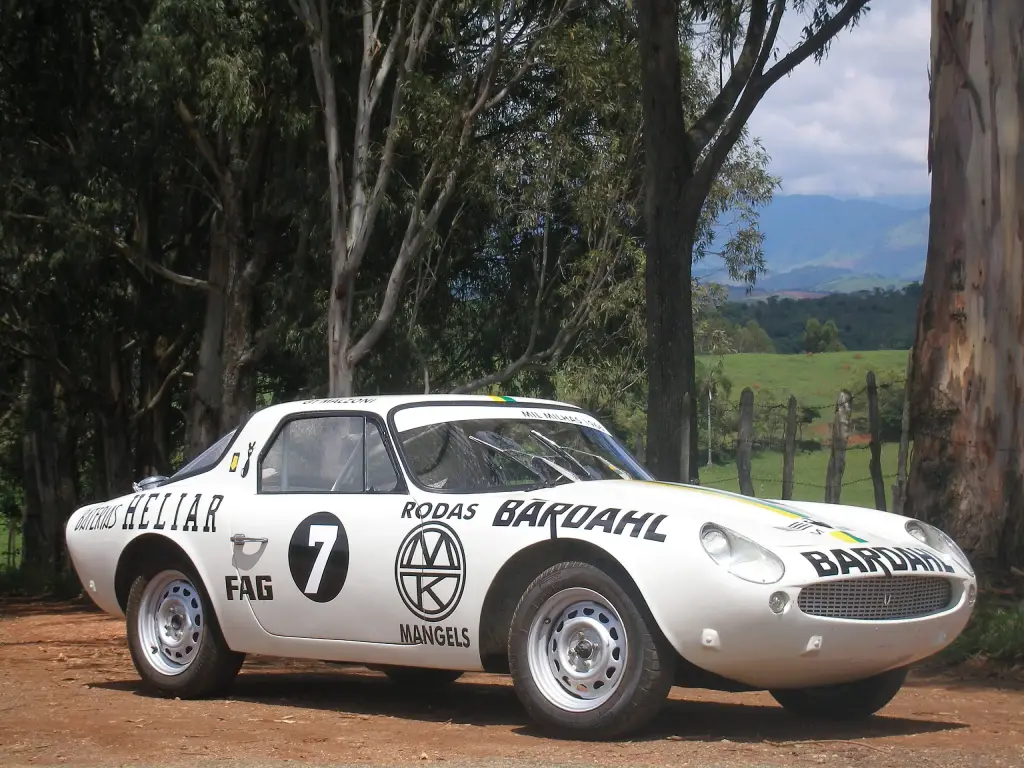
The GT Malzoni was a Brazilian sports car built in a small workshop on the mechanicals of the DKW 3=6. Its designer, the lawyer and racing driver Genaro Rino Malzoni, started with a car for himself in 1961; three prototypes later the Tipo IV went on sale as the DKW-Vemag GT Malzoni, and about 35 were built before it turned into the Puma GT.
DKW-Vemag GT Malzoni at a glance
| Maker | DKW-Vemag, built at Dobrada, São Paulo |
|---|---|
| Production | 1964–1966 |
| Internal name | Tipo IV |
| Designer | Genaro Rino Malzoni |
| Mechanicals | largely from the DKW 3=6 |
| Body | fibreglass |
| Developed with | Jorge Lettry and Anísio Campos |
| Prototypes | Tipo I (1962), Tipo II, Tipo III |
| Built | about 35, road and competition versions |
| Successor | Puma GT, shown in 1966 |
based on Portuguese Wikipedia
History of the DKW-Vemag GT Malzoni
Racing as advertising
In the 1960s Brazilian car makers used racing as publicity. DKW-Vemag had modified Belcars for competition which performed well but were heavy, and the supply of sports cars in the country was small, which left room for experimental projects. In May 1961 the lawyer and driver Genaro Rino Malzoni decided to build a sports car for his own use, using his experience of making bodies for existing chassis. Jorge Lettry, Vemag’s competition director, and the designer and driver Anísio Campos later joined the project, whose aim became beating the Willys-Overland Interlagos — the Brazilian version of the Renault Alpine A108 — on the track. Construction of the first prototype began in November 1962 at Matão, São Paulo.

Four prototypes
In July 1963, about eight months after work began, the magazine Quatro Rodas tested the prototype, by then called the DKW-Vemag-GT or Tipo I, and it was well received for its performance. The test singled out its stability, the result of a short wheelbase that became a fundamental part of the design. Much of what changed later was suggested by Vemag itself, which saw the project as a way to broaden its sporting range. Mário César, later a partner in Puma, proposed a complete redesign of the body that became the Tipo II, with a more aerodynamic profile closer to the look of the eventual GT Malzoni. A third car, the Tipo III, followed and served as the basis for the fibreglass bodies of the Tipo IV — a technique unusual at the time that cut weight and allowed both more design freedom and easier production.
The production car
Building of the final model began in 1964 after about 50 mechanical and styling changes. An estimated 35 GT Malzonis were made in this phase, split between road cars and stripped competition versions, three of which were works cars. The car was built at Dobrada in São Paulo and its technical parts came largely from the DKW 3=6. Its direct successor, the Puma GT, was shown at the fifth São Paulo motor show in 1966 and went on to far greater production, first with DKW mechanicals and then with Volkswagen engines.
Design and features
- Fibreglass body: light and easy to shape, a technique new to Brazilian series production.
- DKW 3=6 mechanicals: proven two-stroke running gear in a much lighter car.
- Short wheelbase: the key to the stability that the press noticed in 1963.
- Road and race versions: about 35 cars, some stripped for competition, three of them works cars.
- Puma ancestor: the design led directly to the Puma GT of 1966.
DKW-Vemag GT Malzoni versions
- Tipo I (1962–1963): Malzoni’s own car, tested by Quatro Rodas.
- Tipo II: aerodynamic redesign proposed by Mário César.
- Tipo III: the prototype whose fibreglass body technique was carried over.
- GT Malzoni (1964–1966): about 35 production cars, road and competition.
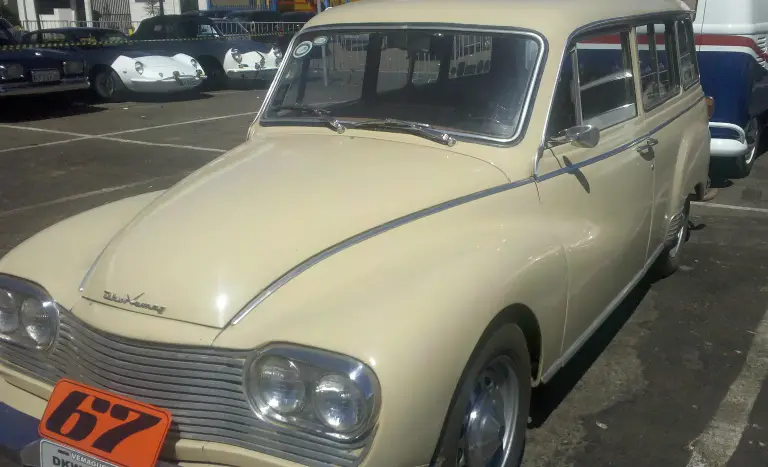
The GT Malzoni used the mechanicals of the DKW 3=6; the Fissore was Vemag’s other attempt at a more exclusive car. More cars are in the DKW collection.
Sources
- DKW-Vemag GT Malzoni, Portuguese Wikipedia: history, prototypes, production
- Vemag, Portuguese Wikipedia: place of the Puma in the range