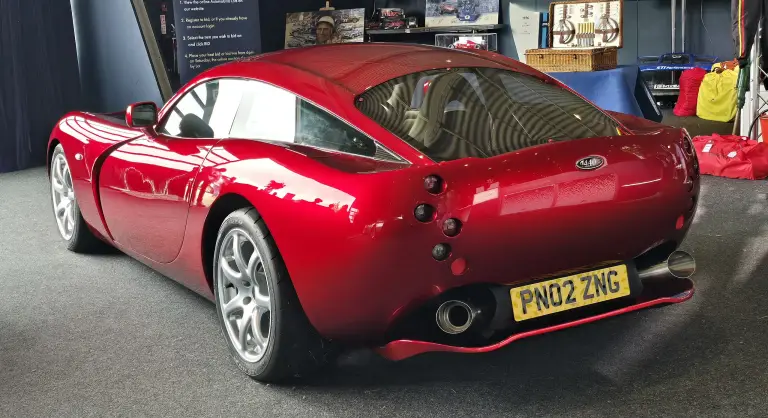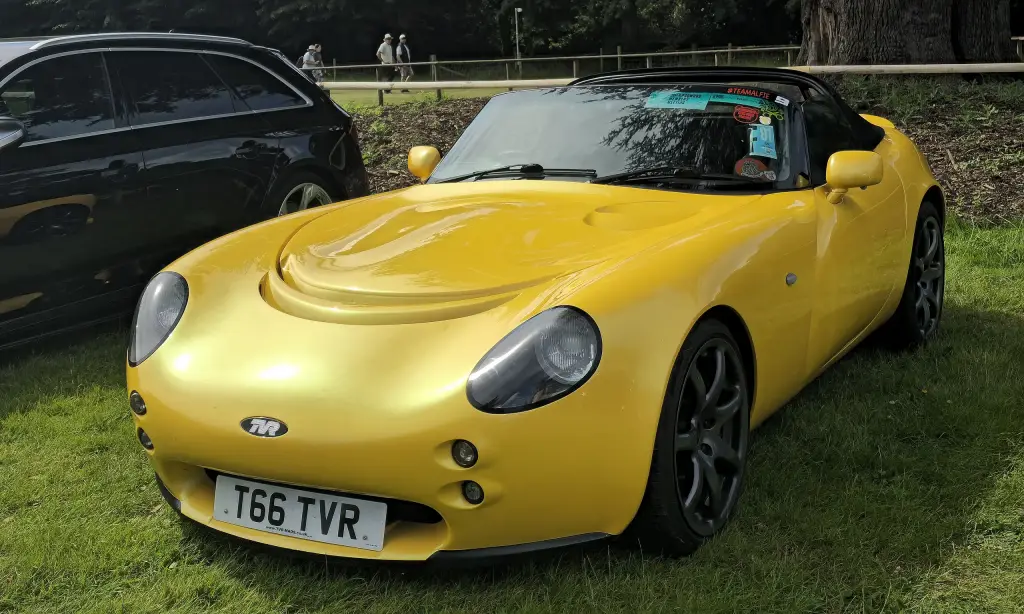
The TVR Tamora was intended to be the practical, urban-friendly TVR. Introduced at the 2000 Birmingham Motor Show and built from 2002, it replaced the Chimaera and Griffith at the bottom of the range and was named after a character in Shakespeare’s Titus Andronicus.
TVR Tamora at a glance
| Maker | TVR, Blackpool |
|---|---|
| Production | 2002–2006 |
| Introduced | 2000 Birmingham Motor Show |
| Engine | 3,605 cc TVR Speed Six, short-stroke 4.0 |
| Power | 350 hp (261 kW) at 7,200 rpm |
| Torque | 290 lb·ft (393 N·m) at 5,500 rpm |
| Gearbox | five-speed manual |
| Brakes | 300 mm front, 280 mm rear, by AP Racing |
| Weight | 1,060 kg, 58/42 front to rear |
| Wheelbase | 2,400 mm |
| 0–60 mph | 4.2 seconds according to Autocar |
| Top speed | over 170 mph |
| Built | 356 |
Based on one source: the English Wikipedia article on the TVR Tamora.
History of the TVR Tamora
The Tamora filled the space left by the Chimaera and Griffith as the entry-level TVR. Peter Wheeler was no longer directly responsible for design, and the car was styled by a team led by Damian McTaggart, who also did the interior, although Wheeler still had final approval. Based on the Tuscan Speed Six, it used the same chassis and suspension, with a short-stroked version of the Tuscan’s 4.0-litre Speed Six reduced to 3.6 litres.
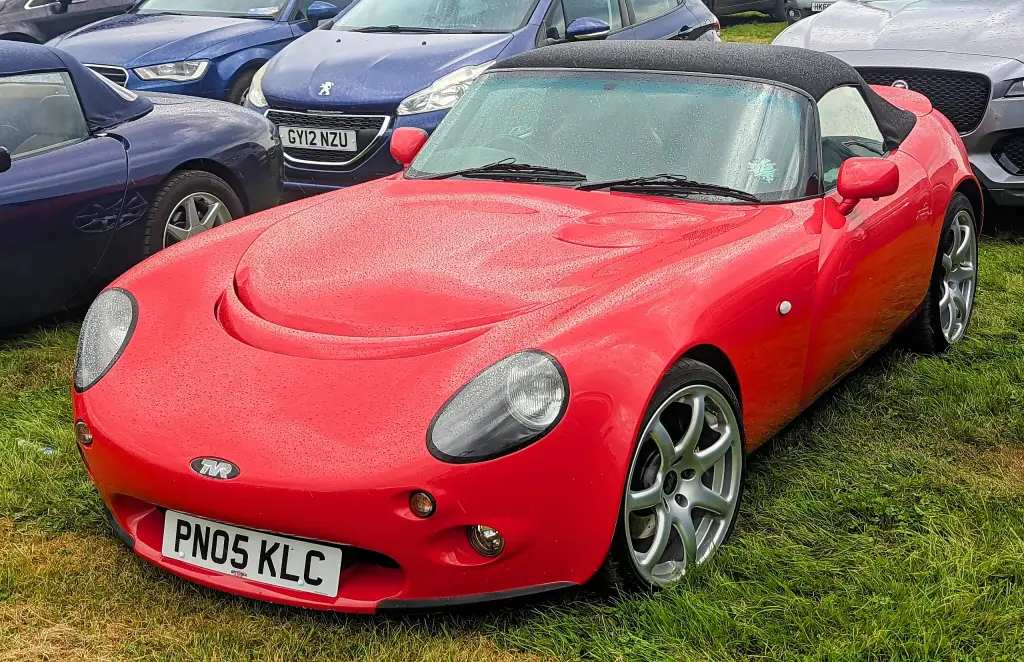
In keeping with TVR tradition the Tamora had no ABS or traction control, but it did have power steering and a softer clutch for easier manoeuvring, which was the point of the car: a more practical and urban-friendly model. The engine produced 350 hp at 7,200 rpm and 290 lb·ft at 5,500 rpm through a five-speed manual gearbox. AP Racing supplied the brakes, 300 mm at the front and 280 mm at the rear, and the suspension was double wishbones at all four corners. Standard wheels were 16×7-inch aluminium with 225/50ZR-16 Avon ZZ3 tyres, though most cars were ordered with 18-inch wheels and 225/35/18 front and 235/40/18 rear tyres.
The Tamora sat on a 2,400 mm wheelbase and measured 3,920 mm long, 1,710 mm wide and 1,200 mm high, weighing 1,060 kg with a 58/42 weight distribution. The interior had leather upholstery, aluminium switches and an adjustable steering column, plus central locking, electric windows, a boot release, electric mirrors and an engine immobiliser. Autocar recorded 0–60 mph in 4.2 seconds, a quarter mile in 12.5 seconds at 119 mph and a top speed over 170 mph. The Tamora was not a sales success, thanks to reliability problems, a high price and divisive styling, and only 356 were made before it was discontinued in 2006. It also provided the base for the T350 coupe.
Design and features
- Speed Six: a short-stroke 3.6-litre six with 350 hp.
- Easier to live with: power steering and a softer clutch than other TVRs.
- No driver aids: no ABS or traction control, in the TVR tradition.
- T350 base: the same platform later became the T350.
TVR Tamora versions
- Tamora (2002–06): the standard car, 356 built.
- 18-inch wheel cars: most cars were ordered on the larger wheels.
- T350: the coupe developed from the Tamora.
The Tamora replaced the Chimaera and Griffith, shared its platform with the Tuscan and led to the T350. More cars are in the TVR collection.
Video: 2001 TVR Tamora Review
Video by Men and Motors on YouTube.
Sources
- TVR Tamora, English Wikipedia: development, specifications, production, performance