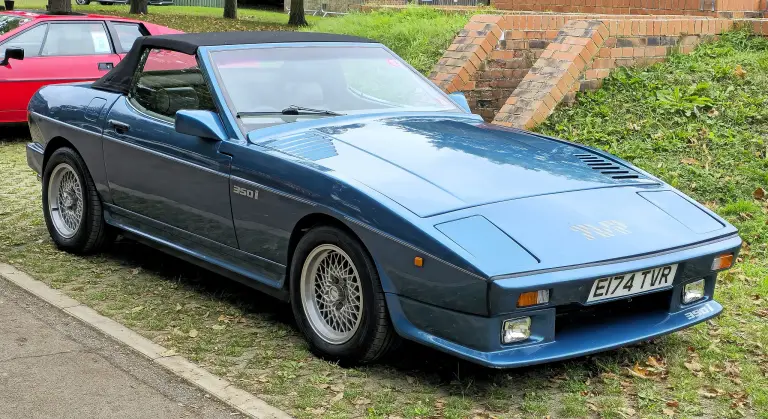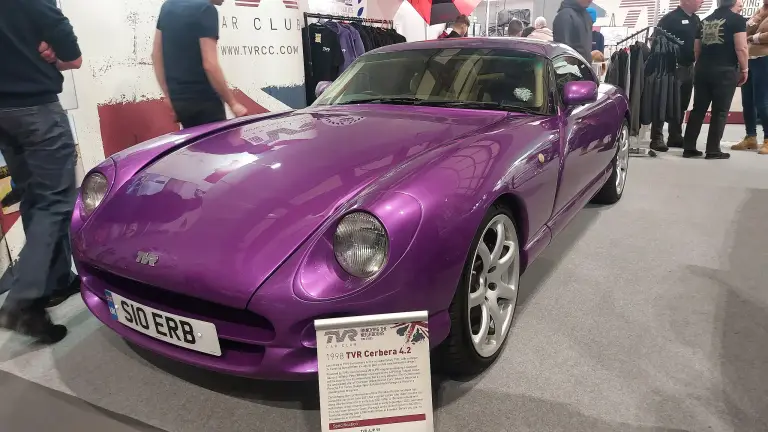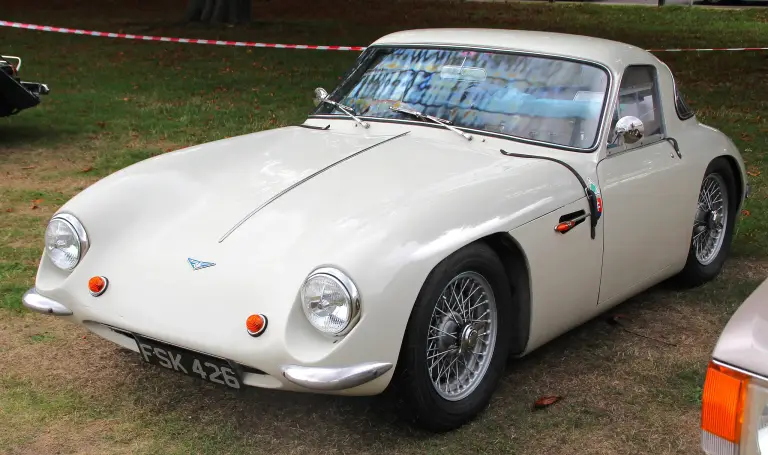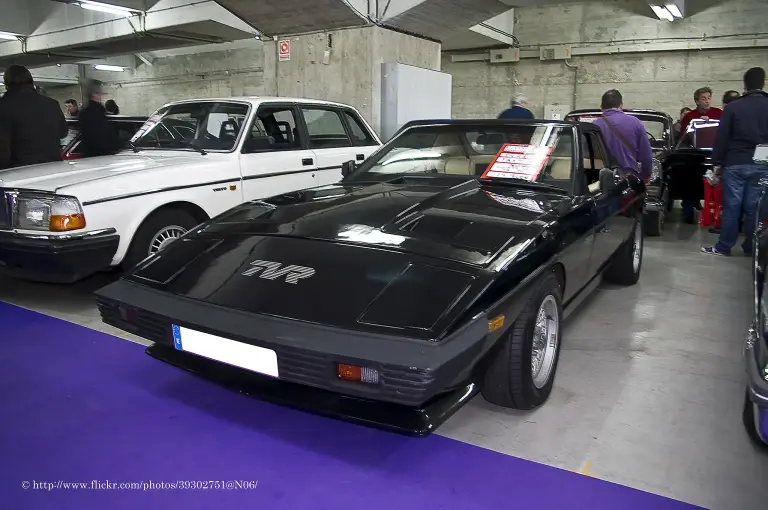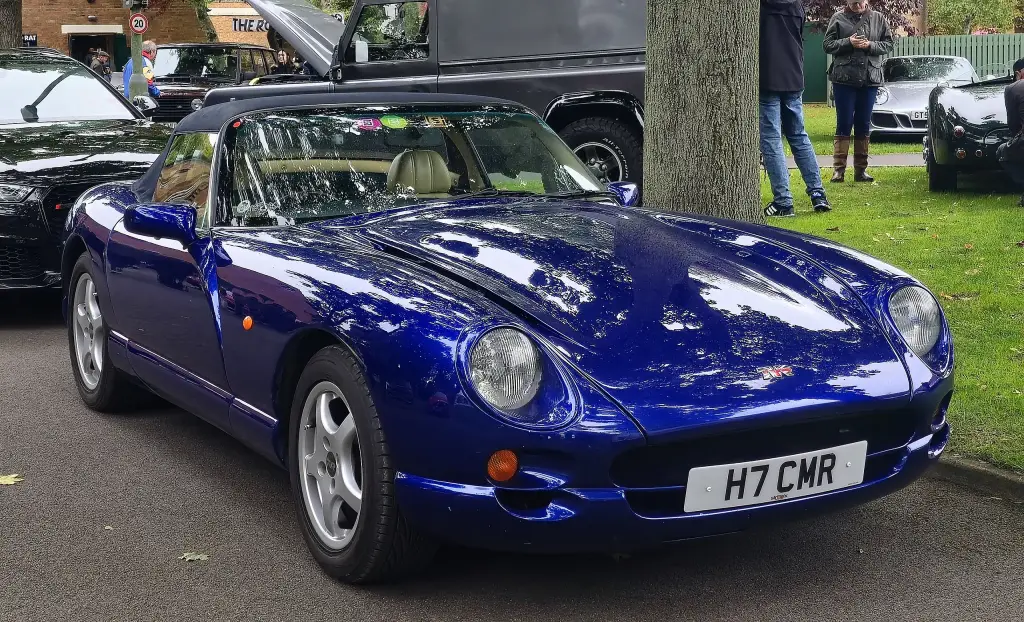
The TVR Chimaera was the touring member of the family. Shown at the 1992 Earl’s Court Motor Show, it shared the Griffith’s backbone chassis and Rover V8 engines but was longer, more spacious and more softly sprung.
TVR Chimaera at a glance
| Maker | TVR, Blackpool |
|---|---|
| Production | 1992–2003 |
| First shown | 1992 Earl’s Court Motor Show |
| Layout | two-seat open roadster |
| Chassis | backbone, shared with the Griffith |
| Engines | Rover V8 derivatives from 3.9 to 5.0 litres |
| Suspension | independent double wishbones, coil-over gas dampers, anti-roll bars |
| Ground clearance | about 130 mm |
| Front brakes | 239 mm discs, 260 mm ventilated on five-litre cars |
| Steering | rack and pinion, 2.2 turns assisted or 2.5 unassisted |
| Successor | Tamora, from 2002 |
Based on one source: the English Wikipedia article on the TVR Chimaera.
History of the TVR Chimaera
The Chimaera takes its name from Chimera, the creature of Greek myth assembled from parts of several animals. It was first shown at the 1992 Earl’s Court Motor Show as an open-top roadster using the same backbone chassis and Rover V8 derivatives as the TVR Griffith. TVR intended it as the long-distance tourer of the range, so it was longer and more spacious than its sister car, with slightly softer suspension.
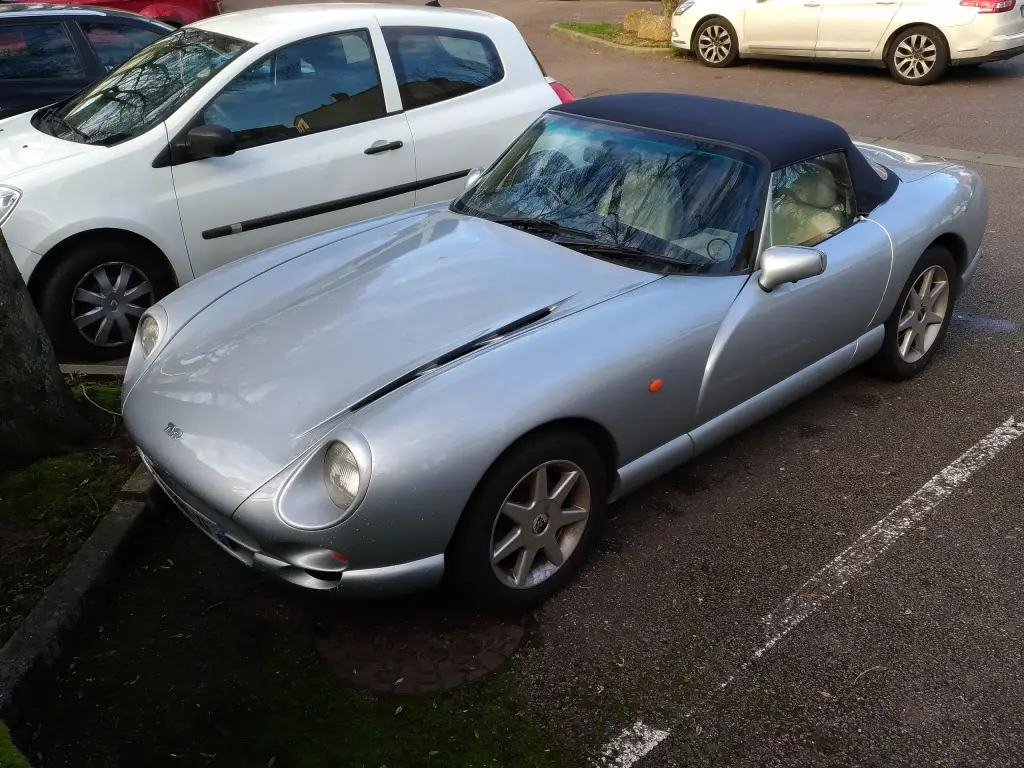
All engines were based on the 3.9-litre Rover V8, with capacity increasing on later models. Suspension was independent all round with unequal-length double wishbones and coil-over gas dampers assisted by anti-roll bars, and ground clearance was about 130 mm. Brakes were discs all round, servo assisted with a front/rear split dual circuit and a cable handbrake: 239 mm at the front on smaller-engined cars and 260 mm ventilated on five-litre models, with 253 mm or 273 mm at the rear. Power steering was optional and worked through rack and pinion with an adjustable column, 2.2 turns lock to lock when assisted and 2.5 without. Options included air conditioning, full leather, heated seats, a six-CD autochanger, wool carpets and the seven-spoke Griffith 500 wheels, standard on the five-litre car.
The Chimaera was meant to replace the Griffith, but demand for both was strong enough for TVR to keep them in parallel. A Chimaera 500 joined the range in 1994, bringing the BorgWarner T5 gearbox in place of the Rover LT77, along with a new alternator, power steering and a single Vee belt. The 4.3-litre option gave way to a 4.0-litre high-compression unit. The 1996 update brought a rear bumper and boot lid shared with the Cerbera, push-button doors with buttons under the mirrors, a horizontal bar front grille instead of mesh and a BTR differential in place of the GKN unit. A 4.5-litre model arrived in 1997 with a stroked Rover V8, because the intended AJP8 was not ready in time; the rear lights changed in 1998, when the 4.0-litre base model was dropped. A 2001 facelift added Griffith headlights and Cerbera seats, and the Tamora succeeded the Chimaera in 2002.
Design and features
- Rover V8 power: engines based on the 3.9-litre unit, up to 5.0 litres.
- Touring bias: longer, roomier and softer than the Griffith.
- Well-equipped cabin: leather, air conditioning, heated seats and a CD autochanger on the options list.
- Long life: eleven years of production with steady updates.
TVR Chimaera versions
- 3.9 and 4.0: the original and later base engines.
- 4.3: an early option, replaced by the 4.0 high-compression unit.
- Chimaera 500 (1994): the five-litre car with the T5 gearbox.
- 4.5 (1997): a stroked Rover V8 while the AJP8 was delayed.
- 2001 facelift: Griffith headlights and Cerbera seats.
The Chimaera was the softer sister of the Griffith and was replaced by the Tamora. More cars are in the TVR collection.
Video: More fun in a TVR Chimaera
Video by Mark Lee on YouTube.
Sources
- TVR Chimaera, English Wikipedia: history, engines, suspension, brakes, updates