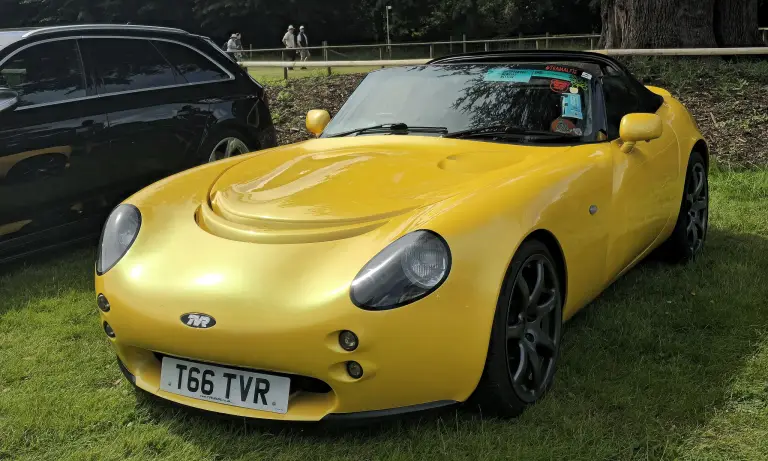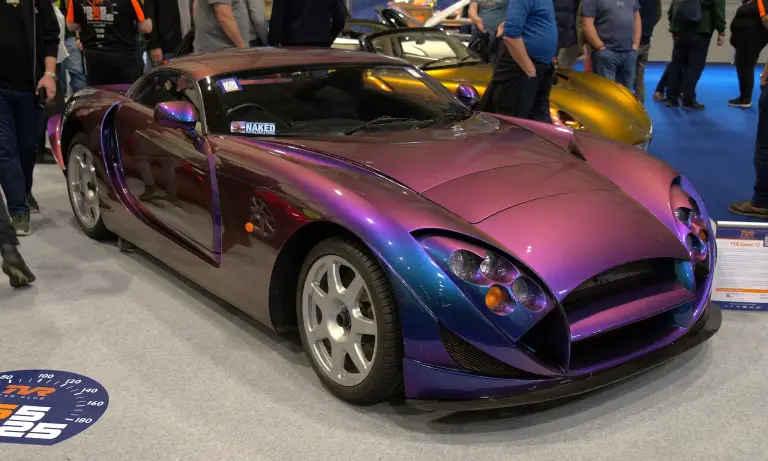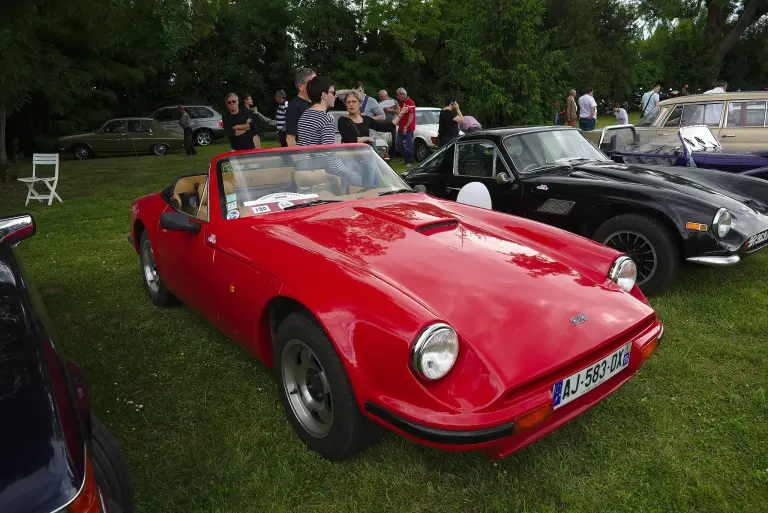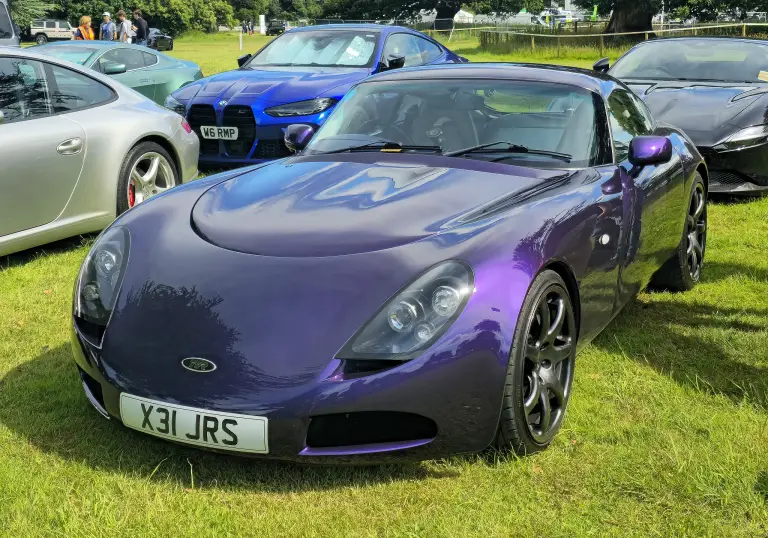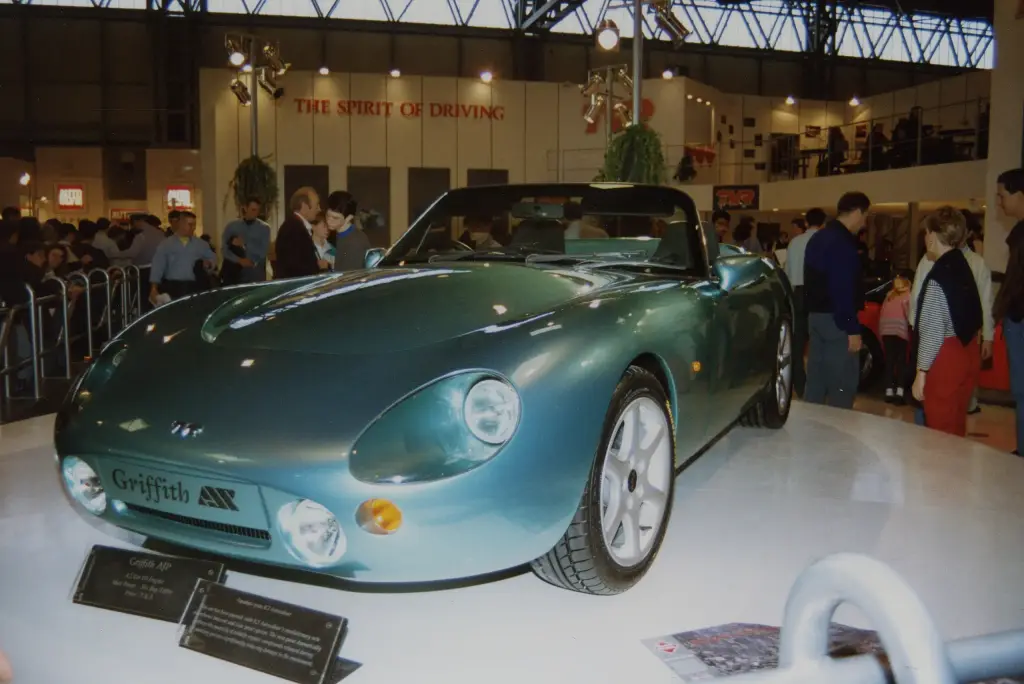
The TVR Griffith of 1990 revived a name last used in the 1960s. A lightweight glass-fibre roadster with Rover V8 power, it was almost mechanically identical to the Chimaera but had its own body and was built in much smaller numbers.
TVR Griffith at a glance
| Maker | TVR, Blackpool |
|---|---|
| Production | 1990–2002 |
| Earlier Griffiths | Griffith 200 (1963–64) and Griffith 400 (1964–67) |
| Body | glass fibre, two seats |
| Weight | 1,060 kg (dry) |
| Engines | 4.0 L Rover V8 with 240 hp; 4.3 L with 280 hp from 1992; 5.0 L with 340 hp from 1993 |
| Engine management | Lucas 14CUX |
| Gearbox | five-speed manual, Rover or TREMEC |
| Brakes | 260 mm ventilated discs front and rear |
| Dimensions | 3,891 mm long, 2,286 mm wheelbase, 57-litre tank |
| Final edition | 100 Special Edition cars, 2000–2002 |
Based on one source: the English Wikipedia article on the TVR Griffith.
History of the TVR Griffith
The name had been used before: the TVR Griffith 200 was produced from 1963 to 1964 and the Griffith 400 from 1964 to 1967. The modern Griffith, like those forerunners, was a lightweight, glass-fibre-bodied two-seater with a V8, weighing 1,060 kg dry. It began with a 4.0-litre 240 hp Rover V8, optionally enlarged to 4.3 litres and 280 hp in 1992 with a further option of big-valve cylinder heads, and from 1993 a TVR-developed 5.0-litre version of the Rover V8 gave 340 hp. All versions used the Lucas Industries 14CUX engine management system and a five-speed manual gearbox from Rover and TREMEC.
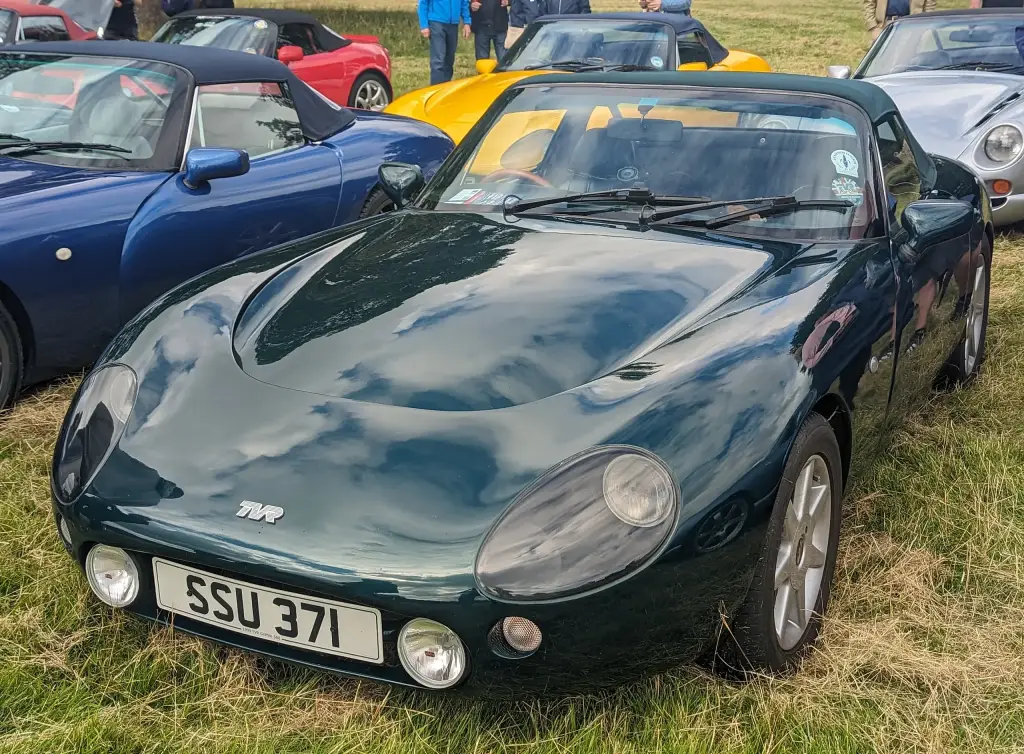
Although the Griffith was almost mechanically identical to its sister car, the Chimaera, it had a different body design and was produced in much smaller numbers. TVR described it as lightweight, high-power and well-balanced. A low-cost Speed Six Griffith proposal never reached production; by the time it was launched alongside the Griffith in 1999 it had become the Tuscan Speed Six. A special edition for the Japanese market, the Blackpool B340, was based on the Griffith 500 with bespoke options, and Japan also received a B275 4.0-litre car with an aluminium basketweave dashboard. The Griffith 500 appeared in the Gran Turismo games.
In 2000 TVR announced that Griffith production would end with a limited run of 100 Special Edition cars. Still very similar to the Griffith 500, the SE used a hybrid interior with the Chimaera dashboard and Cerbera seats, and had different rear lights, door mirrors, higher-powered headlights and clear indicator lenses; some came on 16-inch wheels. Each car carried a numbered plaque in the glove box and a Special Edition badge on the boot, plus a signature under the boot carpet. The SEs were built between 2000 and 2002, the last being registered in 2003. A second-generation Griffith was revealed in September 2017 with design work by Gordon Murray and a planned run of 500 Launch Edition cars at £89,995, but it never entered production. Owners still hold an annual gathering called “The Griff Growl”.
Design and features
- Light weight: 1,060 kg dry in a glass-fibre body.
- Rover V8 range: 4.0, 4.3 and 5.0 litres, up to 340 hp.
- Sharp focus: a smaller, more sporting sister to the Chimaera.
- Special Edition: 100 cars closing the run in 2000–2002.
TVR Griffith versions
- 4.0 (1990 onwards): 240 hp.
- 4.3 (1992): 280 hp, with optional big-valve heads.
- Griffith 500 (1993): the 5.0-litre, 340 hp car.
- Blackpool B340: a Japanese-market special edition.
- Special Edition (2000–02): 100 cars with a hybrid interior.
The Griffith shared its chassis and engines with the Chimaera, and its name dates back to the original Grantura-based Griffith. The Tuscan Speed Six began as a Griffith proposal. More cars are in the TVR collection.
Video: TVR Griffith 500 Drive
Video by Kieran D on YouTube.
Sources
- TVR Griffith, English Wikipedia: engines, dimensions, special editions, production