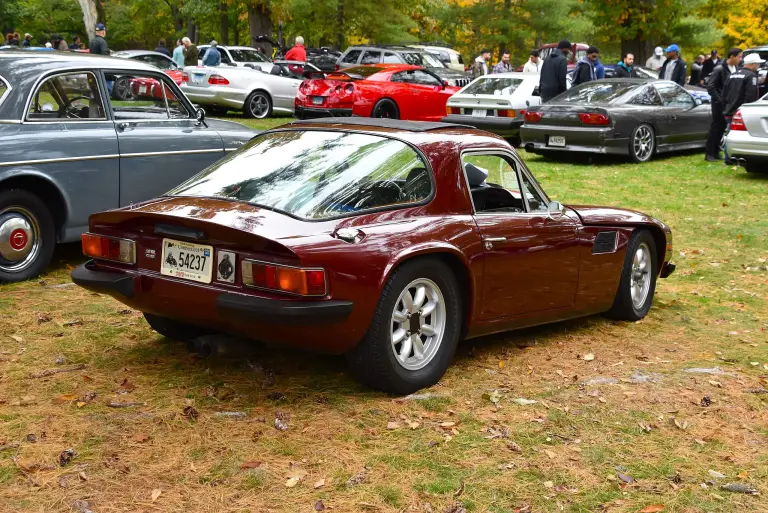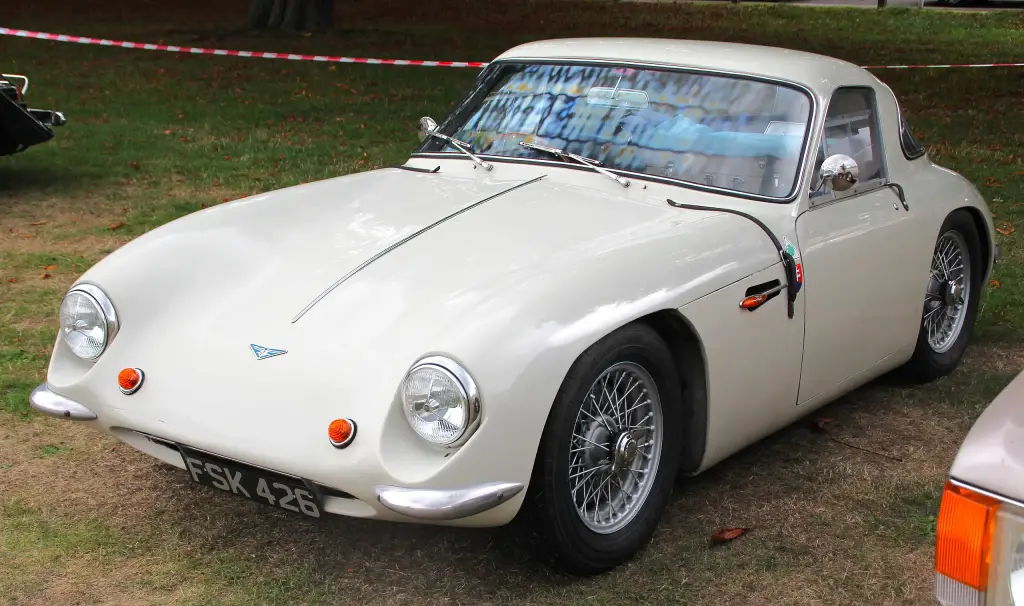
The TVR Grantura was the first production model in a long line of TVR cars. It debuted in 1958 and was developed through the Mark I to Mark IV and the 1800S before the last examples were made in September 1967.
TVR Grantura at a glance
| Maker | TVR, Blackpool |
|---|---|
| Production | 1958–1967 |
| Body | glass-reinforced plastic over a tubular steel backbone chassis |
| Suspension | VW Beetle-based at first, later coil-sprung independent |
| Parts bin | Austin-Healey brakes, VW or Triumph suspension, BMC axles |
| Engines | Ford, Coventry Climax, MGA and BMC B-series units |
| Mark I built | about 100, 1958–1960 |
| Mark II/IIa built | about 400 |
| Mark III, 1800S and IV built | about 300 |
| Replaced by | TVR Vixen, 1967 |
Based on one source: the English Wikipedia article on the TVR Grantura.
History of the TVR Grantura
Granturas were hand-built at the TVR factory in Blackpool and could be bought in kit form. The glass-fibre bodyshell used a variety of proprietary components: the bonnet was front hinged, there was no opening at the rear, and the boot had to be reached from inside the car, with the spare wheel removed through the front doors. Buyers could choose from a range of engines, including side-valve and overhead-valve Fords, a Coventry Climax unit, the MGA engine and finally the 1,798 cc BMC B-series.
The Mark I used a fibreglass body on a tubular steel backbone chassis with Volkswagen Beetle-based suspension front and rear. At the back the VW suspension was paired with an inboard MGA differential fastened to the chassis, driving each rear hub through short shafts with Hardy-Spicer joints, with inboard Austin-Healey 100M drum brakes. Independent rear suspension of this kind was advanced at a time when most rivals used a solid axle. The car was designed around a 1,098 cc Coventry Climax FWA engine, but 1,172 cc Ford side-valve to 1,600 cc MGA units were fitted. About 100 Mark Is were built between 1958 and 1960.
The Mark II had MGA engines as standard, with the 1,622 cc MGA Mark II or a 1,340 cc Ford in the Mark IIa; the expensive 1,216 cc Coventry Climax FWA from the Lotus Elite was also available. The IIa brought front disc brakes and rack-and-pinion steering as standard. The Motor tested a 1,600 cc car in 1961 and recorded 98.4 mph, 0–60 mph in twelve seconds and 32.8 mpg, at £1,298 including taxes. Some 400 Mark II and IIa cars were built. The Mark III introduced a longer, stiffer chassis designed by John Thurner with coil-sprung independent suspension, a chassis that would underpin TVRs up to the 2500M of 1972, and a new front end with a higher grille. BMC B-series engines of 1,622 or 1,798 cc were used, the larger unit becoming standard around September 1963. In 1965 came the 1800S with a squared-off “Manx tail” and Ford Cortina rear lights, on a chassis modified to make room for the V8 of the new Griffith. Under Martin Lilley’s ownership the 1800S returned in 1966 as the Mark III 1800S, followed by the Mk IV with a longer wheelbase, more luxurious trim and a larger fuel tank. About 300 cars of this group were built before the Vixen replaced the Grantura in 1967.
Design and features
- TVR’s first production car: the model that established the marque.
- Choice of engines: Ford, Coventry Climax, MGA and BMC units.
- Kit form: buyers could assemble the car themselves.
- Advanced rear suspension: independent inboard brakes on the Mark I.
TVR Grantura versions
- Mark I (1958–60): VW-based suspension, about 100 built.
- Mark II and IIa (to 1963): MGA engines, front discs and rack-and-pinion on the IIa.
- Mark III and Mark III 1800: new Thurner chassis
- 1800S (1965): the squared-off Manx tail.
- Mk IV: longer wheelbase and more luxurious trim.
The Grantura was replaced by the Vixen, and its chassis was modified to take the V8 of the original Griffith. More cars are in the TVR collection.
Video: TVR Grantura Oldtimer Grand Prix Marathon
Video by Revival Race Shop on YouTube.
Sources
- TVR Grantura, English Wikipedia: marks, chassis, engines, production numbers, road test