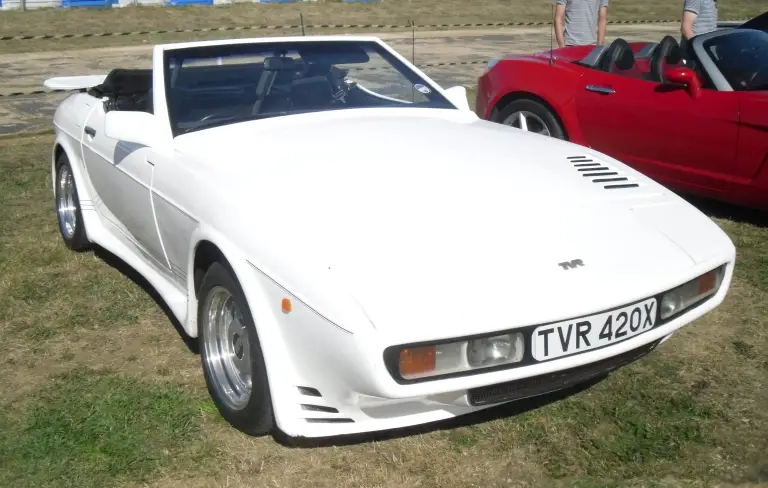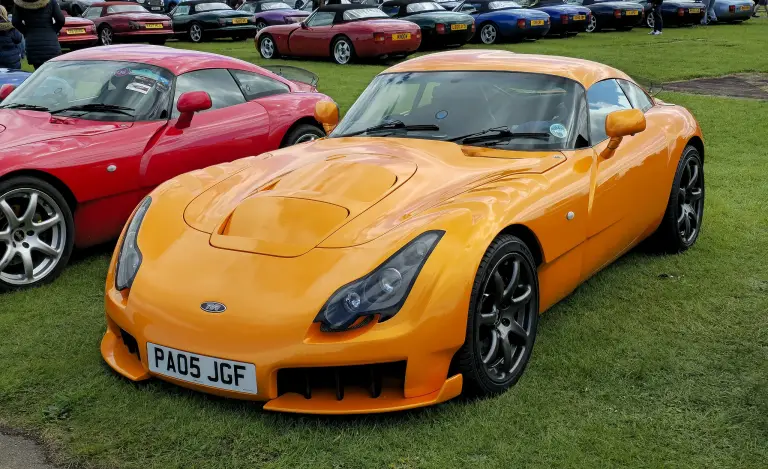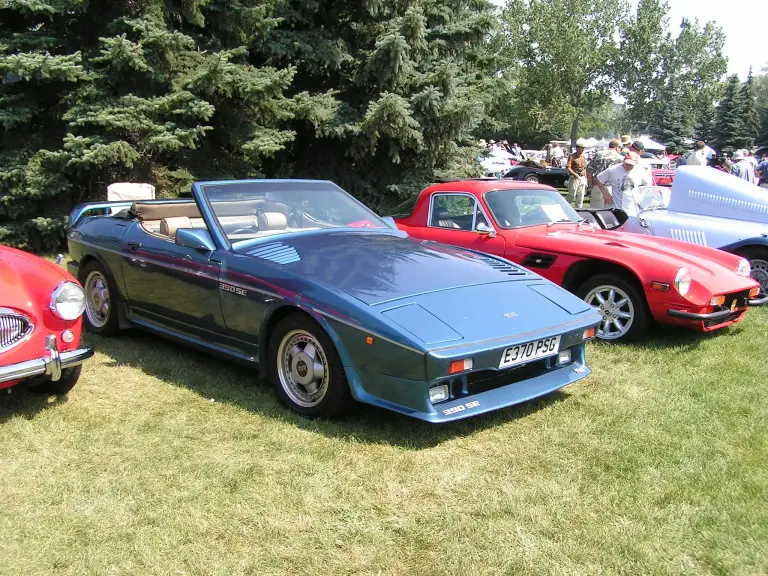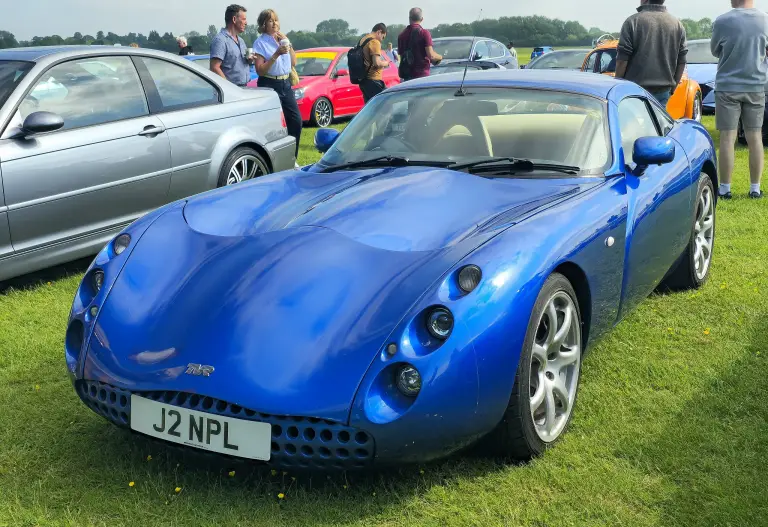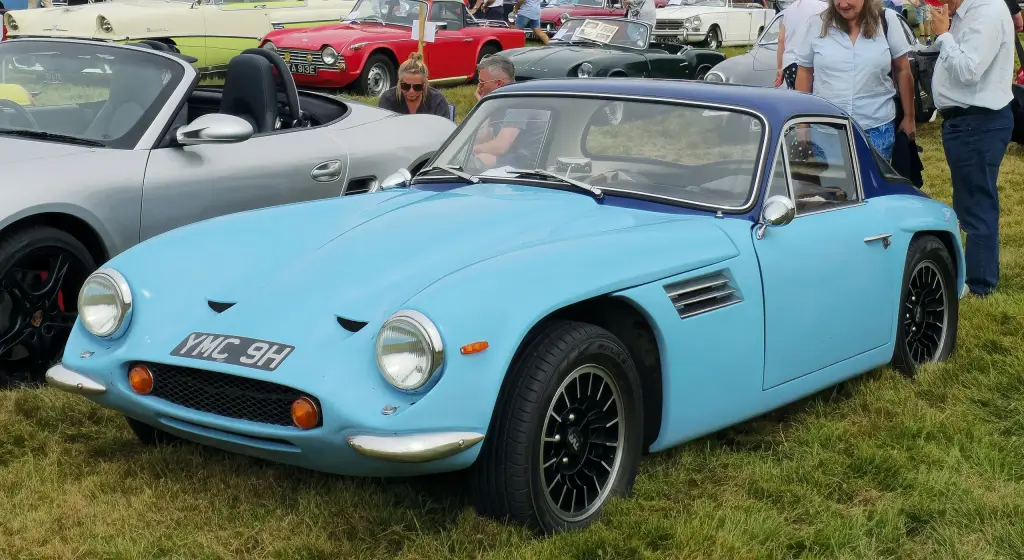
The TVR Vixen succeeded the MGB-engined Grantura 1800S in 1967, switching to Ford power and running until 1973. It was hand-built in Blackpool, significantly lighter than mainstream rivals such as the MG MGB GT, and it also became the basis for the V6 and V8 TVR Tuscan.
TVR Vixen at a glance
| Maker | TVR, Blackpool |
|---|---|
| Production | 1967–1973 |
| Body | glass fibre on a tubular-frame chassis |
| Chassis | the same as the Mk4 1800S |
| Suspension | double wishbones at both ends |
| Brakes | discs at the front, drums at the rear |
| Series 1 engine | 1,599 cc Ford Kent, 88 bhp |
| S2 wheelbase | 90 inches |
| Series 1 built | 117 |
| Series 2 built | 438 |
| Series 3 built | 165 |
| Series 4 built | 23 |
Based on one source: the English Wikipedia article on the TVR Vixen.
History of the TVR Vixen
The Vixen Series 1 arrived in 1967 as an evolution of the discontinued 1800S, using the same chassis but with a significant change of engine: the 1,599 cc Ford Kent unit from the Cortina GT, developing 88 bhp. The switch was forced by TVR’s difficulty in getting MG engines delivered, and it also helped lower the price; to use up remaining stock, the first twelve Vixens still had the MGB engine. The bodywork was revised with a broad, flat air intake scoop on the bonnet and round Cortina Mark I tail lamps. 117 Series 1 cars were built.
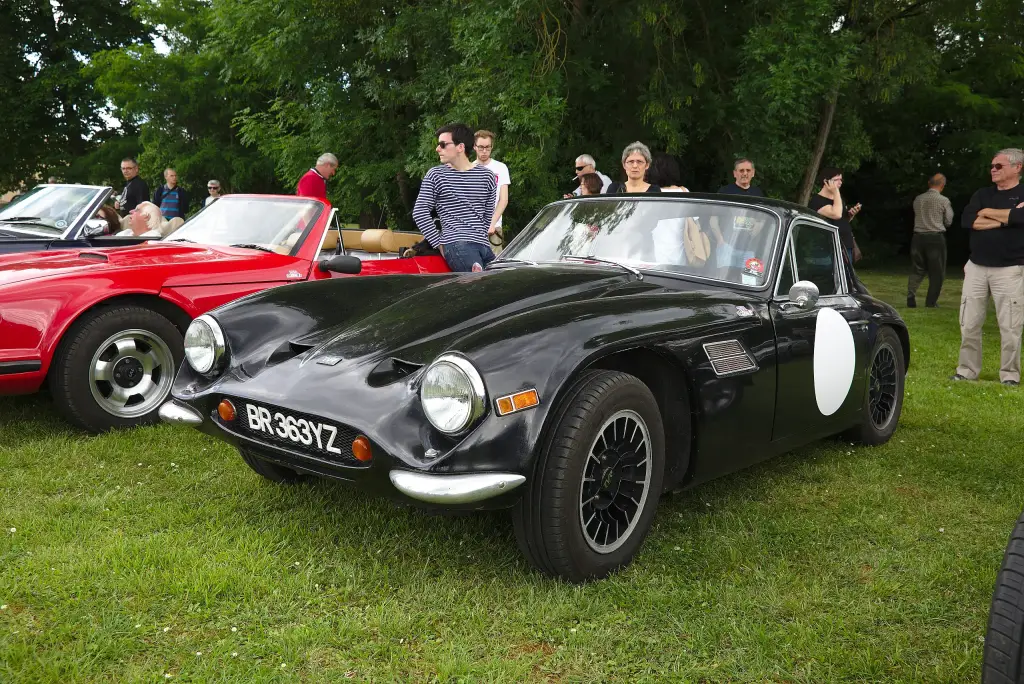
The 1968 Series 2 moved to the longer 90-inch wheelbase chassis introduced on the Tuscan V8, which TVR had now standardised to answer complaints about difficult access. The bonnet was restyled again, early cars with a prominent central bulge and later ones with twin intake ducts at the front corners, and the tail lamps changed from the round Cortina Mark I style to the wraparound Mark II type. The body was now bolted rather than bonded to the chassis, so it could be removed for repairs, and the interior was improved with a leather-covered steering wheel mounted much lower than before. The body was thicker and panel fit better, in a further attempt to raise perceived quality. In December 1968 TVR added the S.2 Sport and S.2 Super Sports, with Speedwell-modified engines using a balanced bottom end, a ported cylinder head and two twin-choke Weber carburettors, producing 100 and 115 bhp. Both came with seat belts and a leather steering wheel and were designated S.2.S. Series 2 production reached 438.
The Series 3 brought detail improvements: heat extraction vents behind the front wheels decorated with “Aeroflow” grilles borrowed from the C-pillars of the Ford Zodiac Mark IV, a Ford four-cylinder engine tuned as in the Ford Capri to 92 bhp, and cast alloy wheels instead of wire wheels as standard. 165 were built. The Series 4 of 1972 and 1973 was an interim model using the M-series chassis under the Vixen body, with no other significant mechanical or cosmetic changes: 22 cars in 1972 and one in 1973.
Two further models shared the Vixen body. The 1300 of late 1971 was an attempt at an economy sports car, using the 1,296 cc Standard SC engine from the Triumph Spitfire with 63 bhp, a top speed of barely 90 mph and only fifteen built, mostly in 1972; the last six used the M-series chassis and the very last also had M-series bodywork. The 2500, sold as the Vixen 2500 in the United States and not to be confused with the later 2500M, was built in 1971 and 1972 with Triumph’s 2.5-litre inline six, already certified for US emissions in 105 bhp form; 385 were built, the final 96 on the M-series chassis.
Design and features
- Ford power: the 1.6-litre Kent engine replaced TVR’s troublesome MG supply.
- Light weight: quicker and more economical than an MGB GT.
- Bolted body: from the Series 2 the shell could be lifted off for repairs.
- Speedwell versions: the S.2 Sport and Super Sports with 100 and 115 bhp.
TVR Vixen versions
- Series 1 (1967): 117 cars with the Ford Kent engine.
- Series 2 (1968): longer wheelbase, bolted body, 438 built.
- S.2.S Sport and Super Sports: Speedwell-tuned engines.
- Series 3: 92 bhp and alloy wheels, 165 built.
- Series 4 (1972–73): M-series chassis, 23 built.
- 1300 and 2500: Triumph-engined models, 15 and 385 built.
The Vixen replaced the Grantura, became the basis of the Tuscan, and was itself replaced by the M series. More cars are in the TVR collection.
Video: TVR Vixen vs Porsche 928 during Eifelrennen 2012 part 2
Video by Classictvr on YouTube.
Sources
- TVR Vixen, English Wikipedia: series, engines, bodies, production numbers