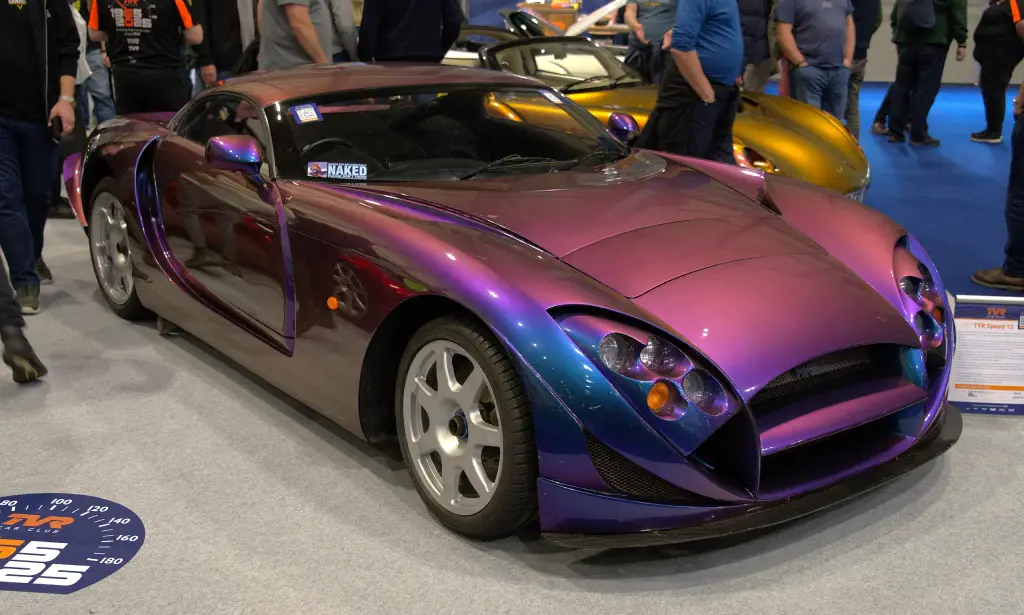
The TVR Cerbera Speed 12, first shown as the Project 7/12, was TVR’s attempt at the world’s fastest road car and at a GT1 endurance racer. It was abandoned because the regulations changed and because Peter Wheeler decided that no customer could safely use it.
TVR Cerbera Speed 12 at a glance
| Maker | TVR, Blackpool |
|---|---|
| Designed | 1997 |
| First shown | 1996 Birmingham Motor Show, as Project 7/12 |
| Engine | 7.7 L (7.73 L) V12, essentially two AJP6 sixes on one crankshaft |
| Claimed power | over 800 hp initially; about 960 hp estimated later |
| Engine block | steel, designed by John Ravenscroft |
| Weight | about 1,000 kg |
| Gearbox | six-speed manual, specially built |
| Intended price | £245,000, the most expensive TVR ever |
| Race class | GT1, later GT2 in the British GT Championship |
| Brakes | ventilated discs, 378 mm front and 273 mm rear |
| Surviving car sold | May 2023, for £601,500 |
Based on one source: the English Wikipedia article on the TVR Cerbera Speed 12.
History of the TVR Cerbera Speed 12
The car appeared at the 1996 Birmingham Motor Show as the TVR Project 7/12 and drew bigger crowds than anything else there. The 7 stood for the 7.7-litre engine, actually 7.73 litres, and the 12 for its cylinder count. TVR claimed more than 800 hp and a top speed beyond the McLaren F1. The first concepts followed FIA GT1 rules, restricted to 660 hp and kept at about 1,000 kg, but the road car was to run without restrictors and with far more power. Its engine was made from two TVR AJP6 straight sixes on a single crankshaft, with a steel block rather than iron or aluminium, designed by John Ravenscroft.
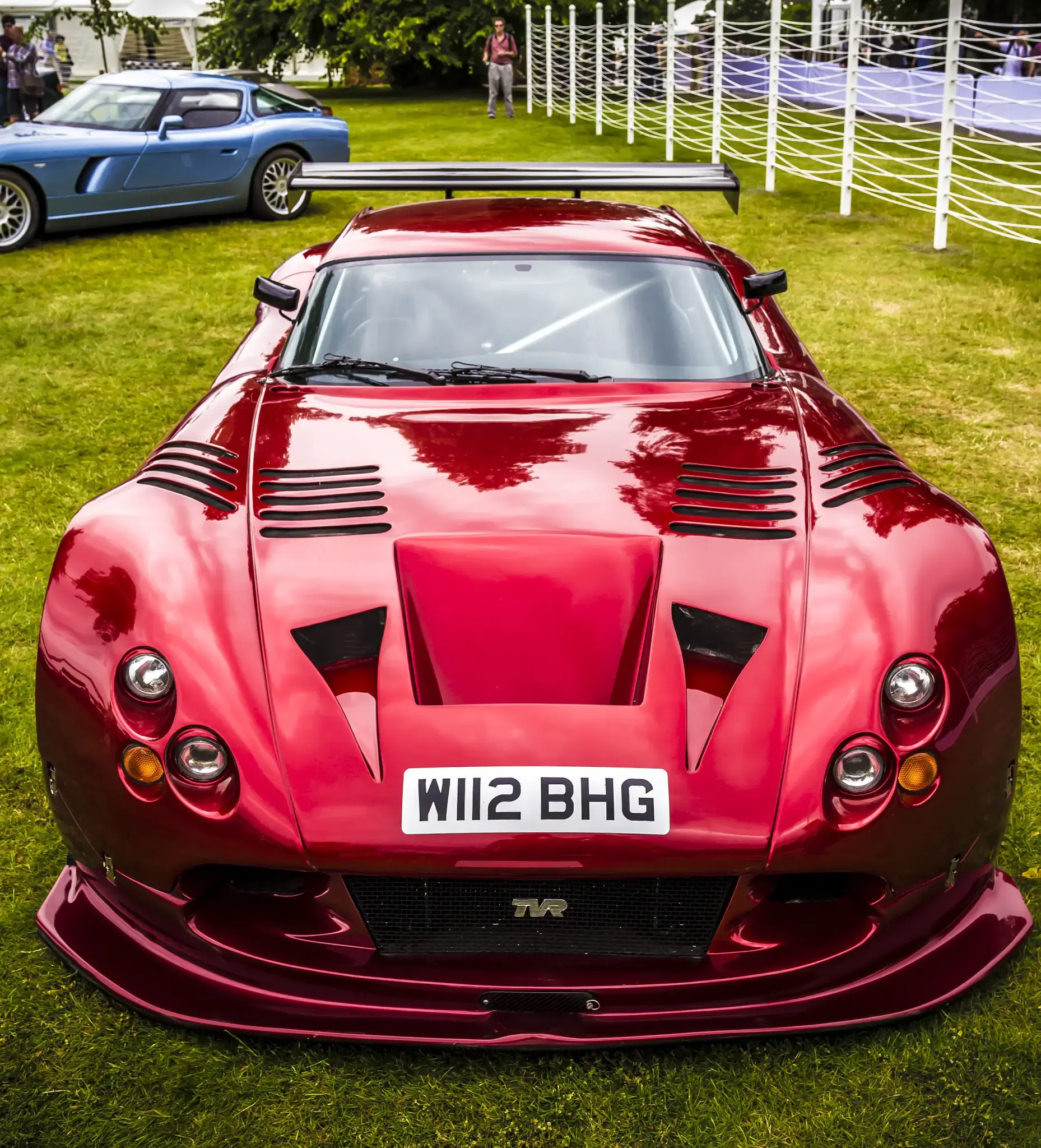
By 1998 the car had been renamed the TVR Speed 12, and the racing version, the Speed 12 GTS, was being finished for the GT1 class. TVR wanted to race at Le Mans but never did; the GTS did compete in a few rounds of the 1998 British GT Championship before rule changes and the cost of purpose-built racers such as the Porsche 911 GT1, Nissan R390 and Toyota GT-One made the class obsolete. Rather than waste the work, TVR began developing the road car.
Completed in 2000 and renamed the Cerbera Speed 12, it still had no officially measured power output. The original engine, quoted at 800 hp by TVR, was later confirmed at around 840 hp, and the car weighed 1,000 kg. TVR talked of “over 240 miles per hour” and priced it at £245,000, the most expensive TVR in history, taking a good number of orders and deposits. When TVR tried to measure the power on a dyno rated at 1,000 hp, the test broke the dyno’s input shaft; testing each bank separately gave 480 hp, suggesting about 960 hp in total. Peter Wheeler drove a finished prototype home and concluded the car was unusable on the road, simply too powerful, so production was cancelled and the deposits returned. The remaining prototypes were cannibalised for the race cars until 2003, when TVR rebuilt one, registered W112 BHG, using a shell from a GT racer. Buyers had to be vetted by Wheeler in person; the car appeared in Evo in May 2005, spent time at the Lakeland Motor Museum and sold at auction on 20 May 2023 for £601,500.
Design and features
- 7.7-litre V12: two AJP6 sixes on one crankshaft, with a steel block.
- Road-car ambitions: TVR aimed beyond the McLaren F1’s top speed.
- Racing career: the Speed 12 GTS raced in the 1998 British GT Championship.
- Estimated 960 hp: measured bank by bank after the dyno broke.
TVR Cerbera Speed 12 versions
- Project 7/12 (1996): the show concept with GT1 restrictions.
- Speed 12 GTS (1998): the racing version for GT1, later GT2.
- Cerbera Speed 12 (2000): the completed road car.
- W112 BHG (2003): the single rebuilt car sold to a vetted owner.
The Speed 12 was based on the Cerbera, and the same V12 thinking sits alongside the Tuscan Speed Six. More cars are in the TVR collection.
Video: TVR Cerbera Speed 12 BNG 2012
Video by Nick Fisher on YouTube.
Sources
- TVR Cerbera Speed 12, English Wikipedia: development, racing, power estimates, auction