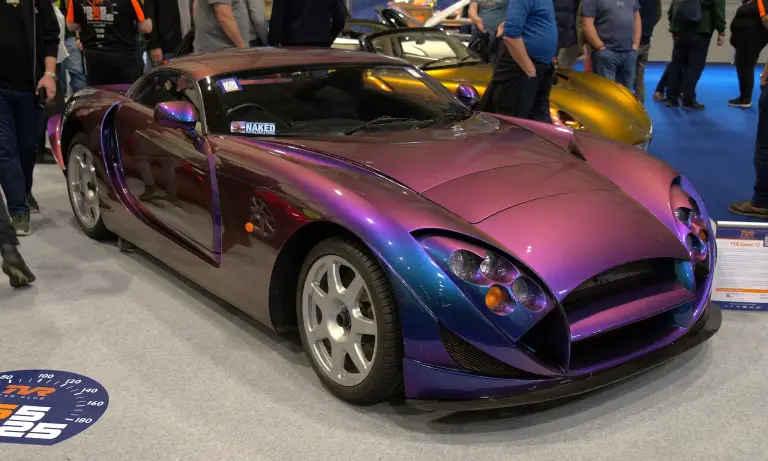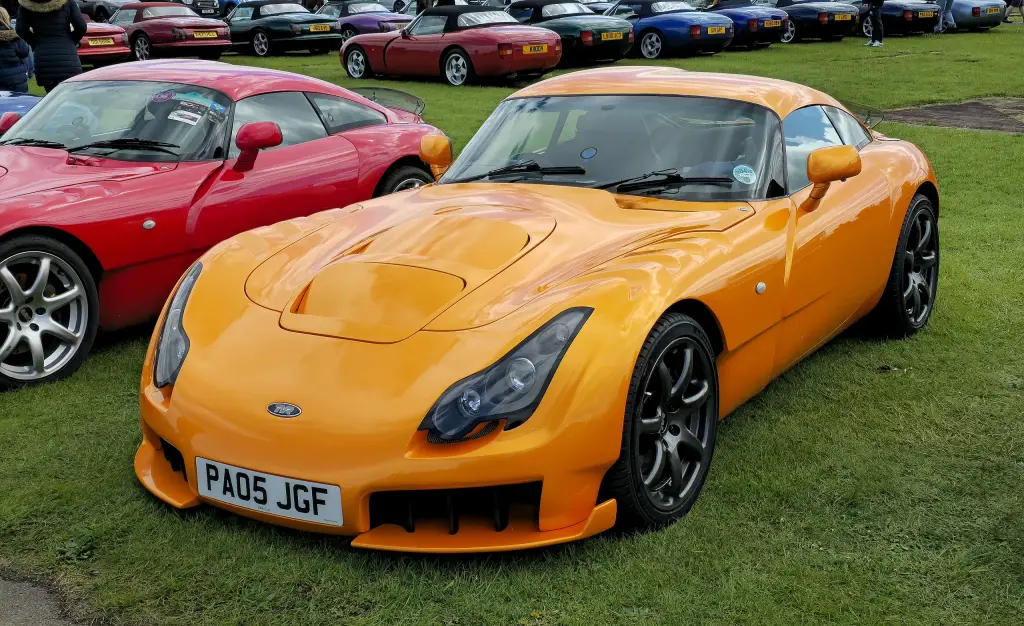
The TVR Sagaris was the last car of the Peter Wheeler era. Based on the T350, it was designed with endurance racing in mind: its many vents and intake openings allow it to run for long periods on a circuit without modification for cooling.
TVR Sagaris at a glance
| Maker | TVR, Blackpool |
|---|---|
| Production | 2005–2006 |
| Debut | MPH03 Auto Show, 2003; pre-production car at Birmingham, 2004 |
| Based on | TVR T350 |
| Engine | 4.0 L TVR Speed Six, 3,996 cc |
| Power | 406 bhp (303 kW) at 7,000 rpm |
| Torque | 349 lb·ft (473 N·m) at 5,000 rpm |
| Gearbox | five-speed manual |
| Brakes | 322 mm ventilated front, 298 mm ventilated rear |
| Weight | 1,075 kg |
| 0–60 mph | 3.7 seconds |
| Top speed | 185 mph (298 km/h) |
| Designer | Graham Browne |
Based on one source: the English Wikipedia article on the TVR Sagaris.
History of the TVR Sagaris
The Sagaris made its debut at the MPH03 Auto Show in 2003, the pre-production car appeared at the 2004 Birmingham Motor Show, and the production model went on sale at TVR dealers in 2005. It was based on the T350 but designed for endurance racing, which explains the multitude of air vents and intake openings in the bodywork. The production car differed from the show cars in small ways: the vents on the wings were not cut out, the mirrors were different, and the fuel filler position and bonnet hinges changed.
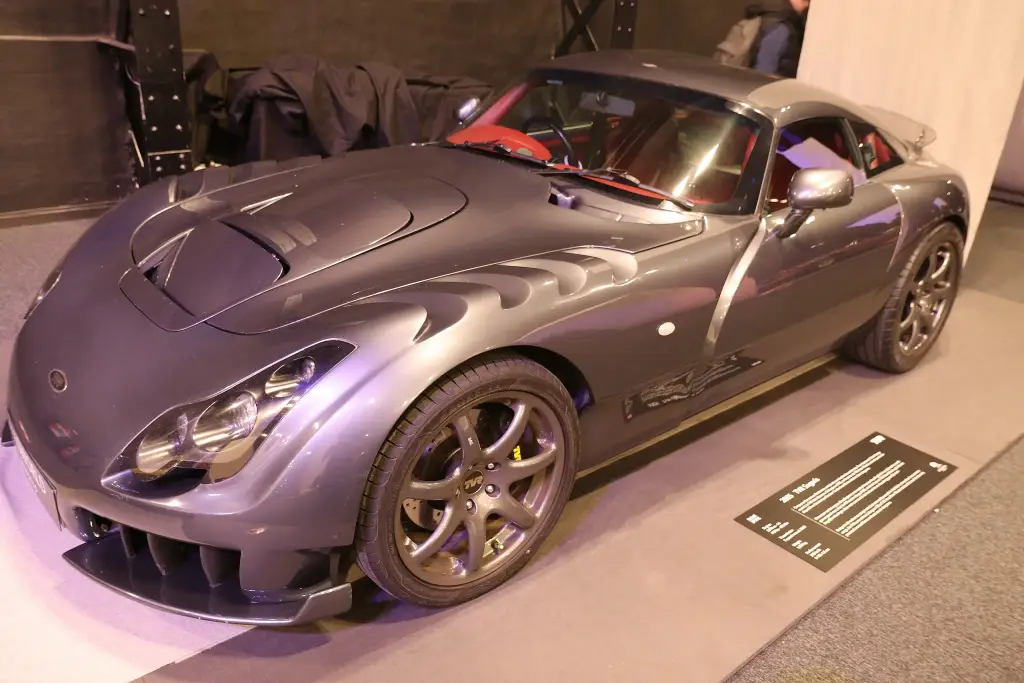
The name comes from the sagaris, the Greek name for a lightweight Scythian battle-axe feared for penetrating armour. The car was designed by Graham Browne. Like all TVRs of the 1990s and early 2000s, it ignored the European Union guideline calling for ABS and at least front airbags, because Peter Wheeler believed such devices promoted overconfidence and could endanger a driver in a rollover, something TVR engineered its cars to resist. It also had no traction control or stability control. Malcolm Thorne of Classic & Sports Car found it “far less intimidating than you might expect” but admitted that in the wet it sent “a prickle of trepidation” down his spine, and still called it stunning.
The chief engineer on the project, Daniel Boardman, was determined to fix the quality problems TVR was known for, such as water leaking in, carpets coming unstuck and awkward handling. The suspension was designed to eliminate bump-steer, the dampers were tuned with input from Bilstein and Multimatic, the bonnet was redesigned to work as well as a conventional steel one, and the door seals were carefully checked. Jeremy Clarkson called the result “the best TVR ever made”. A Sagaris 2 prototype followed in 2008 with a revised rear, exhaust and interior, but the company’s finances stopped it. After TVR’s bankruptcy, Grex Automotive acquired the tooling and in 2018 offered the Sagaris as a kit car, with only ten planned and the engine and gearbox left to the buyer.
Design and features
- Track cooling: vents and intakes designed for endurance racing with no modifications.
- Speed Six power: 406 bhp from 4.0 litres, 0–60 mph in 3.7 seconds.
- No driver aids: no ABS, airbags, traction or stability control.
- Build quality push: a deliberate effort to cure TVR’s known faults.
TVR Sagaris versions
- Pre-production show cars (2003–04): cut-out wing vents and different details.
- Production Sagaris (2005–06): the sale version.
- Sagaris 2 (2008): a prototype with a revised rear, exhaust and interior.
- Grex kit car (2018): ten planned cars using the original tooling.
The Sagaris was developed from the T350 and uses the same Speed Six engine as the Tuscan. More cars are in the TVR collection.
Video: TVR Sagaris – Just Don’t Crash | Car Review | Top Gear
Video by Top Gear on YouTube.
Sources
- TVR Sagaris, English Wikipedia: development, specifications, quality work, racing