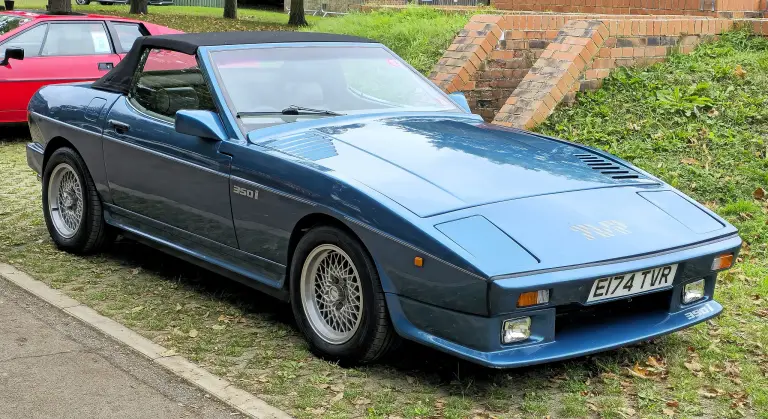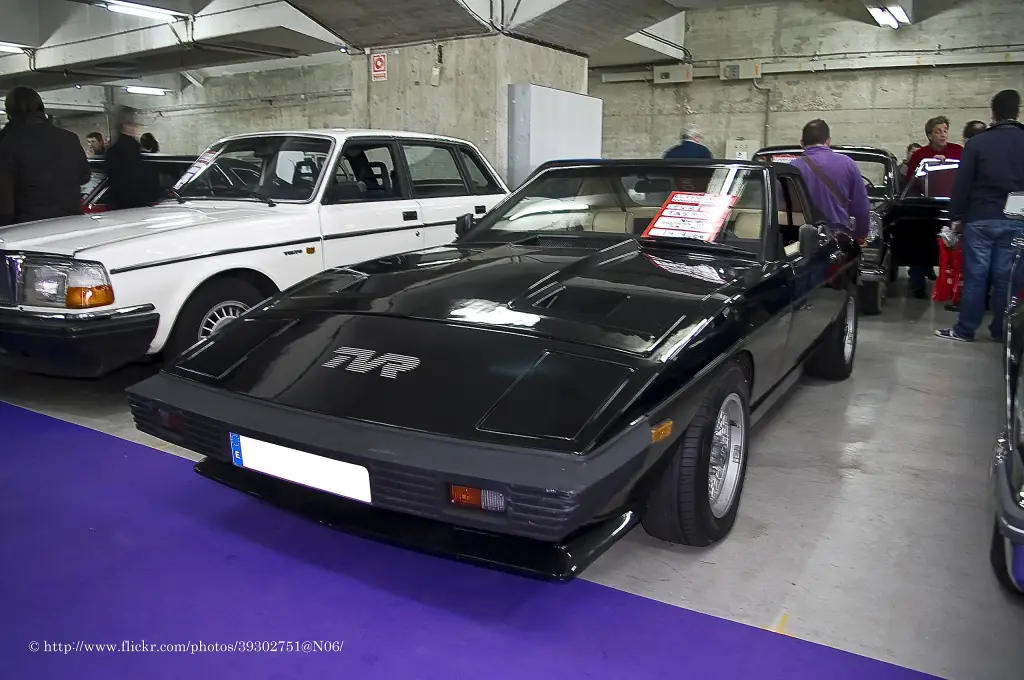
The TVR Tasmin, later known as the 280i, was the first of TVR’s wedge-shaped models and the basis of its range for the rest of the 1980s. It was designed by Oliver Winterbottom for the coachwork and Ian Jones for the chassis, and built from 1980 to 1987.
TVR Tasmin at a glance
| Maker | TVR, Blackpool |
|---|---|
| Production | 1980–1987 |
| Designers | Oliver Winterbottom (body), Ian Jones (chassis) |
| Body styles | two-seat coupé, 2+2 coupé and two-seat convertible |
| Engine | 2,792 cc Ford Cologne V6 with Bosch fuel injection |
| Power | 160 bhp (Series 1), 150 bhp (Series II) |
| Torque | 162 lb·ft (220 N·m) |
| Gearboxes | four- and five-speed Ford manuals, three-speed Ford automatic |
| Suspension | Ford Cortina front, TVR trailing arms at the rear |
| Weight | 1,074 kg |
| 0–60 mph | 8.0 seconds, 8.2 with the automatic |
| Top speed | 130 mph (Series 1), 128 mph |
| V6 cars built | 1,167 |
Based on one source: the English Wikipedia article on the TVR Tasmin.
History of the TVR Tasmin
Like every TVR, the Tasmin used a tubular spaceframe steel chassis, powder coated for corrosion resistance, but much of the running gear came from Ford. The suspension and steering were from the Ford Cortina, with TVR-engineered trailing arms at the rear similar to designs used on early Lotus models, and gearboxes came from the Cortina, Granada and Sierra. Brakes were discs all round with Granada units at the front, and the differential and rear brakes were taken from the Jaguar XJ-S.
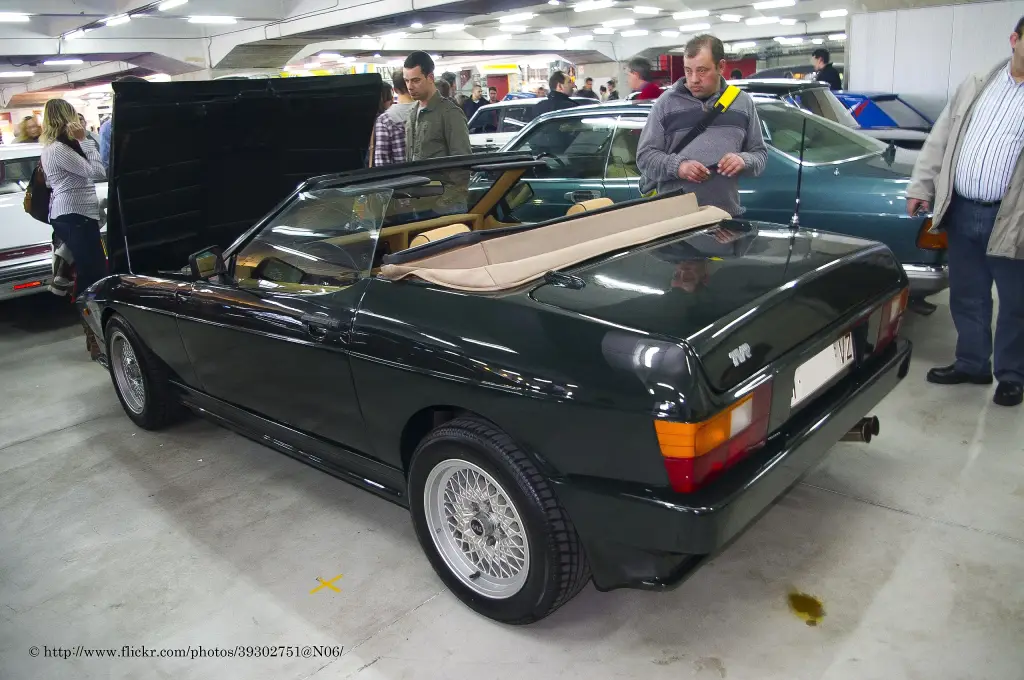
The parts-bin approach ran right through the car. Ford Cortina external door handles, Triumph TR7 or Austin Metro interior handles, Lucas front lamps, rear lamp clusters from the Ford Capri, Rover SD1 or Renault Fuego, Hillman Imp boot hinges, Jaguar ashtrays or later the DeLorean DMC-12 item, a radiator from the Ford Granada Mk2 or Range Rover, and the Lotus Esprit handbrake mechanism all found their way in. The bonded windscreen hid the aerial in the rear screen heater element, and the original wheels were made for the Tasmin by Telcast of Telford. The engine was Ford’s 2.8-litre Cologne V6 with Bosch fuel injection, producing 160 bhp, and the optional automatic made the Tasmin the first TVR offered with one.
The Cologne V6 was already certified for US sales, so the Tasmin took TVR back to America after a six-year break. It was also the last TVR exported there, the final car being a Series II 280i brought over in 1987; the withdrawal is attributed to a deteriorating relationship with the import agents, warranty problems and liability insurance premiums rising from $160,000 to over $1 million. A Series II appeared in 1981 with a front suspension redesign that addressed bump-steer, and a restyled bodyshell that added three inches behind the rear axle and tilted the previously vertical glass tail panel, coinciding with the launch of the convertible. In 1984 the Tasmin name was dropped in favour of TVR 280i, although the factory kept using it and early 350i cars were still called Tasmin 350i. Production had sunk to 121 cars in 1982 but reached 472 a year by 1985, and 1,167 V6 cars were built in total.
A cheaper Tasmin 200 arrived in late 1981 with a 2.0-litre Ford Pinto engine of about 100 bhp. It kept the Series I body and cost under £10,000, but it was not a success: only 16 coupes and 45 convertibles were made.
Design and features
- The first wedge: Oliver Winterbottom’s shape set the tone for the 1980s TVRs.
- Ford running gear: Cortina suspension, steering and gearboxes.
- Three body styles: two-seat and 2+2 coupes and a convertible.
- US return: the Cologne V6 brought TVR back to America after six years.
TVR Tasmin versions
- Tasmin (1980–84): the original name, in coupé and convertible form.
- Series II (1981): revised front suspension and a restyled tail.
- 280i (1984–87): the new name for the same car.
- Tasmin 200 (1981): the 2.0-litre Pinto version, 61 built.
The Tasmin was the starting point for the 350i and the whole wedge line, including the 390SE. More cars are in the TVR collection.
Video: TVR Tasmin plus2
Video by SporttiAuto on YouTube.
Sources
- TVR Tasmin, English Wikipedia: history, engines, components, US market, production