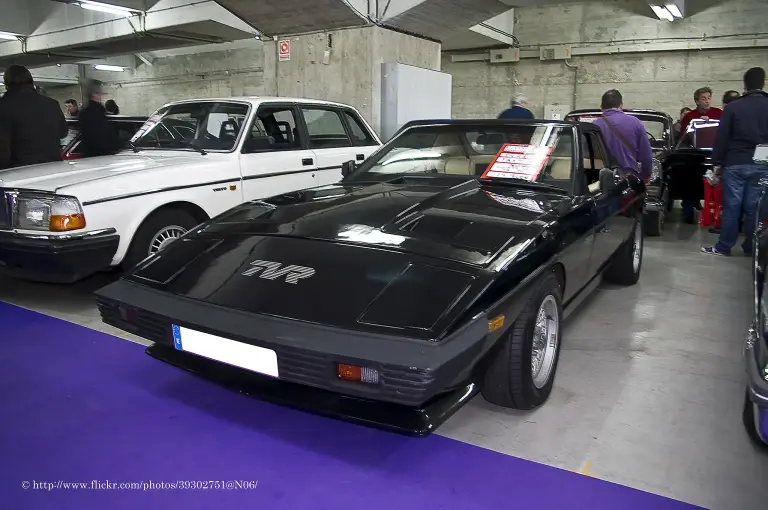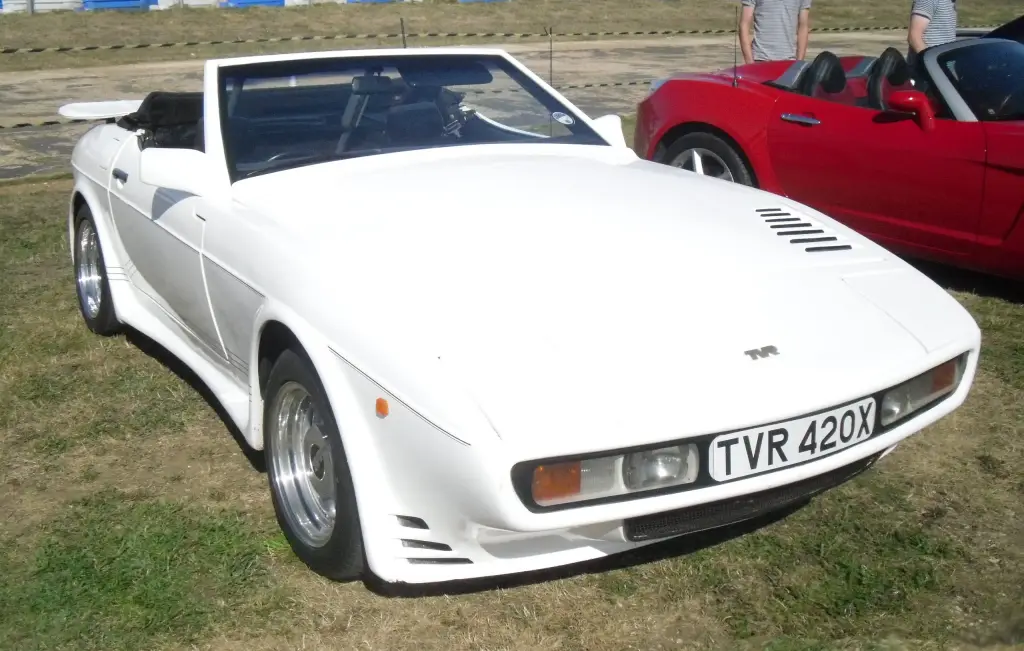
The TVR 420 SEAC is regarded as the ultimate “wedge” TVR and the top of the Tasmin family. Built between 1986 and 1988, it was developed as a racing car by TVR’s competition manager Chris Schirle, and its body used aramid composite in place of plain glass fibre.
TVR 420 SEAC at a glance
| Maker | TVR Engineering, Blackpool |
|---|---|
| Production | 1986–1988 |
| Name | Special Equipment Aramid Composite |
| Engine | 4,228 cc TVR Power Ashik V8 |
| Power | 300 bhp (224 kW) |
| Torque | 290 lb·ft (393 N·m) |
| Gearbox | Rover LT77 five-speed |
| Chassis | tubular spaceframe |
| Body | kevlar; glass fibre and kevlar; or carbon fibre and glass fibre |
| 0–60 mph | 4.7 seconds |
| Top speed | 165 mph (266 km/h) |
| Road cars built | 37 by 1988 |
| Price | twice that of a standard 350i |
Based on one source: the English Wikipedia article on the TVR 420 SEAC.
History of the TVR 420 SEAC
The 420 SEAC was developed as a race car by TVR’s competition manager Chris Schirle, who used his Formula One experience to prepare the Tasmin for competition. The car took pole position in its first three outings at Oulton Park, Donington and Cadwell, and in the 1986/87 season it won 21 of 24 races. At the end of 1987 it was banned on homologation grounds, because TVR had not built the 200 cars the rules required.
SEAC stands for Special Equipment Aramid Composite, and more than 20 per cent of the body was kevlar rather than the glass fibre used on other wedges. That made the car more than 100 kg lighter without losing rigidity, although problems with the finish and stiffness of the kevlar panels meant only the first eight to ten cars had full kevlar bodies; the rest were standard GRP, apart from the last four or five 420 SEACs, which used carbon fibre and glass fibre. SEAC bodies were shorter and wider than the other wedges.
The SEAC differed from the 350i, 390SE and 400SE in more than its body. It had a different chassis with a narrower transmission tunnel, an umbrella-type handbrake under the dashboard, a flat four-gauge dashboard and twin exhaust pipes routed under the rear differential instead of a single pipe above it. The kevlar and the highly tuned Rover V8 made the car extremely quick, but the price was twice that of a standard 350i. By 1988, when the even more powerful 450 SEAC replaced it, 37 road-going 420 SEACs had been built.
Design and features
- Kevlar body: aramid composite saved more than 100 kg over glass fibre.
- Race breeding: 21 wins from 24 races in the 1986/87 season.
- Big spoiler, rounder nose: the easiest way to recognise a SEAC.
- Different cabin: flat four-gauge dash and an umbrella handbrake.
TVR 420 SEAC versions
- Early kevlar cars: the first eight to ten with full kevlar bodies.
- GRP cars: the majority, with standard glass fibre bodies.
- Late carbon cars: the last four or five with carbon fibre and glass fibre bodies.
- 450 SEAC: the more powerful replacement from 1988.
The SEAC was the extreme end of the line that began with the 350i and passed through the 390SE. More cars are in the TVR collection.
Video: Why This Retired Policeman Bought A Rare TVR 420 SEAC
Video by Car Throttle on YouTube.
Sources
- TVR 420 SEAC, English Wikipedia: racing, body, chassis, specifications, price