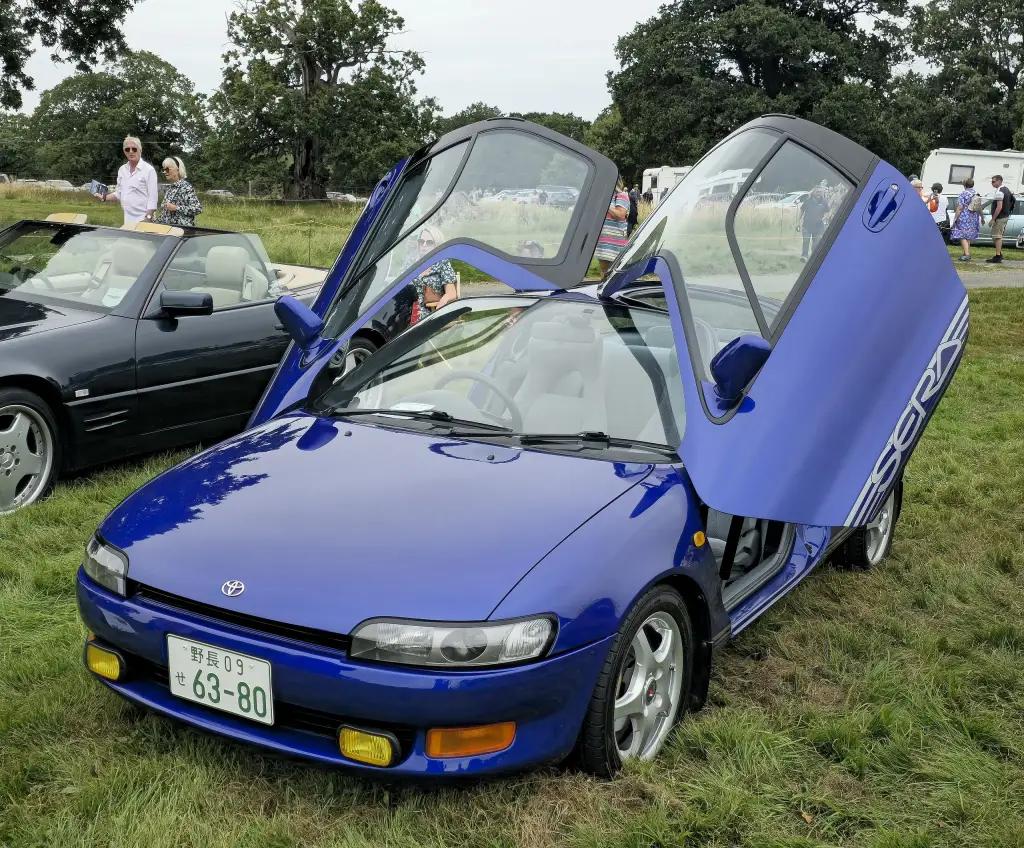
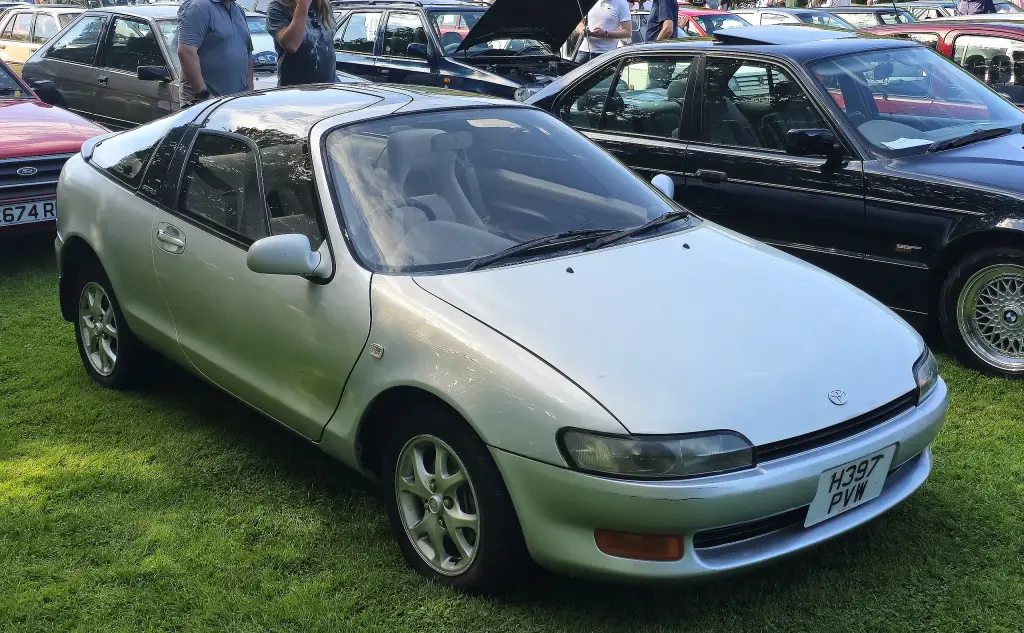
The Toyota Sera is a three-door 2+2 liftback coupe produced from 1990 to 1995 and sold officially only in Japan. It is remembered for its mostly glass roof canopy and its butterfly doors, which tilt up and forward when opened, and its name comes from the future tense of the French verb être, “to be”.
Toyota Sera at a glance
| Maker | Toyota |
|---|---|
| Production | February 1990 – December 1995 |
| Market | Japan only |
| Class | 2+2 liftback coupe |
| Engine | 1.5-litre 5E-FHE four, 104 hp |
| Gearboxes | Five-speed manual or four-speed automatic |
| Doors | Butterfly doors hinged at the top of the windscreen |
| Roof | Six glass panels, with removable interior panels |
| Trims | Three phases |
| Built | 15,941 cars |
| Name | French future of être, “to be” |
Based on one source: the English Wikipedia article on the Toyota Sera.
History of the Toyota Sera
From concept to production
The Sera debuted in 1988 as the Toyota AXV-II concept car in near production-ready form, and the production version was shown at the Tokyo Motor Show in 1989, alongside a vertically mounted and electrically operated display model that demonstrated the doors and rear hatch in action. It went on sale in Japan through Toyota Auto Store as an alternative to the MR2, which was sold through Vista Store. Between February 1990 and December 1995, 15,941 cars were built, 15,852 of them registered in Japan, with about 30 pre-production cars used for development.
Engineering
The Sera used the 1,496 cc 5E-FHE engine, the largest version of Toyota’s E-series four, as fitted to the Paseo and Starlet, producing 104 hp and 132 N·m. It was mounted transversely at the front, driving the front wheels through a five-speed manual or four-speed automatic, with power-assisted rack-and-pinion steering. Brakes were vented discs at the front and drums at the rear, or vented discs all round with the optional ABS. Mechanically the car was related to the Paseo and Starlet, sharing similar floorpans, suspension, steering and brakes. The butterfly doors are hinged at the top centre of the windscreen and the bottom of the A-pillar, supported by a thick gas strut and a smaller counterbalancing strut, and they need only 43 cm of lateral clearance to open fully. McLaren F1 designer Gordon Murray cited the Sera as the inspiration for the F1’s door arrangement.
Design and trim phases
The body is a steel monocoque with six separate glass pieces: a steeply raked windscreen, glass upper doors and roof panels, and a rear hatch made of a single piece of glass without a steel frame. The high solar load was handled with standard air conditioning and twin removable interior roof panels. Stewart Reed first presented the idea to Eiji Toyoda in the early 1980s, having developed it at Calty in Newport Beach, and the Japanese design team softened the curves for production. Toyota sold the car in three phases: Phase I, about 12,000 cars from March 1990 to May 1991, in six colours; Phase II, about 2,300 cars to June 1992, with pastel seat patterns; and Phase III, 1,550 cars to December 1995, with a grey interior, side impact beams and optional airbags.
Design and features
- Butterfly doors: hinged at the top of the windscreen, needing only 43 cm of clearance.
- Glass canopy: six glass panels, including a frameless glass hatch.
- Removable roof panels: twin interior panels to cut solar load.
- McLaren link: Gordon Murray cited the Sera as inspiration for the F1’s doors.
Toyota Sera versions
- Phase I (1990–1991): about 12,000 cars in six colours.
- Phase II (1991–1992): about 2,300 cars with pastel seat patterns.
- Phase III (1992–1995): 1,550 cars with a grey interior and side impact beams.
- AXV-II concept (1988): the near-production show car that preceded it.
The Sera was mechanically related to the Paseo and Starlet and sold as an alternative to the MR2. More cars are in the Toyota collection.
Sources
- Toyota Sera, English Wikipedia: design, engineering, phases