The Toyota Starlet was a subcompact car produced from 1973 to 1999, replacing the Publica but keeping its P model codes. In Japan it was exclusive to Toyota Auto Store, and it was the first subcompact from a Japanese maker to offer a high-performance variant.
Toyota Starlet at a glance
| Maker | Toyota |
|---|---|
| Production | April 1973 – 1999 |
| Predecessor | Toyota Publica |
| Class | Subcompact car |
| First generation | P40/P50 |
| Second generation | P60, widely exported |
| Hot versions | Turbo S, GT Turbo, Glanza V |
| Engine family | K series, then A series |
| Sold through | Toyota Auto Store |
| Replaced by | Toyota Vitz (Yaris) and bB |
Based on one source: the English Wikipedia article on the Toyota Starlet.
History of the Toyota Starlet
First generation (P40/P50; 1973)
The Starlet launched in April 1973 as the higher-grade, larger model of the Publica P30, with 1,000 and 1,200 cc engines. The coupe’s wedge shape came from sketches by Giorgetto Giugiaro, and the car looked like a shortened Corolla, earning the nickname “Baby Celica”. It was initially a two-door coupe only, with a four-door sedan added in October 1973, in Standard, Deluxe, Hi-Deluxe, ST and SR grades, the top versions with a five-speed manual. The 1.0-litre 2K produced 58 PS and the 1.2 68 PS, while twin-carburettor 3K-BR and 3K-B engines gave 74 and 77 PS. The Starlet was also a fixture in Japan’s 1,300 cc touring-car racing class: Toyota and Yamaha developed a 16-valve twin-cam 3K-R, and the car dominated for a time. A February 1976 update for emissions replaced the 3K with the cleaner 3K-U, dropping power to 64 PS and ending the twin-carburettor options, and a two-speed Toyoglide automatic joined in September.
Second generation (P60; 1978)
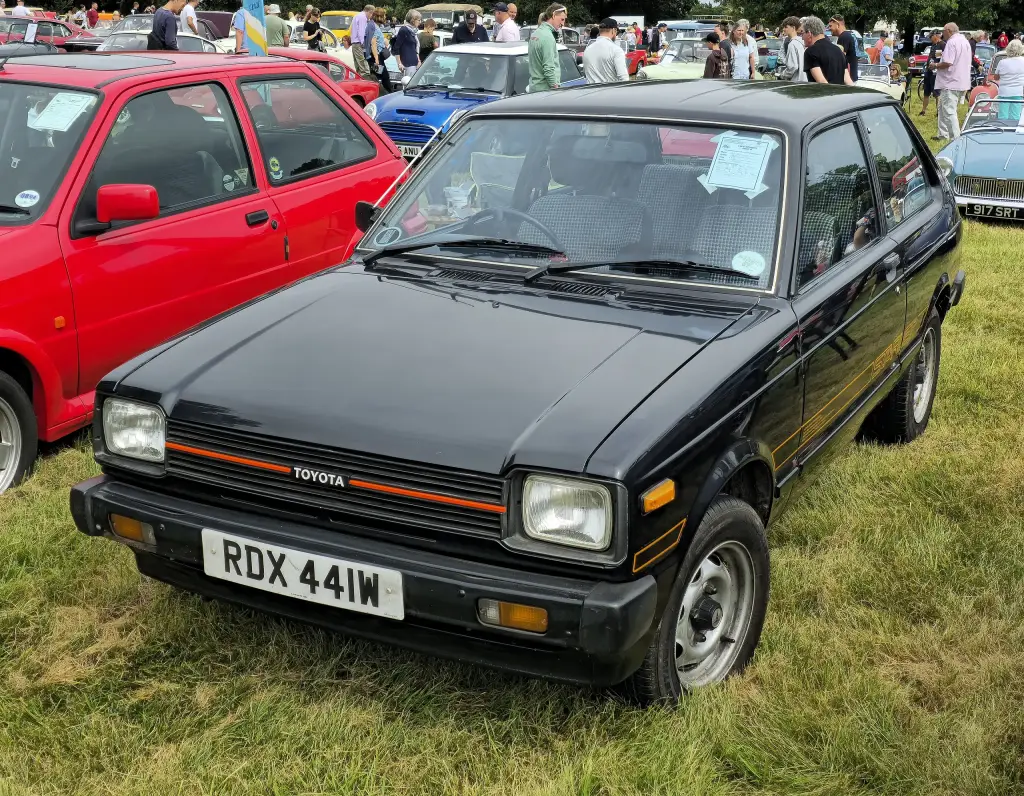
The 60 series of February 1978 was the first Starlet sold widely outside Japan and was well received in Europe, where superminis were booming. It came with 993, 1,166 or 1,290 cc engines, three- and five-door hatchbacks and, in Japan and some Asian and European markets, a longer five-door wagon called the Van. It was the first Toyota passenger car with rack-and-pinion steering, and used MacPherson struts at the front with a four-link coil-sprung rear axle on hatchbacks and leaf springs on vans. Trims ran from Standard to De Luxe, GL, XL, S, Si, Sprint, SE and Lisse; the Si had a fuel-injected 4K-E, and the Sprint added Toyota’s Sports Handling Suspension, a tachometer, a five-speed gearbox and a sportier interior.
Hot versions and the end
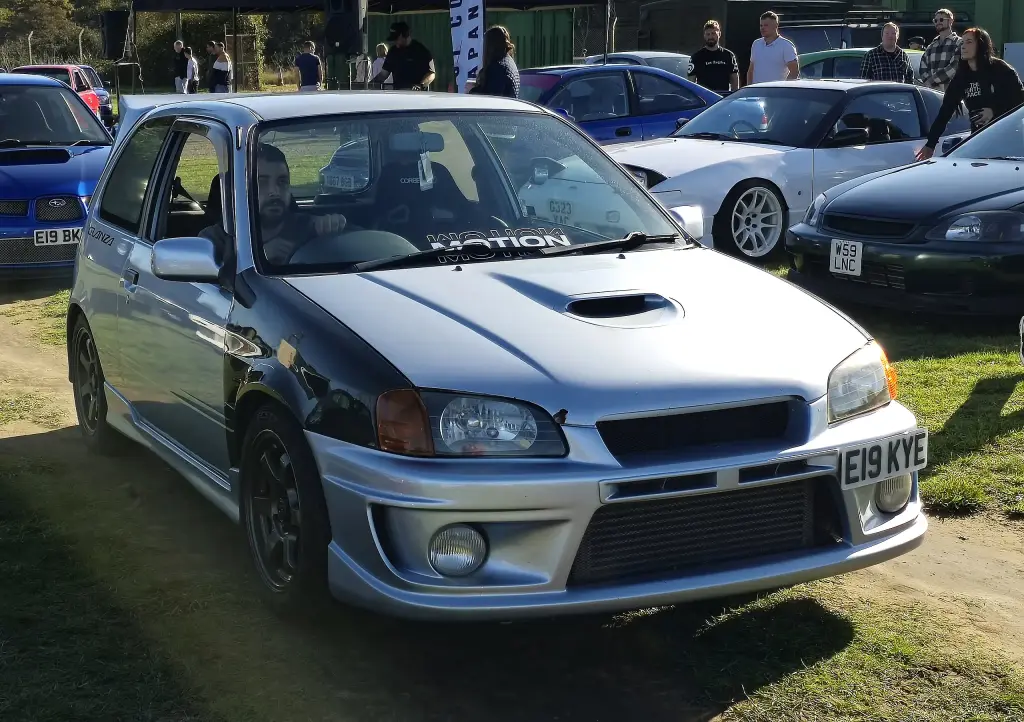
The Starlet’s performance reputation grew through three turbocharged generations: the 1986–1989 Turbo S (EP71), the 1990–1995 GT Turbo (EP82) and the 1996–1999 Glanza V (EP91). The Sera coupe of the early 1990s, sold only in Japan with butterfly doors, shared the Starlet’s chassis and mechanicals. In 1999 the Starlet was replaced by the Vitz, sold abroad as the Echo or Yaris, and by the bB mini MPV, leaving Toyota without a European city car until the Aygo arrived in 2005. The Starlet name returned in 2020 on a rebadged Suzuki Baleno sold in some African countries and in India as the Glanza.
Design and features
- Publica successor: a subcompact that kept the Publica’s P codes.
- First hot subcompact: the Turbo S, GT Turbo and Glanza V led the class.
- Racing pedigree: the 3K-R engine made it a touring-car class winner.
- Sera connection: the glass-roofed Sera used the Starlet’s chassis.
Toyota Starlet versions
- P40/P50 (1973): coupe and sedan with K-series engines.
- P60 (1978): second generation, widely exported.
- Turbo S (1986): EP71 turbocharged model.
- GT Turbo (1990): EP82 performance version.
- Glanza V (1996): the final hot Starlet, EP91.
The Starlet replaced the Publica and shared its chassis with the Sera and Paseo. Its successor was the Yaris, and more cars are in the Toyota collection.
Sources
- Toyota Starlet, English Wikipedia: generations, engines, hot versions