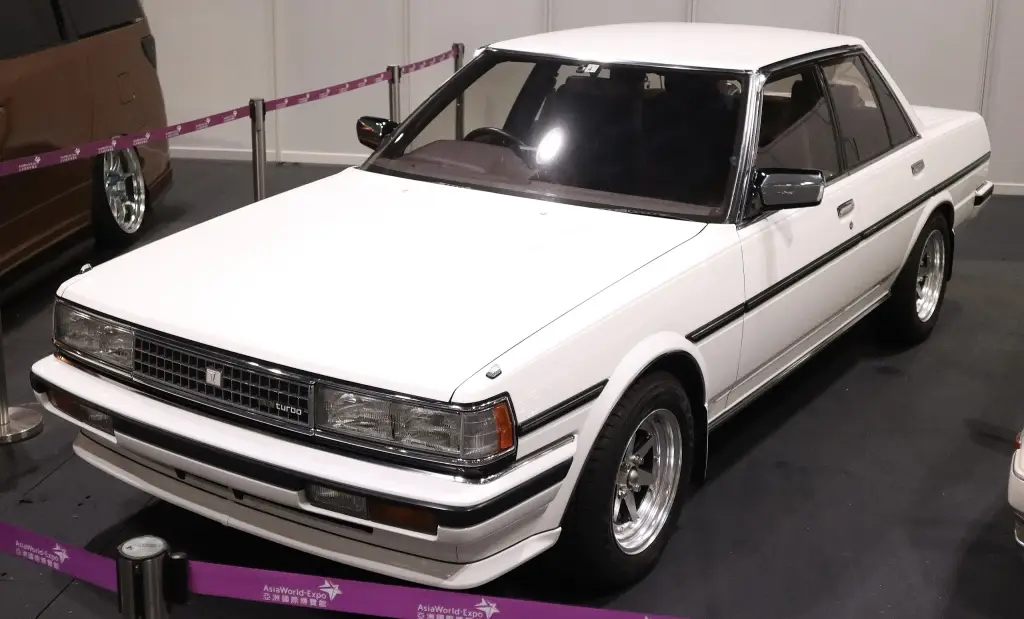
The Toyota Cresta was a mid-size luxury saloon launched in April 1980 and sold only in Japan. It shared its chassis with the Mark II and Chaser and was the top model at Toyota Vista Store, positioned as the most luxurious of the three sister cars.
Toyota Cresta at a glance
| Maker | Toyota |
|---|---|
| Production | April 1980 – 2001 |
| Generations | Five |
| Class | Mid-size luxury saloon |
| Platform | Toyota Mark II / Chaser |
| Sold through | Toyota Vista Store, Japan |
| First engines | 2.0-litre M-EU and 1G-EU straight sixes |
| Gearboxes | Five-speed manual or four-speed automatic |
| Top trim | Super Lucent |
| Replaced by | Toyota Verossa |
| Name | Vulgar Latin for “crest” |
Based on one source: the English Wikipedia article on the Toyota Cresta.
History of the Toyota Cresta
First generation (X50/X60; 1980)
The Cresta arrived in April 1980, sold exclusively through the new Toyota Vista Store while Toyota Auto Store sold the Chaser and Toyopet Store the Mark II. Its job was to offer a more luxurious package than the Mark II without breaking Japanese dimension and engine-size rules, so it came with fewer trim choices than its sisters and a stronger luxury focus. It was launched with four halogen headlamps, later replaced by single units for a more European look, and used the 2.0-litre M-EU or 1G-EU straight-six with a five-speed manual or four-speed automatic from the Crown. After the Soarer coupe appeared in February 1981, the Cresta’s styling was updated to resemble it.
Equipment and image
Each trim came in seven exterior colours plus one two-tone dark-grey-over-silver scheme reserved for the Super Lucent, the top grade whose name comes from the Latin lucens, “to shine”. Interiors were blue, grey or brown, in cloth only; leather was never offered. Options included several sound systems with a graphic equaliser, a trip computer, power windows, a glass sunroof, cruise control, a digital clock with alarm, a rear wiper with defroster, headlight washers and three-point belts with emergency locking retractors. Suspension used MacPherson struts all round, with semi-trailing arms and four links at the rear borrowed from the Crown and Soarer. The six-cylinder engine went to the Super Lucent, Super Touring and Super Deluxe, while Super Custom and Custom used a four-cylinder; no diesel was offered.
Later generations
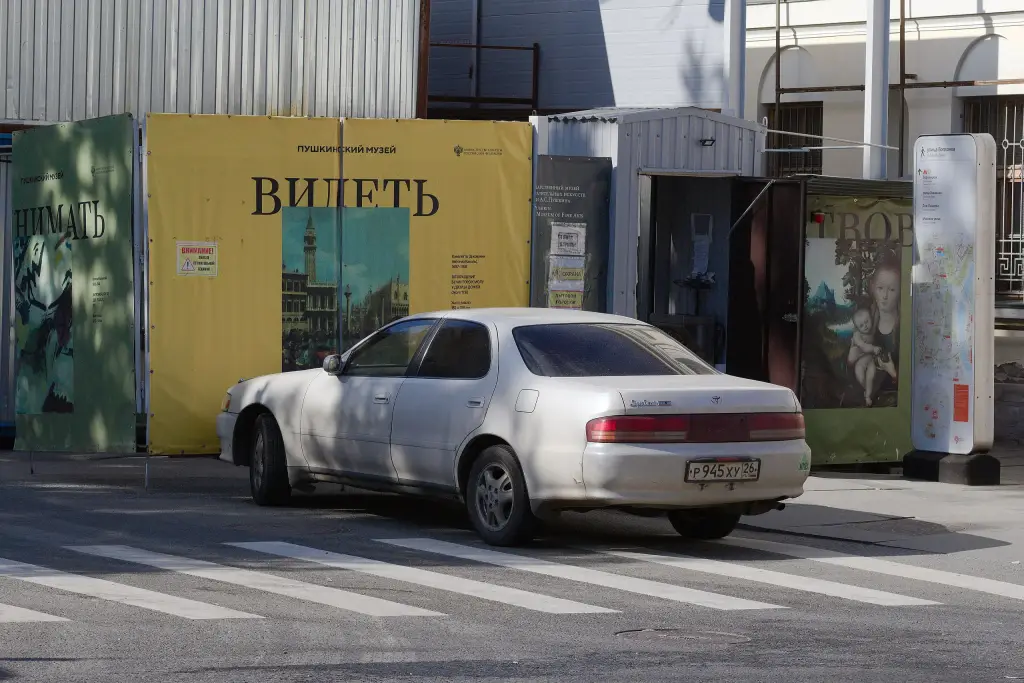
The X70 of March 1984 became a four-door, four-window hardtop with a distinctive creased rear window, and from then on the Cresta, Chaser and Mark II shared model codes. In October 1985 the 1G-GTEU parallel twin-turbo engine arrived in a GT Twin Turbo grade shared with the Chaser, along with larger disc brakes, Supra bucket seats, side repeater lights above the headlights, improved four-wheel independent suspension called PEGASUS and the ECT-S automatic. The Cresta continued for five generations and was merged with the Chaser into the short-lived Verossa when production ended in 2001.
Design and features
- Luxury focus: the plushest of Toyota’s three sister saloons, sold at Vista Store.
- Super Lucent: the top grade, with a two-tone paint option no other trim had.
- Twin-turbo six: the 1G-GTEU from 1985, in the GT Twin Turbo grade.
- PEGASUS suspension: the improved four-wheel independent set-up introduced with the X70.
Toyota Cresta versions
- X50/X60 (1980): first generation with M-EU and 1G-EU sixes.
- Super Lucent: the top trim, with exclusive two-tone paint.
- X70 (1984): four-window hardtop body.
- GT Twin Turbo (1985): 1G-GTEU twin-turbo engine.
- Later generations: three more series until 2001.
The Cresta shared its platform with the Mark II and Chaser, sat below the Crown and borrowed styling from the Soarer. More cars are in the Toyota collection.
Sources
- Toyota Cresta, English Wikipedia: generations, trims, equipment