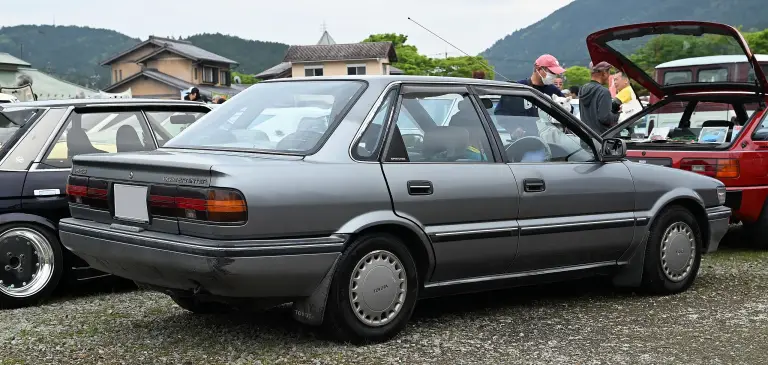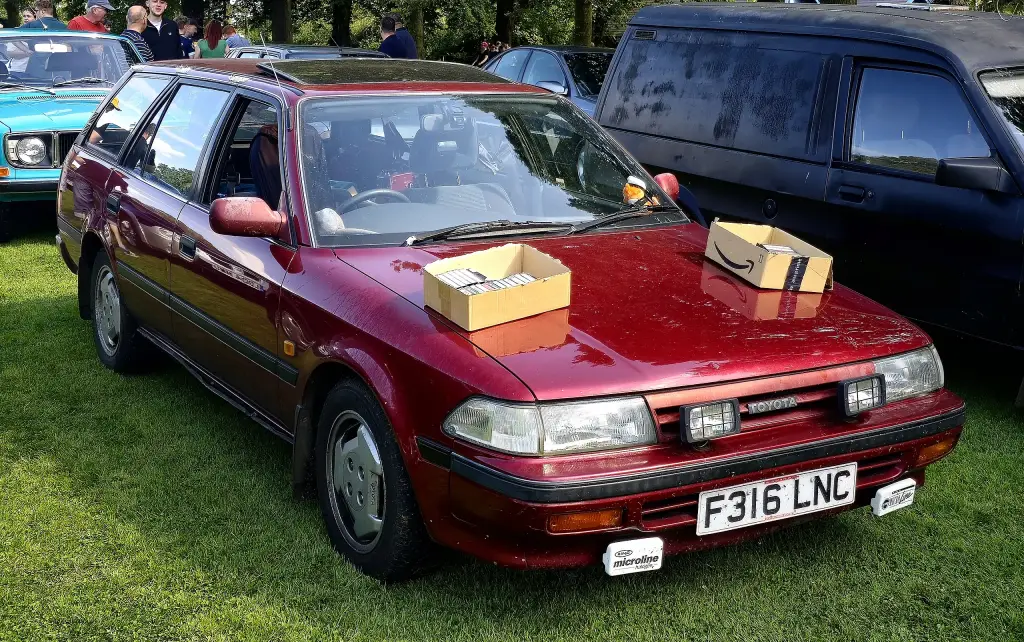
The Toyota Carina was built from December 1970 to December 2001. It was introduced as the saloon counterpart of the Celica and originally shared its platform, then moved to the Corona platform while keeping a sportier image and its own bodywork and interior, aimed at younger buyers and sold only through Toyota Store dealers in Japan.
Toyota Carina at a glance
| Maker | Toyota |
|---|---|
| Production | December 1970 – December 2001 |
| Class | Family saloon and coupe |
| First generation | A10/A30, from December 1970 |
| Second generation | A40/A50, from August 1977 |
| Platform | Initially shared with the Celica, later the Corona |
| Sold through | Toyota Store, Japan |
| European market | From October 1971 |
| Replaced by | Toyota Allion in Japan, Avensis in Europe |
| Name | From the constellation Carina |
Based on one source: the English Wikipedia article on the Toyota Carina, which covers the first two generations in detail.
History of the Toyota Carina
First generation (A10/A30; 1970)
The Carina was launched in December 1970 as a junior saloon and coupe below the Crown, similar in size to the Corona, and shared its platform with the Celica sports coupe — a way for Toyota to save development and tooling costs by building a family car and a sports car in the same factory. European sales began in October 1971. Equipment included reclining seats with built-in head restraints, a radio, a clock, reversing lights and servo-assisted brakes. Engines were a 1,407 cc OHV T or a 1,588 cc OHV 2T, with four-speed manual, two-speed automatic or three-speed automatic gearboxes and front disc brakes on all but the cheapest model.
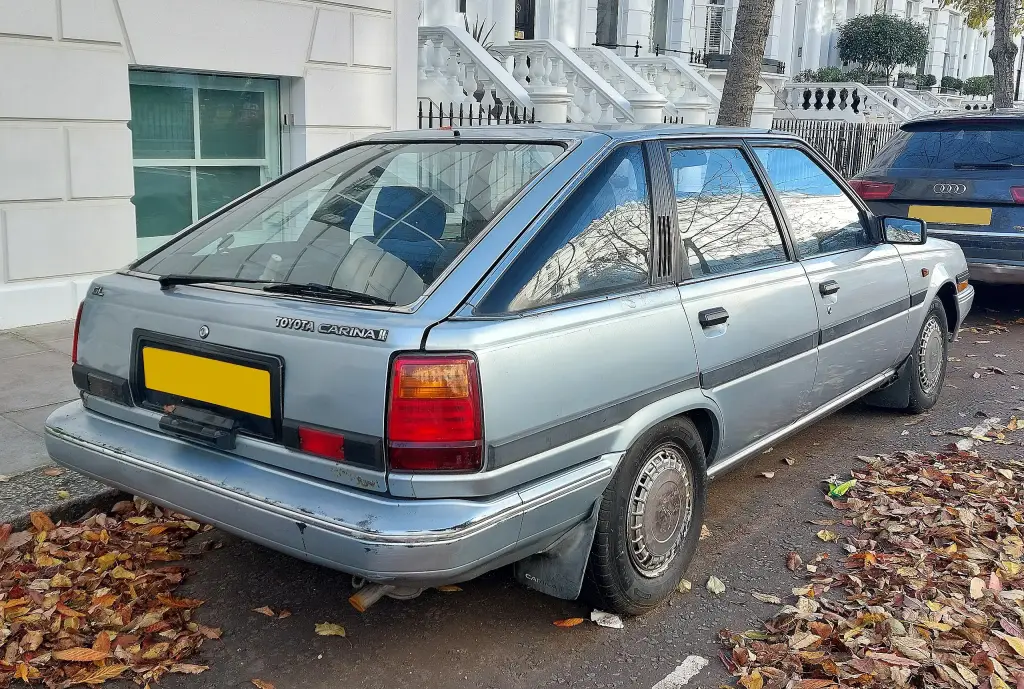
The 1600GT and the facelifts
In 1971 Toyota added the Carina 1600GT coupe with the 2T-G twin-cam engine shared with the Celica GT. It was sold only through Toyota Store, while the Corona 1600GT belonged to Toyopet Store and the Celica GT to Corolla Store. The car was revised in 1972 with a restyled body, new rear lights and a repositioned filler cap, and again in 1974 with a sealed cooling system, improved brakes, flared arches and a new interior. In late 1975 it received new front and rear styling, a dual-line servo braking system and a modified dashboard, with engines ranging from 1.4 to 2.0 litres in Japan. A van version followed in December 1975, using the cargo door of the 30-series Corolla wagon and an unusual opera-style side window.
Second generation (A40/A50; 1977)
The next Carina arrived in Japan in August 1977, in Germany in December 1977 and elsewhere in Europe during 1978. Its chassis was largely that of the facelifted first-generation car, and most markets used the same 1,588 cc 2T engine, rated at 75 PS. Automatic transmission became available in many export markets. An estate was offered to export customers for the first time, with the heavy-duty leaf-spring rear suspension of the Japanese van. In 1980 all models received revised front and rear styling and better interiors, and in 1981 the saloon and coupe gained a standard five-speed gearbox. The Carina continued for several more generations before the Allion replaced it in Japan in 2001 and the Avensis took over in Europe.
Design and features
- Celica platform: the first Carina shared its underpinnings with the Celica coupe.
- 1600GT: a twin-cam coupe using the 2T-G engine, sold only at Toyota Store.
- Van version: a commercial derivative with the Corolla wagon’s cargo door.
- Export estate: added with the second generation for European buyers.
Toyota Carina versions
- A10 saloon and coupe (1970): 1.4- and 1.6-litre OHV engines.
- 1600GT coupe (1971): 2T-G twin-cam engine shared with the Celica GT.
- 1972 and 1974 revisions: restyled body, brakes and interior.
- Carina Van (1975): commercial version with opera windows.
- A40 (1977): second generation with an export estate.
The Carina shared its platform with the Celica and its size with the Corona; its European successor was the Avensis. More cars are in the Toyota collection.
Sources
- Toyota Carina, English Wikipedia: generations, engines, versions