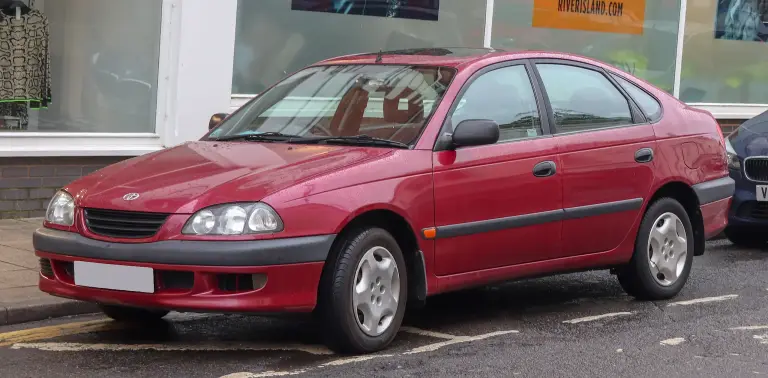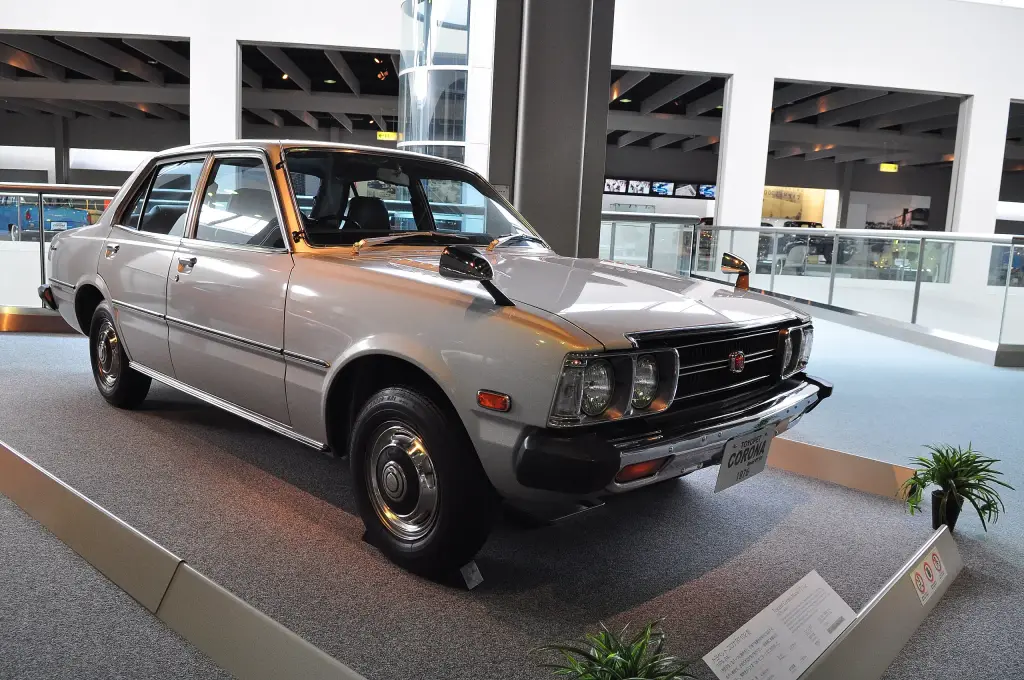
The Toyota Corona was produced from 1957 to 2001 across eleven generations. It was Toyota’s second-highest model at launch, just below the Crown, was sold through Toyopet Store dealers in Japan and became one of Toyota’s first exported models.
Toyota Corona at a glance
| Maker | Toyota |
|---|---|
| Production | May 1957 – 2001 |
| Generations | Eleven |
| Position | Below the Crown, above the Corolla |
| First engine | Sidevalve S, 33 PS |
| First update | 997 cc P engine, 45 PS, from 1959 |
| Export name | Tiara in some markets |
| Sold through | Toyopet Store, Japan |
| Successors | Premio in Japan, Avensis in Europe, Camry elsewhere |
| Name | Latin for “crown” |
Based on one source: the English Wikipedia article on the Toyota Corona.
History of the Toyota Corona
First generation (T10; 1957)
The Corona was introduced in May 1957 and used parts from the Crown and the Master after the Crown was restyled and enlarged. It was a four-door saloon with the old sidevalve S engine of 33 PS, joined in October 1958 by a three-door van sold as the Toyopet Coronaline. In October 1959 the 997 cc OHV P engine replaced the S with 45 PS and a top speed of 105 km/h, and the car gained a mesh grille and a rear seat for five instead of four. It was the first Toyota with a monocoque chassis and independent front suspension with double wishbones, which kept it under 1,000 kg, and it was built to serve the taxi market after the Crown grew larger.
Tiara and America (T20/T30; 1960)
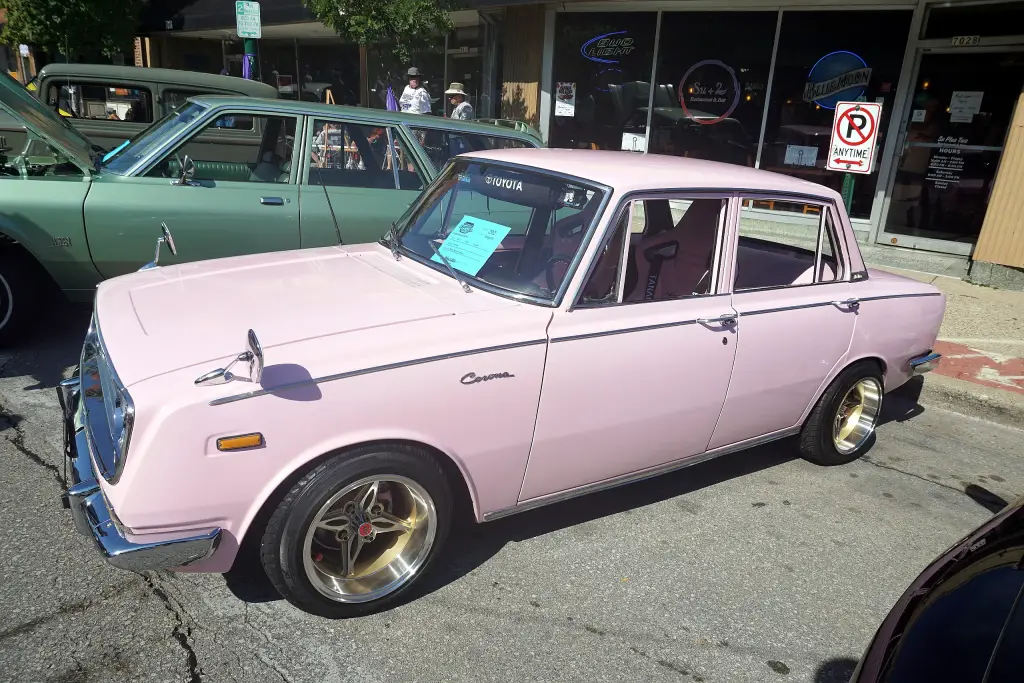
The second generation, introduced in March 1960, was exported in some markets as the Tiara. It arrived at a critical moment: the Toyopet Crown had failed in the United States and Toyota withdrew in 1961, then returned in June 1964 with the third-generation Corona and its first television commercial. The Tiara was lighter than the Crown by 180 kg, which made its R-series engine adequate, and it sold better than the Crown with fewer mechanical problems. A 1.5-litre R engine arrived in March 1961 and a 1.9-litre in 1964, and only 318 Tiaras were sold in the United States before the Corona name was adopted there.
Growth and replacement
The Corona grew into a full range, and by 1968 the larger Corona Mark II had been split off as a separate line. The car was sold under many names around the world, including Carina in Europe, and its platform and engines underpinned several related models. The Corona was well received in America: it won the 1969 Road Test Import Car of the Year, helped lift Toyota’s American sales above 20,000 cars in 1966 and made the company the third-best-selling import brand by 1967. In 2014 Car and Driver called it one of the best Toyotas ever made, arguing that Toyota survived long enough to thrive in America because of the Corona. The model was replaced in Japan by the Premio, in Europe by the Avensis and in Asia, the Pacific and the Americas by the Camry.
Design and features
- Monocoque construction: the first Toyota with a unitary chassis and double-wishbone front suspension.
- Taxi role: built to fill the size class the Crown had outgrown.
- American breakthrough: the 1964 Corona re-established Toyota in the United States.
- Many names: sold as the Tiara and, in Europe, linked to the Carina family.
Toyota Corona versions
- T10 (1957): the original saloon with the sidevalve S engine.
- P-engined Corona (1959): 997 cc engine of 45 PS.
- Tiara (1960): second generation, exported under that name.
- Third generation (1964): the car that relaunched Toyota in America.
- Corona Mark II (1968): a larger platform split off as its own line.
The Corona was replaced by the Premio in Japan, and its size class is now covered by the Camry. The Carina and Mark II are close relatives, and more cars are in the Toyota collection.
Sources
- Toyota Corona, English Wikipedia: generations, exports, reputation