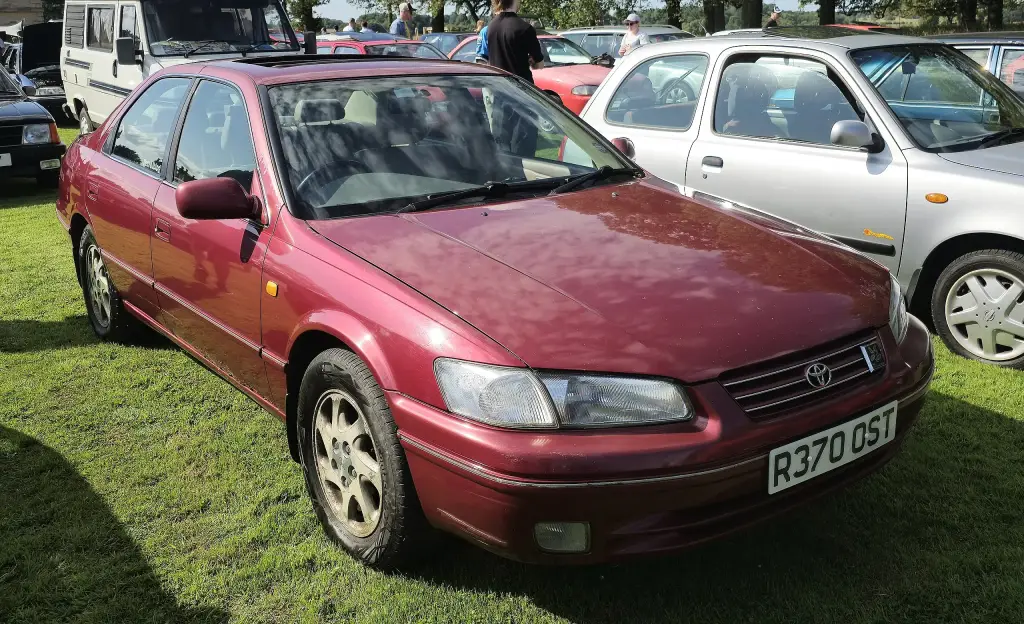
The Toyota Camry is a mid-size saloon sold internationally since 1982. Originally a narrow-body compact car for Japan, it grew into a wide-bodied mid-size model in the 1990s and became, in Toyota’s words, the firm’s second world car after the Corolla.
Toyota Camry at a glance
| Maker | Toyota |
|---|---|
| Production | Since 1982 |
| First Camry name | Celica Camry, 1979–1982 |
| Name | From the Japanese kanmuri, “crown” |
| Body styles | Saloon, liftback, estate, hardtop over the years |
| Japanese twin | Toyota Vista (narrow-body cars) |
| Luxury derivative | Lexus ES / Toyota Windom |
| Wide-body Camry | XV10, from 1991 |
| Current generation | XV70 |
| Worldwide sales | Over 22 million by 2026 |
Based on one source: the English Wikipedia article on the Toyota Camry.
History of the Toyota Camry
Celica Camry and V10 (1979–1986)
The Camry name first appeared in 1979 on the Celica Camry, a four-door saloon related to the Carina that went on sale in January 1980 at Toyota Corolla Store dealers in Japan. The Camry became an independent line in 1982 with the V10 series, which was offered as a saloon and as a five-door liftback. The V20 followed in 1986 with a station wagon replacing the liftback and with hardtop saloons for Japan only. Narrow-body cars also produced a Japanese twin, the Toyota Vista, sold through Vista Store.
Two widths (1990–2001)
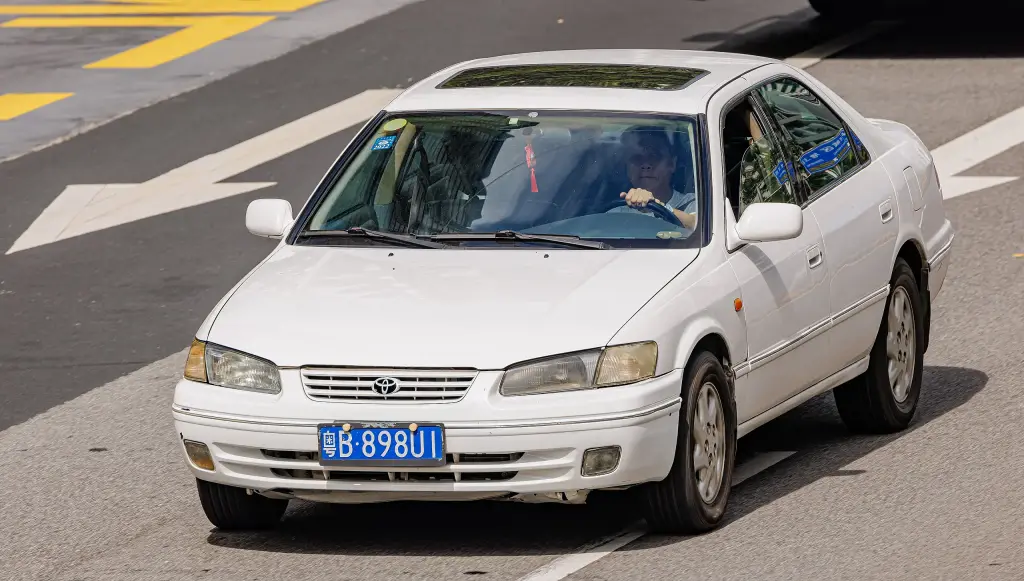
The V30 of 1990 was a Japanese-only model, kept narrow because of local tax rules, while overseas demand produced the wide-body XV10 saloon and estate of 1991; Japan received that car as the Toyota Scepter. A coupe version of the XV10 arrived in 1993 and became a separate line, the Camry Solara, in 1998. Japan kept a narrow V40 until 1998 and called the wide XV20 the Camry Gracia until 1999, after which the Japanese Camry again matched the international car. The Vista went its own way from 1998 with the V50 series.
World car
The XV30 of 2001 was sold only as a saloon and came with two different front and rear treatments: one for Japan and most markets, a more conservative one for East and Southeast Asia. From the XV40 of 2006 the Australian Aurion supplied the conservative Asian body, and the XV50 of 2011 spread that alternative styling to Japan and Eastern Europe. Luxury versions have followed the Camry since 1989, when the Lexus ES appeared as a close relative; from 1991 to 2005 it was sold in Japan as the Toyota Windom. Japanese Camry sales ended in late 2023 after 43 years, though Toyota plans to bring the model back to Japan in 2026.
Design and features
- Name from the crown: kanmuri means crown, continuing Toyota’s royal naming tradition.
- Narrow and wide bodies: Japanese tax rules kept a narrow Camry alive alongside the wide export car.
- Vista twin: narrow-body Camrys were sold in Japan as the Toyota Vista.
- Lexus ES relative: the luxury ES has been derived from the Camry since 1989.
- Global sales: more than 22 million cars by 2026.
Toyota Camry versions
- Celica Camry (1979–1982): the first car to use the name, based on the Carina.
- V10 (1982): saloon and five-door liftback.
- V20 (1986): estate replaces the liftback; Japanese hardtop saloons.
- XV10 (1991): the first wide-body Camry, sold in Japan as the Scepter.
- XV30 (2001): two different front and rear designs for different regions.
- XV70: the current generation.
The Camry is the basis of the Camry Solara coupe and gave rise to the Windom. Compare it with the Corolla and the rest of the Toyota collection.
Sources
- Toyota Camry, English Wikipedia: history, generations, names