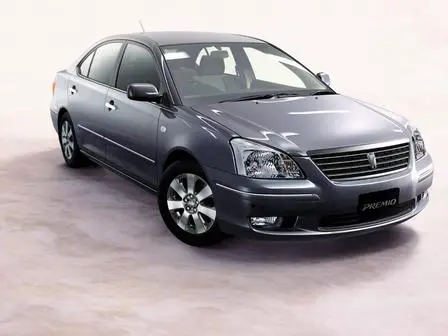
The Toyota Premio and its twin, the Toyota Allion, were compact saloons sold in Japan from 2001 to 2021. The Premio replaced the Corona and the Allion the Carina, and unlike most Toyotas they were never exported. Size and pricing were taken over by the E210 Corolla in 2018.
Toyota Premio at a glance
| Maker | Toyota |
|---|---|
| Production | 25 December 2001 – 2021 |
| Market | Japan only |
| Class | Compact saloon |
| Twin model | Toyota Allion |
| Predecessors | Corona (Premio), Carina (Allion) |
| Engines | 1.5, 1.8 and 2.0-litre petrol |
| Gearboxes | Four-speed automatic, CVT on 2.0-litre |
| Sold through | Toyopet Store (Premio), Toyota Store (Allion) |
| Name | Premio, Spanish for premium or prize |
Based on one source: the English Wikipedia article on the Toyota Premio. No free photograph of a Premio or an earlier Allion was available, so the record keeps its existing cover.
History of the Toyota Premio
Two saloons, one car
The Premio and Allion were launched on 25 December 2001. Mechanically they were identical to the Avensis, which Toyota sold in Japan only as a five-door estate, and both were four-door saloons. The first-generation Premio was the more upmarket of the pair, with wood trim and chrome accents, while the Allion was aimed at younger buyers and could be ordered with front spoilers, a boot wing and ground-effect parts, plus rear seats that tilted like the front ones. The Premio went to Toyopet Store as a smaller companion to the Mark X, and the Allion to Toyota Store as a companion to the Crown. Both replaced four-door hardtops as well: the Corona EXiV by the Progrès and the Carina ED by the Brevis, which briefly overlapped with the new cars until 2007.
Engines and updates
The first generation offered 1.5-, 1.8- and 2.0-litre engines, the 2.0 with a CVT and the smaller units with a four-speed automatic. On 20 December 2004 the Premio gained LED tail lights in a modest restyle. The second generation arrived on 4 June 2007 with a gap-filling role between the Corolla and Camry, smart entry and start, a colour rear-view monitor and a hard-disk navigation system working with G-BOOK. Four-wheel drive was offered with the 1.8-litre 2ZR-FE, and in January 2008 a 2.0-litre Valvematic 3ZR-FAE joined the range with 75 per cent lower emissions than the 2005 standard and 20 per cent better fuel economy than the 2010 target, mated to a Super CVT-i. The 2.0-litre option was dropped in July 2020.
Fuel economy and the end
The 1.5-litre models reached 18 km/l and the 1.8-litre 17 km/l once both used CVTs, and in October 2009 the 1.5 improved to 18.6 km/l through engine, transmission and alternator changes. A 2010 facelift brought sharper headlights, twin LED tail lights and a Valvematic 1.8-litre engine good for 18.6 km/l on the 10-15 cycle, while the 1.5 reached 20 km/l in June 2010; the switch to the stricter JC08 test later cut the published figure to 18.2 km/l. Revisions at the end of September 2019 added stop-start, bringing the front-wheel-drive 1.5-litre car to 18.2 km/l on JC08 and making it eligible for an eco-car tax reduction, along with steering-assisted stability control and hill start assist.
Design and features
- Japan-only saloons: never exported, replacing the Corona and Carina.
- Premio and Allion: one car in two characters, luxury and sporty.
- Valvematic engines: the 2.0 and later 1.8-litre units with CVT.
- Tax-efficient: stop-start made the 1.5 eligible for Japan’s eco-car tax break.
Toyota Premio versions
- T240 (2001): first generation with 1.5, 1.8 and 2.0-litre engines.
- 2004 restyle: LED tail lights.
- T260 (2007): second generation with G-BOOK and a rear-view monitor.
- 2.0 Valvematic (2008): 3ZR-FAE engine with Super CVT-i.
- 2010 facelift: new lamps and a Valvematic 1.8.
- 2019 update: stop-start and stability control.
The Premio replaced the Corona and the Allion the Carina, and both were related to the Avensis. More cars are in the Toyota collection.
Sources
- Toyota Premio, English Wikipedia: generations, engines, updates