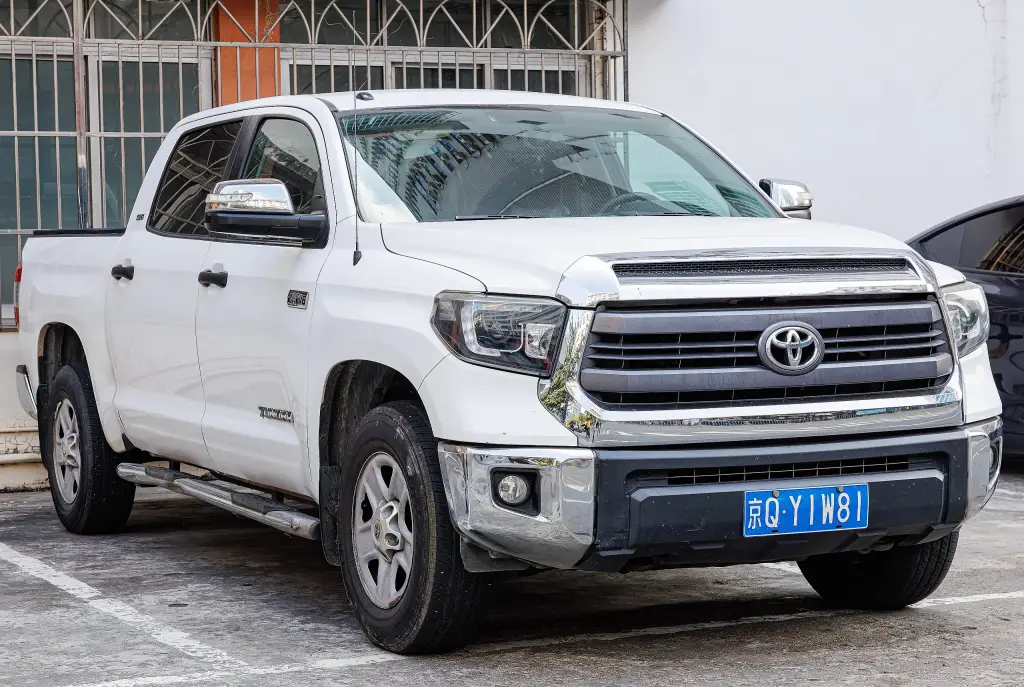
The Toyota Tundra is a full-size pickup built in the United States since May 1999. It was the second full-size pickup from a Japanese maker after the T100, but the first to be built in North America, and it was Motor Trend’s Truck of the Year in 2000 and 2008.
Toyota Tundra at a glance
| Maker | Toyota |
|---|---|
| Production | Since May 1999 |
| Market | North America |
| Class | Full-size pickup |
| First generation | XK30 (rear-wheel drive) and XK40 (four-wheel drive) |
| Engines | 3.4, 4.0 and 4.7-litre |
| First V8 | 4.7-litre 2UZ-FE i-Force, 245 hp |
| Built in | Princeton, Indiana, then San Antonio, Texas |
| Awards | Motor Trend Truck of the Year 2000 and 2008 |
| Related | T100, Tacoma and Sequoia |
| Name | Chosen after Ford objected to the T150 name |
Based on one source: the English Wikipedia article on the Toyota Tundra, which covers the first generation in most detail.
History of the Toyota Tundra
First generation (XK30/XK40; 1999)
The first Tundra had much in common with the T100 and the compact Tacoma, including the 3.4-litre V6 that topped the range in both. That V6 served as the Tundra’s base engine, joined by a 4.7-litre V8, the first V8 in a Toyota pickup. The truck was publicly introduced in May 1999 as a 2000 model, but its prototypes and show trucks were first known as the T150; Ford and journalists criticised the name as too close to the market-leading F-150, and after a lawsuit the production truck became the Tundra.
Engines and sales
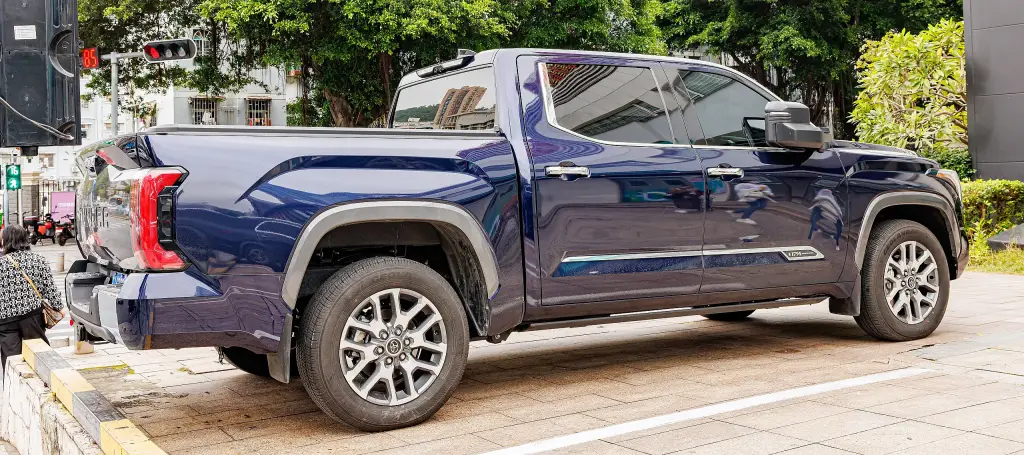
The Tundra was slightly larger than the T100, and with a production capacity of 120,000 its sales ran at twice the T100’s rate, the highest initial sales for any Toyota at the time. It won Motor Trend’s Truck of the Year for 2000 and was named Best Full-Size Truck by Consumer Reports. Engines were a 24-valve 3.4-litre 5VZ-FE V6 of 190 hp and 300 N·m and an LEV-certified 32-valve 4.7-litre 2UZ-FE i-Force V8 of 245 hp and 427 N·m. The V6 lasted until 2004, when a 4.0-litre 1GR-FE of 236 hp arrived, and the V8 gained VVT-i for 2005 with 282 hp, re-rated at 271 hp for 2006 because testing standards changed rather than the engine. A Toyota Racing Development supercharger was available for the V6 from 2000 to 2003 and for the V8 from late in its second year, taking the V8 to the mid-300 hp range and about 542 N·m; it was dropped when the VVT-i engine arrived.
Body styles and special editions
The grille was updated for 2003 and a StepSide bed became available on Access Cab models. The Double Cab, added in late 2003 for 2004, was a crew cab with four rear-opening doors and much of the Sequoia’s interior and exterior detailing; its bed was nearly 127 mm longer than the Nissan Titan’s or Ford F-150’s, and it was 330 mm longer, 76 mm taller and 102 mm wider than the Regular and Access Cabs, on a 305 mm longer wheelbase, and came only with the V8. The T3 Special Edition of 2003, tied to the film Terminator 3, added a TRD package, blacked-out trim, 17-inch wheels and T3 badges, with 650 sold in the United States and 200 in Canada. The 2006 Darrell Waltrip Edition was limited to 2,000 V8 Double Cabs. The Tundra was the first full-size pickup to earn an overall Good rating in the Insurance Institute for Highway Safety’s frontal offset test. A larger second generation arrived in 2006.
Design and features
- First V8 Toyota pickup: a 4.7-litre i-Force engine of 245 hp.
- Built in America: the first Japanese full-size pickup assembled in North America.
- Double Cab: a crew cab with a longer bed than its rivals.
- Safety first: the first full-size pickup with an overall Good IIHS frontal rating.
Toyota Tundra versions
- Regular and Access Cab (1999): 3.4-litre V6 or 4.7-litre V8.
- T3 Special Edition (2003): 650 US and 200 Canadian trucks.
- Double Cab (2004): four-door crew cab with the V8 only.
- 4.0-litre V6 (2005): 1GR-FE engine of 236 hp.
- Darrell Waltrip Edition (2006): 2,000 V8 Double Cabs.
The Tundra succeeded the T100, shares its market with the Tacoma and provides the base for the Sequoia. More cars are in the Toyota collection.
Sources
- Toyota Tundra, English Wikipedia: generations, engines, editions