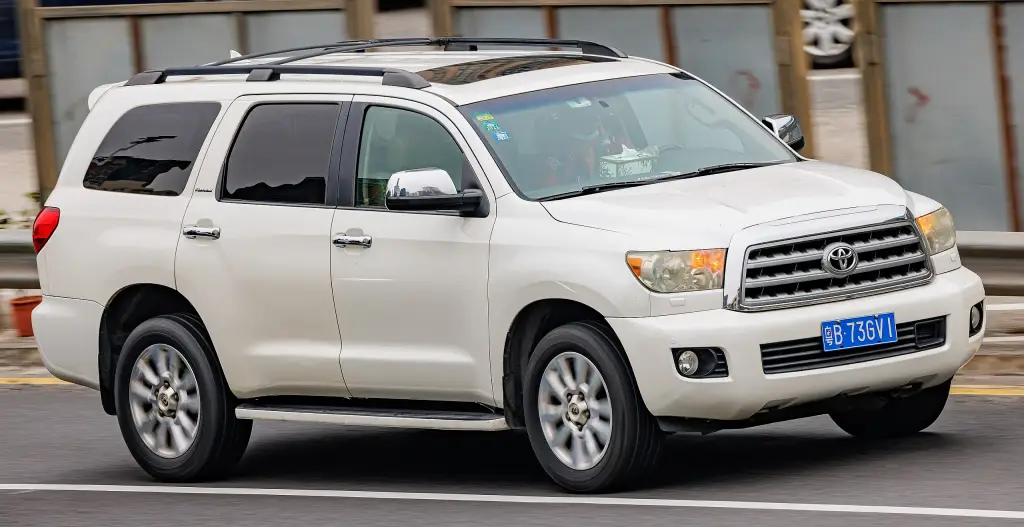
The Toyota Sequoia is a full-size SUV produced mainly for the North American market since 2000 and derived from the Tundra pickup. It is the second-largest SUV ever sold under the Toyota brand after the Japan-only Mega Cruiser, and it was the first vehicle from a Japanese maker in America’s mainstream full-size SUV class.
Toyota Sequoia at a glance
| Maker | Toyota |
|---|---|
| Production | Since September 2000 |
| Market | United States, Canada, Mexico, Costa Rica |
| Class | Full-size SUV |
| Based on | Toyota Tundra |
| First shown | North American International Auto Show, January 2000 |
| Built in | Princeton, Indiana, then San Antonio, Texas |
| Layout | Front engine, rear- or four-wheel drive |
| Drive | Left-hand drive only |
| Name | The giant sequoia redwood of California |
Based on one source: the English Wikipedia article on the Toyota Sequoia.
History of the Toyota Sequoia
First generation (XK30/XK40; 2000)
Development of a full-size SUV alongside a T100 replacement began in the mid-1990s, with a design freeze in 1997 by Toshihiko Shirasawa. After the Tundra appeared in 1999, speculation suggested Toyota would build a Tundra-based SUV called the Highlander, but that name went to the Camry-based crossover and the new vehicle was shown on 11 January 2000 at the North American International Auto Show as the Sequoia, with production from September 2000 for the 2001 model year. Chief engineer Kaoru Hosokawa aimed it directly at the Ford Expedition, Chevrolet Tahoe and GMC Yukon. It shared the Tundra’s engine, dashboard, sheetmetal and chassis, with rear disc brakes and a more sophisticated multi-link live rear axle; Dana supplied frames and driveshafts. The power rear window was a notable feature, and the low-emission V8 made the Sequoia a certified Ultra Low Emission Vehicle. It came in SR5 and Limited trims with two- or four-wheel drive, and was nominated for North American Truck of the Year in 2001.
2005 facelift
For 2005 the 2UZ-FE V8 gained VVT-i and 42 more horsepower, and a five-speed automatic replaced the four-speed. Four-wheel-drive models received a Torsen centre differential that split power 40/60 front to rear in normal driving and could send up to 53 per cent forward or 71 per cent rearward when slipping. The grille and lights were redesigned, the taillights lost their amber lamps and an in-glass antenna replaced the retractable one. Inside there was a new gauge cluster with optional Optitron instruments, an optional touch-screen stereo and navigation system, optional rear air suspension with height adjustment and second-row captain’s chairs with a removable console. Towing capacity was 6,500 lb for two-wheel drive and 6,200 lb for four-wheel drive.
Later generations and flagship status
The second-generation Sequoia was unveiled at the Los Angeles Auto Show in November 2007, with sales from December. It kept the Tundra base but added a fully boxed frame, a rear independent suspension with double wishbones and coil springs, and a locking centre differential on four-wheel-drive models, which also gave it a tighter 19-foot turning circle and a fold-flat rear seat. Through the 2021 model year the Sequoia sat between the 4Runner and the Land Cruiser in North America; when Land Cruiser sales there ended for 2022, the Sequoia became Toyota’s flagship SUV. Production moved from Princeton, Indiana to San Antonio, Texas in 2022, and the car is sold only in left-hand drive.
Design and features
- Tundra base: the full-size pickup’s chassis and V8, with a multi-link rear axle.
- Power rear window: a feature shared with the 4Runner and Tundra Double Cab.
- Three rows: space for a family, with a fold-flat third row from 2008.
- Flagship SUV: Toyota’s top North American SUV after the Land Cruiser left in 2022.
Toyota Sequoia versions
- XK30/XK40 (2000): first generation in SR5 and Limited trims.
- 2005 facelift: VVT-i V8, five-speed automatic and Torsen differential.
- XK60 (2007): second generation with independent rear suspension.
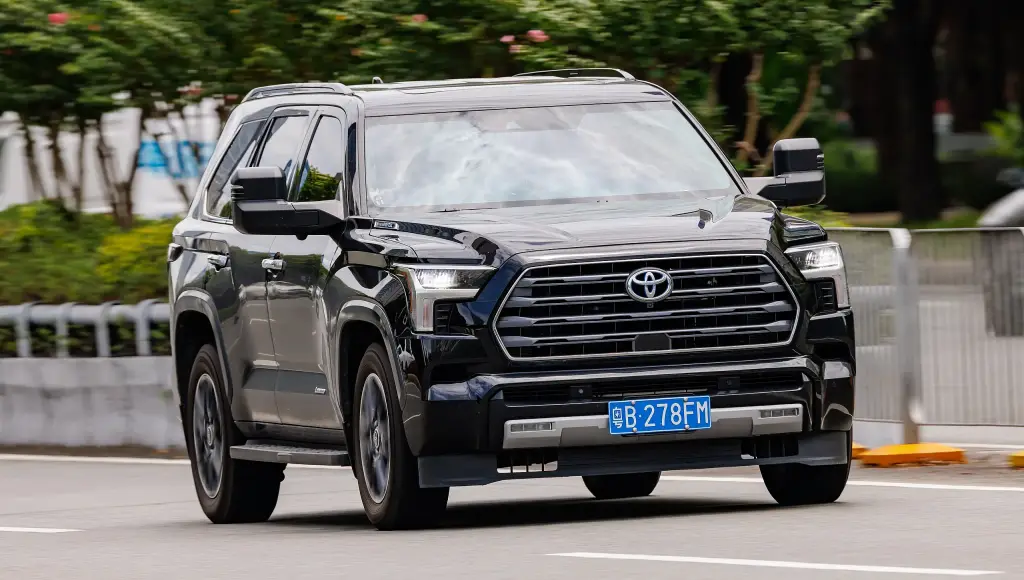
- XK80: the current generation built in Texas.
The Sequoia shares its platform with the Tundra, sits above the 4Runner and replaced the Land Cruiser as Toyota’s American flagship SUV. More cars are in the Toyota collection.
Sources
- Toyota Sequoia, English Wikipedia: generations, engines, market