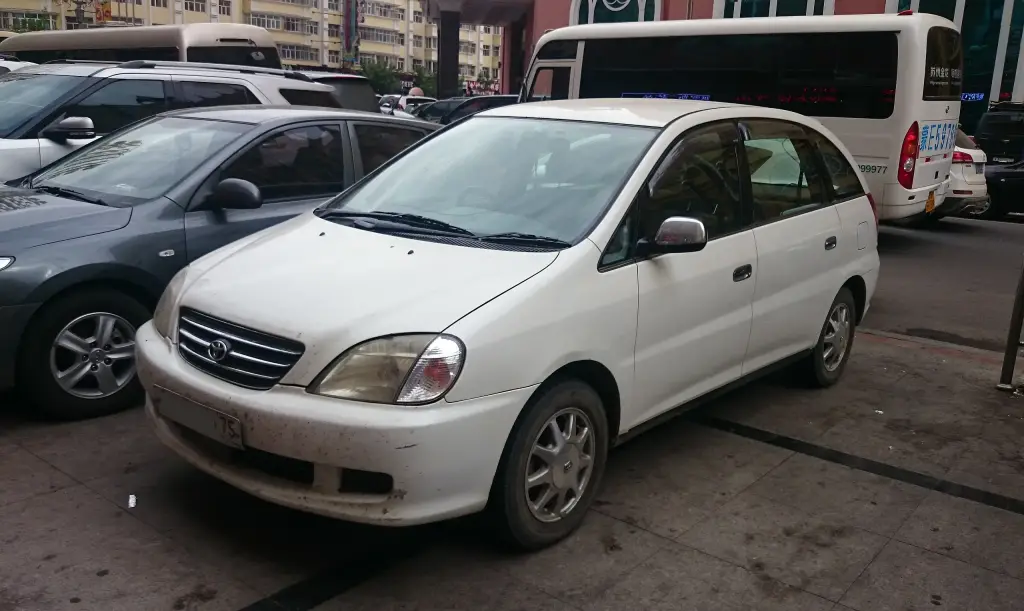
The Toyota Nadia was a compact MPV produced from 1998 to 2003 and sold only in Japan, at Toyota Corolla Store alongside the Corolla. It was a five-seat tall wagon based on the Ipsum, and it became popular in the Russian Far East, in cities such as Yakutsk and Vladivostok.
Toyota Nadia at a glance
| Maker | Toyota |
|---|---|
| Production | 1998–2003 |
| Market | Japan |
| Class | Five-seat tall wagon |
| Base | Toyota Ipsum |
| Engines | 2.0-litre 3S-FE, 3S-FSE and 1AZ-FSE |
| Layout | Front-wheel drive and four-wheel drive |
| Gearbox | Automatic, Super ECT with flex lockup on D-4 cars |
| Tyres | 195/60R15, 215/60R16 for the type SU |
| Sold through | Toyota Corolla Store |
| Name | From Nadezhda, Russian for hope |
Based on one source: the English Wikipedia article on the Toyota Nadia.
History of the Toyota Nadia
A five-seat Ipsum
The Nadia was a minivan-style tall wagon with two rows of seats, developed from the Ipsum. It was shorter overall than the Ipsum but used the same wheelbase, and because it had no third row the seat travel was not limited by a rear bench, giving more flexibility than its sisters, the Ipsum and Gaia. It was even wider than the first-class Century. At launch, tall five-seat wagons with a high eyepoint were a growing European trend, and its rivals included the Nissan R’nessa and Tino and the Toyota Opa sold at Toyopet Store.

Design and engineering
The body used a rounded one-motion form similar to the second-generation Estima, and the interior differed from its siblings in the upper dashboard and centre console, with a virtual centre-projection digital meter. All engines were 2.0-litre units: the 3S-FE twin-cam with port injection and the 3S-FSE petrol direct-injection D-4 engine in the two-wheel-drive standard car, the latter with a Super ECT gearbox and flex lockup. Instead of the Ipsum’s 14-inch tyres it used 195/60R15 rubber, later 215/60R16 for the type SU, and the front brakes were enlarged and the suspension retuned for a sportier feel with more travel. It was the only one of the three Ipsum brothers with a stepping-type parking brake.
Timeline
The Nadia was released in August 1998. In October 1998 Toyota Modellista added the American Billet Version, whose aero parts pushed the width to 1,715 mm and made it a three-number car. In 1999 came the type SU, a crossover-styled version with revised bumpers and wheels, overfenders that took it past 1.7 m, a revised suspension, larger tyres and even the first Harrier’s wheels. An April 2001 facelift brought the new 1AZ-FSE D-4 engine for two-wheel-drive cars, new head and tail lamps, discharge headlamps on some grades, a new grille and bumper, an analog Optitron meter, automatic air conditioning across the range and a wide 2DIN audio panel. In 2002 all models moved to D-4 engines, and production ended in October 2003.
Design and features
- Five seats only: no third row, so the second row could slide further than in the Ipsum.
- Digital centre meter: a virtual centre-projection instrument display.
- Type SU: a crossover-styled version with overfenders and larger tyres.
- D-4 engines: direct injection available from launch and standard from 2002.
Toyota Nadia versions
- 3S-FE and 3S-FSE (1998): launch engines, the latter with direct injection.
- American Billet Version (1998): Modellista aero package, 1,715 mm wide.
- Type SU (1999): crossover version with overfenders and 16-inch tyres.
- 2001 facelift: 1AZ-FSE engine, new lamps and Optitron instruments.
- 2002 update: D-4 engines across the range.
The Nadia was based on the Ipsum and shared its market with the Gaia and Opa. More cars are in the Toyota collection.
Sources
- Toyota Nadia, English Wikipedia: overview, engines, timeline