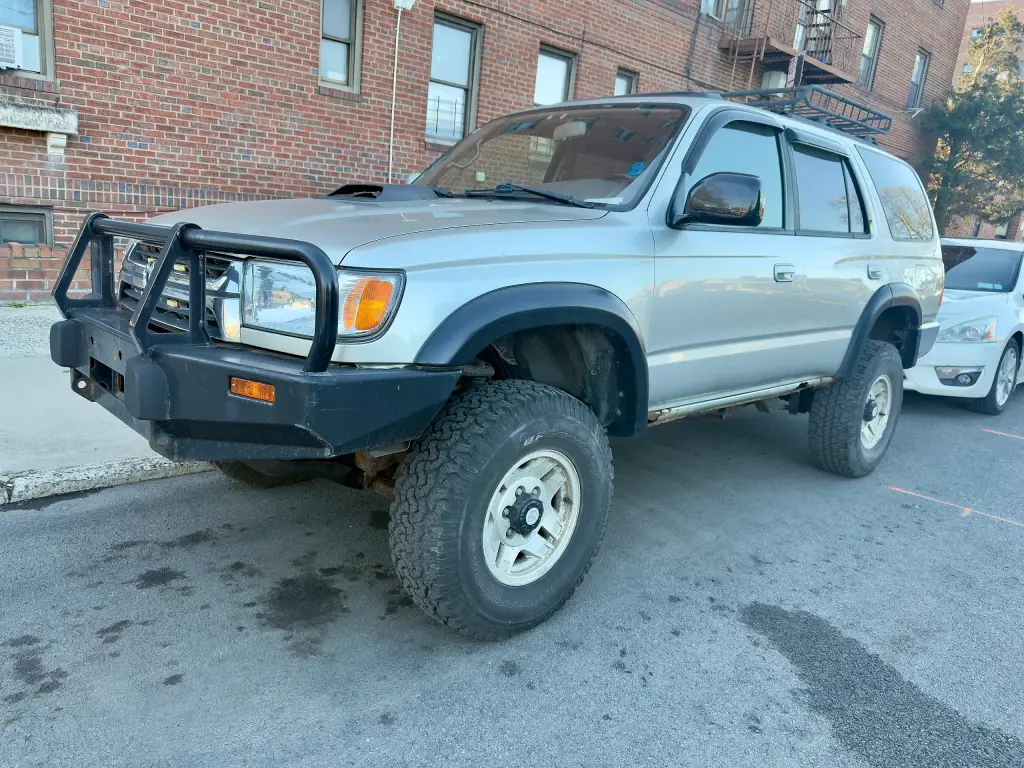
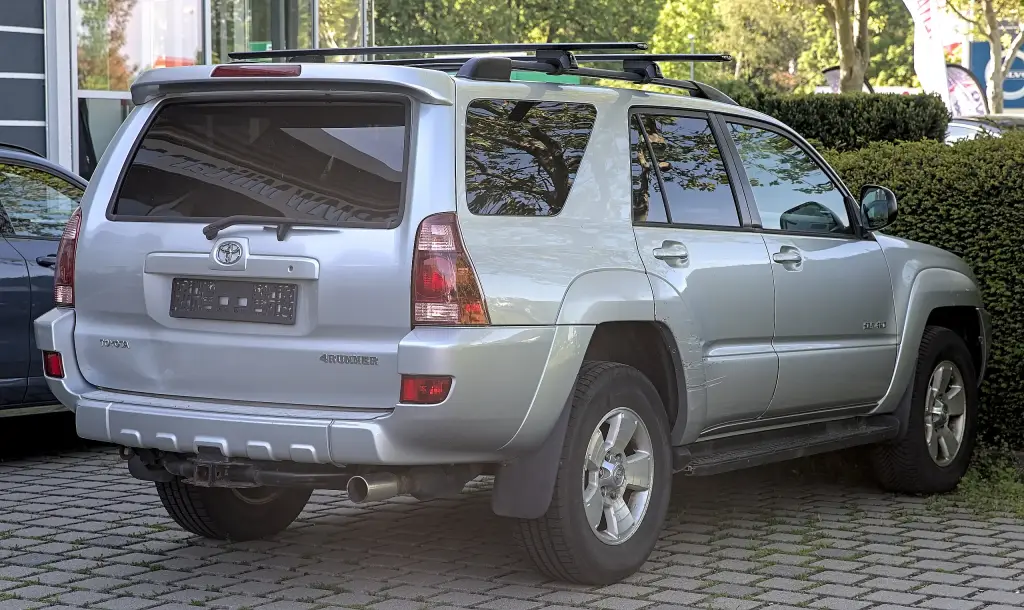
The Toyota 4Runner is an SUV marketed worldwide since 1984 and built over six generations. In Japan it was sold as the Toyota Hilux Surf until 2009. The first 4Runner was little more than a Hilux pickup with a fibreglass shell over the load bed; later generations were developed into independent models sitting between the compact and mid-size classes.
Toyota 4Runner at a glance
| Maker | Toyota |
|---|---|
| Production | Since 1984, six generations |
| Japanese name | Toyota Hilux Surf (until 2009) |
| Predecessor | Winnebago Trekker conversion (1981–1983) |
| First generation | N60, based on the Hilux (1983) |
| Layout | Front engine, rear- or four-wheel drive |
| Built in | Tahara, Aichi, and Hino Motors, Hamura |
| Main markets | North America, Central and South America |
| Alternative | Land Cruiser Prado in Europe, Asia and the Middle East |
| Name | Coined by copywriter Robert Nathan for Saatchi & Saatchi |
Based on one source: the English Wikipedia article on the Toyota 4Runner.
History of the Toyota 4Runner
A marketing experiment becomes a model
Before the 4Runner, Toyota dealers sold third-party conversions. The best known was the Trekker, built by Winnebago Industries from 1981 to 1983 from short-bed Hilux trucks: the bed and rear cab wall were removed and replaced with a fibreglass tub, a fixed canopy and a folding rear bench. About 1,200 to 1,500 Trekkers were sold in the United States, with kits also sent to Canada and Saudi Arabia. The Trekker was discontinued in 1984 when Toyota began building its own SUV.
First generation (N60; 1983)
Rather than design a new vehicle, Toyota modified the 1983 Hilux with a short-bed body, removed the panel behind the cab and added a removable rear roof section. The result was the N60-series Hilux Surf, sold abroad as the 4Runner. It kept the pickup’s chassis, four-wheel drive and engines, and was marketed as a rugged, inexpensive off-roader.
Growing up
Over five further generations the 4Runner gained its own bodywork, more space, coil-sprung rear suspension and larger engines, developing into a cross between a compact and a mid-size SUV. All 4Runners have been built in Japan at Toyota’s Tahara plant or at Hino Motors in Hamura. The Hilux Surf was withdrawn from the Japanese market in 2009, and in many markets the model was replaced by the Fortuner, a cheaper alternative based on the Hilux. As of 2021 the 4Runner is sold mainly in North America, Central America and parts of South America, while Europe, Asia and the Middle East receive the Land Cruiser Prado instead. A 2019 study by iSeeCars.com ranked it fifth among the longest-lasting vehicles in the United States, with 3.94% of cars exceeding 200,000 miles.
Design and features
- Pickup roots: the first generation used the Hilux chassis and drivetrain almost unchanged.
- Removable rear roof: the early cars could be opened up like the Trekker conversion.
- Two names: 4Runner abroad, Hilux Surf in Japan.
- Longevity: ranked fifth among the longest-lasting US vehicles in a 2019 iSeeCars.com study.
Toyota 4Runner versions
- Trekker (1981–1983): Winnebago-built Hilux conversion, the 4Runner’s predecessor.
- First generation (N60; 1983): Hilux-based, with a removable rear roof.
- Hilux Surf: the Japanese-market nameplate, sold until 2009.
- Later generations: five further generations, increasingly independent of the pickup.
- Fortuner: the Hilux-based replacement in some markets.
The 4Runner shares its pickup basis with the Hilux and its role in some markets with the Land Cruiser Prado. More cars are in the Toyota collection.
Sources
- Toyota 4Runner, English Wikipedia: history, generations, markets, study