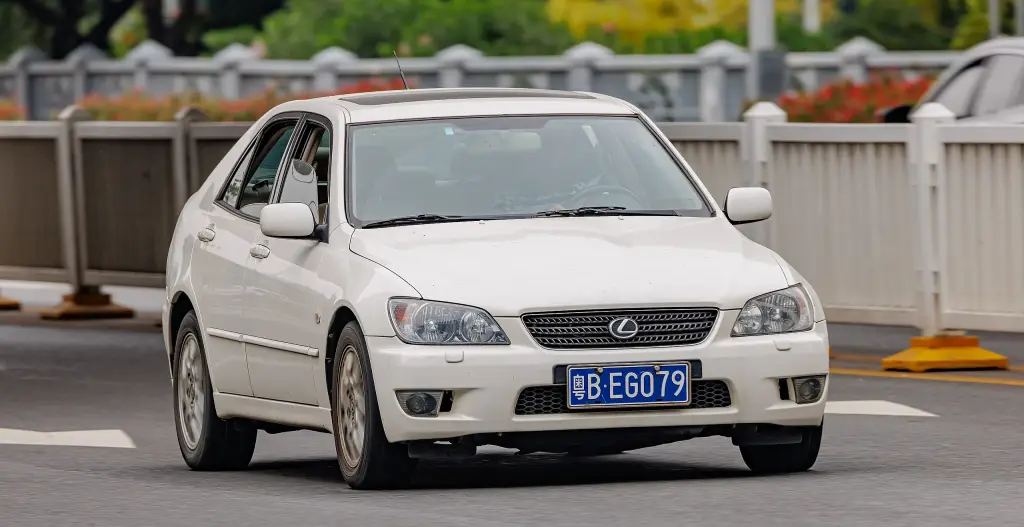
The Toyota Altezza was the Japanese-market version of the first-generation Lexus IS, sold from 1998 to 2005. It was a compact rear-wheel-drive sports saloon engineered under Nobuaki Katayama, and the name — Italian for “height” — was dropped in Japan when the Lexus brand arrived there in 2005.
Toyota Altezza at a glance
| Maker | Toyota |
|---|---|
| Production | October 1998 – 2005 |
| Chassis code | XE10 |
| Class | Compact executive sports saloon |
| Layout | Front engine, rear-wheel drive |
| Engines | 2.0-litre 1G-FE and 3S-GE straight sixes |
| Gearboxes | Four- or five-speed automatic, six-speed manual |
| Body styles | Saloon and Gita hatchback estate |
| Chief engineer | Nobuaki Katayama |
| Award | Japan Car of the Year 1998–1999 |
| Sold through | Toyota Netz Store |
The Altezza is described in the first-generation section of the English Wikipedia article on the Lexus IS; this page uses that section only.
History of the Toyota Altezza
Programme and design
The Altezza was engineered from 1994 to 1998 under programme code 038T, led by Nobuaki Katayama, with design by Tomoyasu Nishi frozen in 1996. It used a shortened rear-wheel-drive platform related to the larger Aristo/GS, and was aimed directly at European sports saloons. The car was 20 mm wider than the 1,700 mm Japanese tax standard, so buyers gained the engine-size tax break without the full size penalty. It was exclusive to Toyota Netz Store dealers until Lexus arrived in Japan in 2006.
Engines and versions
Two saloons launched in 1998: the AS200 with the 2.0-litre 1G-FE straight-six and a four-speed automatic, and the RS200 with the 2.0-litre 3S-GE four-cylinder, a six-speed manual as standard and a five-speed automatic as an option. In Europe the equivalent Lexus IS 200 was rated at 153 hp, reached 216 km/h and took 9.3 seconds to 100 km/h. In July 2001 Toyota added the AS300 Gita, a hatchback estate with the 3.0-litre 2JZ-GE straight-six, rear- or all-wheel drive and an automatic gearbox. A six-speed manual and an all-wheel-drive AS200 followed in January 2002.
Reputation
The design won Japan Car of the Year for 1998–1999 and was praised for its chassis balance. Its clear-covered rear lamp clusters, with the bulbs visible inside, were copied so widely by aftermarket makers that they became known as “Altezza lights”, and the idea influenced factory LED lamps that only show their colour when lit. The first-generation IS and Altezza were replaced in 2005 by the second-generation IS, which was sold as a Lexus everywhere, ending the Altezza nameplate.
Design and features
- Rear-wheel-drive chassis: a shortened platform related to the Aristo/GS, tuned for handling.
- Straight-six engines: the 2.0-litre 1G-FE in the AS200 and the 3.0-litre 2JZ-GE in the Gita.
- Six-speed manual: standard in the RS200 with the 3S-GE engine.
- Altezza lights: clear-covered taillights that became an aftermarket fashion.
- Award-winning design: Japan Car of the Year 1998–1999.
Toyota Altezza versions
- AS200 (1998): 2.0-litre 1G-FE straight-six, four-speed automatic.
- RS200 (1998): 2.0-litre 3S-GE four-cylinder, six-speed manual.
- AS300 Gita (2001): 3.0-litre 2JZ-GE estate with rear- or all-wheel drive.
- AS200 four-wheel drive (2002): with an optional six-speed manual.
- Lexus IS 200 / IS 300: the export versions of the same car.
The Altezza’s bigger relative was the Aristo, and its successor was sold as a Lexus. Other compact Toyotas are in the Corolla E120 article and the Toyota collection.
Sources
- Lexus IS, English Wikipedia: Altezza history, engines, versions