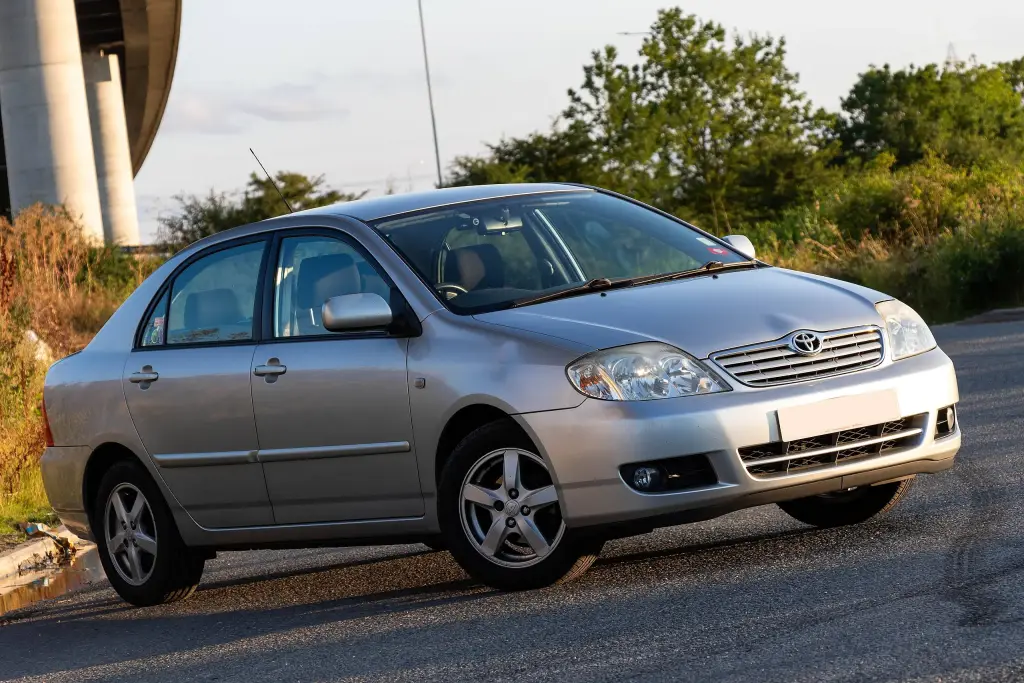
The Toyota Corolla E120/E130 is the ninth generation of Toyota’s compact car, launched in Japan in August 2000 and exported from 2001 and 2002 depending on the market. It was built on a 2,600 mm wheelbase and became one of Toyota’s most versatile and popular models.
Toyota Corolla (E120) at a glance
| Maker | Toyota |
|---|---|
| Production | 2000–2006 (China until 2017) |
| Generation | Ninth |
| Wheelbase | 2,600 mm |
| Platform | Shortened V50 Vista platform |
| Body styles | Saloon, estate, three- and five-door hatchback |
| Japanese hatchback | Corolla RunX, twin Allex |
| Japanese estate | Corolla Fielder |
| Engines | 1.3, 1.5, 1.8 and 2.2-litre diesel |
| Award | What Car? Car of the Year 2002 |
Based on one source: the English Wikipedia article on the Corolla E120.
History of the Toyota Corolla (E120)
Launch and body styles
The saloon and estate arrived first in August 2000, followed by the five-door hatchback in January 2001 and a Europe-only three-door in 2002. From 2002 the hatchback gained a sharper styling treatment of its own, and Japanese saloons and estates received a new front end in 2004 that mostly stayed out of Europe. Other Asian markets and the Americas used unique front and rear styling. The car sat on a shortened V50 Vista platform with a 2,600 mm wheelbase, and Toyota designed it as a global car that could be a premium compact saloon or an affordable hatchback depending on the market.
Japan
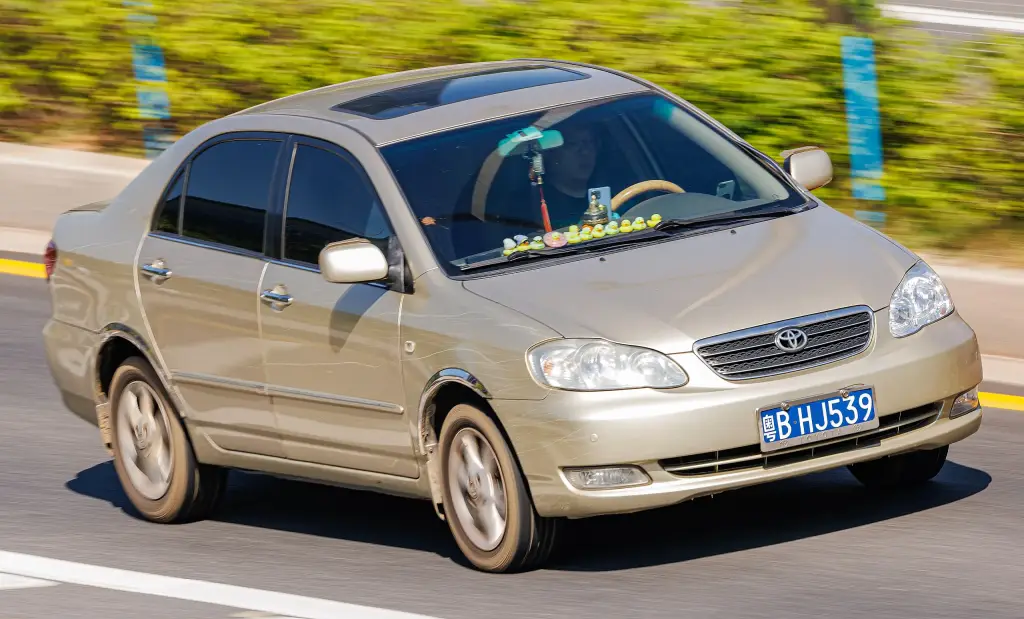
Japanese saloon trims were X Assista Package, X, G and Luxel, with 1.3-litre 2NZ-FE, 1.5-litre 1NZ-FE and 1.8-litre 1ZZ-FE engines; the 2ZZ-FE was reserved for the estate and the RunX, and diesels used the 2.2-litre 3C-E. The estate was called the Corolla Fielder, with X, X G Edition and Z Aero Tourer grades, and both saloon and estate came with front- or all-wheel drive and an optional Welcab version. The five-door hatchback was the Corolla RunX from December 2001, and its badge-engineered twin, the Toyota Allex, replaced the Sprinter saloon at Netz Store while the RunX stayed at Corolla Store. The Allex differed in colour range and small details such as a chrome trim above the number plate, and its top RS180 used the 2ZZ-GE engine.
Other markets
In Australia the E120 was sold from December 2001 as a saloon, estate and five-door hatchback with the Seca badge, in Ascent, Ascent Sport, Conquest, Levin and Ultima trims. A small number were built in South Africa, including the high-performance Sportivo hatchback with the 2ZZ-GE and a six-speed manual, which was dropped in 2006 when Euro IV emissions made the engine too expensive to modify. Australian engines were detuned from 100 to 93 kW in October 2005 to meet Euro IV, and the estate ceased production in August 2006. New Zealand offered GL, GLX and T Sport hatchbacks and GL or GLX saloons with the 1.8-litre engine. The E120 was replaced by the E140/E150 in late 2006 or early 2007 but stayed in production in China until 2017, and it won What Car? Car of the Year for 2002.
Design and features
- Longer wheelbase: 2,600 mm on a shortened V50 Vista platform.
- RunX and Allex: Japanese five-door hatchbacks sold through different dealer chains.
- Fielder estate: sold with front- or all-wheel drive and a Welcab option.
- Sportivo: South African-built hatchback with the 2ZZ-GE and a six-speed manual.
Toyota Corolla (E120) versions
- Saloon (2000): X Assista Package, X, G and Luxel grades.
- Fielder estate (2000): X, X G Edition and Z Aero Tourer.
- RunX (2001): Japanese five-door hatchback at Corolla Store.
- Allex (2001): twin hatchback at Netz Store, with the RS180 top grade.
- Seca (2001): Australian five-door hatchback.
- Sportivo: South African 2ZZ-GE hatchback with a six-speed manual.
The E120 belongs to the Corolla family, followed the E90 and preceded the Auris. Its Matrix relative is covered in the Matrix article, and more cars are in the Toyota collection.
Sources
- Toyota Corolla (E120), English Wikipedia: launch, versions, markets