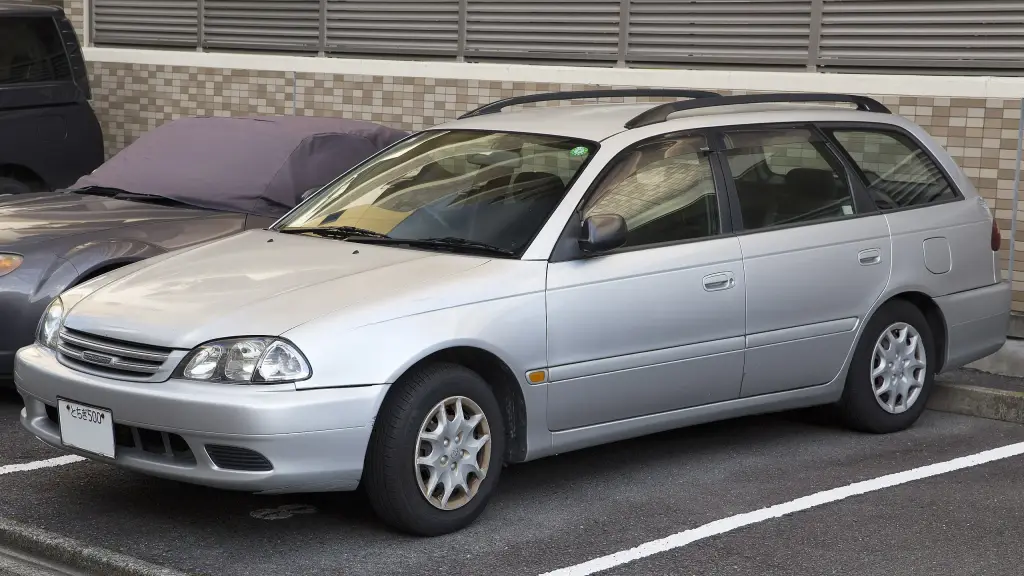
The Toyota Caldina was an estate car built for the Japanese market from 1992 to 2007. It replaced the Corona and Carina estates, was sold through Toyota Store and Toyopet Store, and although Toyota never officially exported it, its four-wheel drive and space made it a popular grey import in Australia, New Zealand, Russia and South America.
Toyota Caldina at a glance
| Maker | Toyota |
|---|---|
| Production | November 1992 – 2007 |
| Market | Japan |
| Class | Estate car and commercial van |
| First generation | T190, 1992–2002 |
| Second generation | T210, from September 1997 |
| Top version | GT-T with the 3S-GTE turbo, 260 PS |
| Drive | Front- or four-wheel drive |
| Gearbox | Five-speed manual or four-speed automatic |
| Replaced | Corona and Carina estates |
| Successor role | Avensis estate |
| Name | From “cardinal”, essential or fundamental |
Based on one source: the English Wikipedia article on the Toyota Caldina.
History of the Toyota Caldina
First generation (T190; 1992)
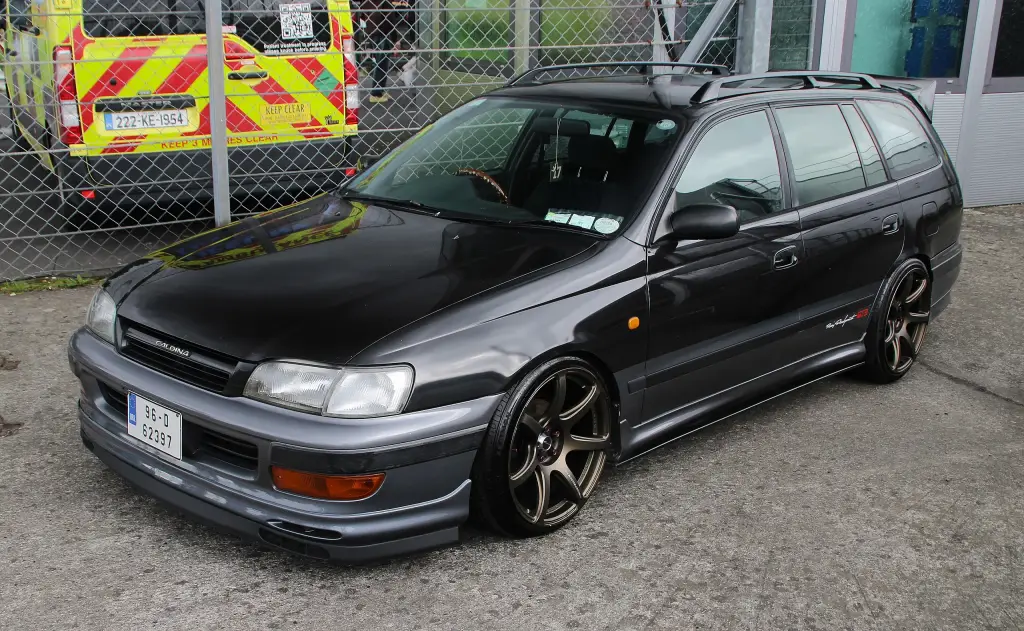
The first Caldina arrived in November 1992 as the five-door estate and commercial van version of the Corona and Carina saloons, and became a separate line in response to the success of the Subaru Legacy estate in Japan. Wagons had independent strut rear suspension, while vans used leaf springs. A January 1996 facelift brought a new dashboard — shared with the Corona Premio — a new grille and redesigned tailgate and lights, and the 1.8-litre engine changed from the 4S to the lean-burn 7A. The 2.0-litre 3S-FE produced 140 PS, or 135 PS with four-wheel drive, while the wide-angle 3S-GE in the four-wheel-drive TZ-G made 175 PS. Special versions included the Sky Canopy of 1993 with its taller glazed roof and the Aerial of 1996 with a sliding sunroof. Wagon sales ended in 1997, but the van continued until July 2002.
Second generation (T210; 1997)
The second-generation Caldina was the Japanese version of the European Avensis estate, launched in Japan in September 1997, with door handles from the E110 Corolla and T210 Corona Premio. There was no commercial version this time. Engines were a 1.8-litre 7A-FE, a 2.0-litre 3S-FE and a 2.2-litre 3C-TE turbo-diesel. The four-wheel-drive All-Trac models carried the ST215 code and included GT versions with the 3S-GE VVT-i engine; the top GT-T used the turbocharged fourth-generation 3S-GTE of 260 PS with a viscous centre differential similar to the Celica GT-Four’s. It came with a five-speed manual, joined in November 1997 by a four-speed automatic with VSC.
The end
The Caldina remained a Japanese-market specialist, popular with enthusiasts for the GT-T’s combination of estate space and rally-derived power. When it was discontinued in 2007, the T270 Avensis estate took over its place in the range. Its four-wheel-drive versions and generous load space are why so many were imported privately to Australia, New Zealand, Russia and South America.
Design and features
- Estate and van bodies: the first generation offered both passenger and commercial versions.
- GT-T: a 260 PS turbocharged 3S-GTE with four-wheel drive and a viscous centre differential.
- All-Trac: four-wheel-drive versions coded ST215.
- Japanese-only: never officially exported, but a popular grey import.
Toyota Caldina versions
- T190 estate (1992): five-door wagon with independent rear suspension.
- T190 van (1992–2002): commercial version with leaf springs.
- Sky Canopy (1993): taller, partly glazed roof.
- Aerial (1996): sliding sunroof and masked headlamps.
- GT-T (1997): 260 PS turbo with four-wheel drive.
- TZ-G (1995): 3S-GE engine of 175 PS with four-wheel drive.
The Caldina replaced the estates of the Corona and Carina, and its second generation shared its body with the Avensis. More cars are in the Toyota collection.
Sources
- Toyota Caldina, English Wikipedia: generations, engines, versions