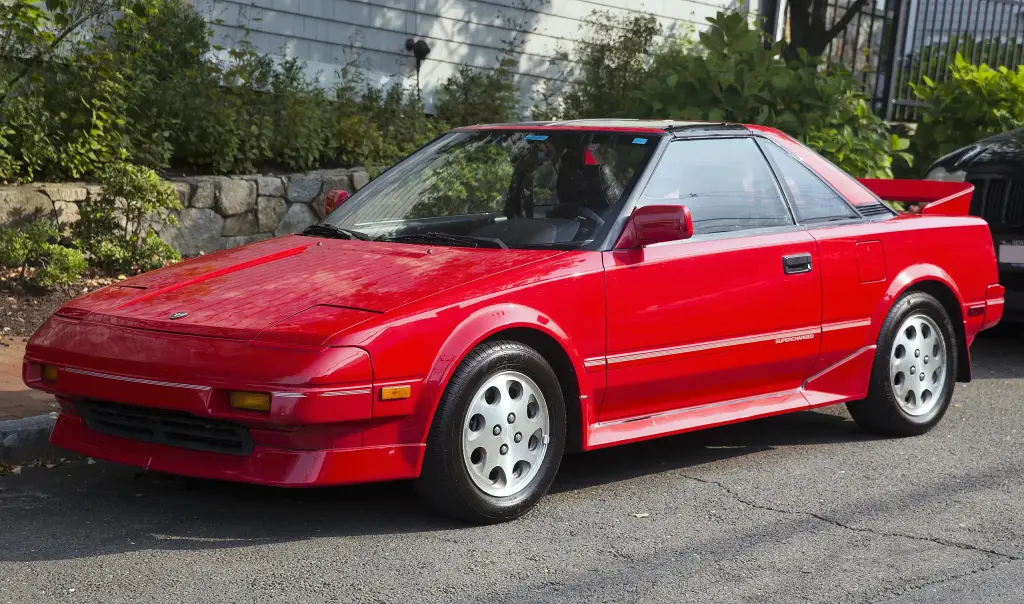
The Toyota MR2 is a two-seater sports car built from 1984 to 2007 over three generations, and the first Japanese rear-mid-engine, rear-wheel-drive production car. Its name stands for either “mid-ship run-about 2-seater” or “mid-engine, rear-wheel-drive, 2-seater”, and in French-speaking markets it was sold as the Toyota MR because MR2 sounds like an obscenity in French.
Toyota MR2 at a glance
| Maker | Toyota |
|---|---|
| Production | 1984–2007 |
| Generations | Three: W10, W20 and W30 |
| Layout | Transverse mid engine, rear-wheel drive |
| Engines | 1.5 and 1.6-litre fours, later 1.8 and 2.0 |
| Brakes | Four-wheel discs |
| Suspension | Independent coilover MacPherson struts |
| First generation | W10, 1984–1989 |
| Supercharged | 4A-GZE from 1986 |
| Award | Car of the Year Japan, 1984 |
| Name | Mid-ship run-about 2-seater |
Based on one source: the English Wikipedia article on the Toyota MR2, which covers the first generation in most detail.
History of the Toyota MR2
Origins
The MR2 grew from a 1976 Toyota project for a car that was enjoyable to drive but economical, not necessarily a sports car. Design work began in 1979 when Akio Yoshida of Toyota’s testing department evaluated engine placement and drive methods, settling on a transverse mid-mounted engine. Toyota called the 1981 prototype the SA-X and tested further prototypes in Japan and the United States, including sessions at Willow Springs with former Formula One driver Dan Gurney. The SV-3 concept appeared at the Tokyo Motor Show in October 1983, and the production car was launched in 1984.
First generation (W10; 1984)
The W10 was sold in Japan through Toyota Auto Store and Toyota Vista Store, and it won Car of the Year Japan on introduction. Toyota engineered the body to take a 2-litre engine, but the car was light, as little as 950 kg in Japan, with strong handling and a small, low-power engine. Its suspension and handling were developed with help from Lotus engineer Roger Becker, and the car owed much to 1960s and 1970s Lotus sports cars. The main engine was the 1,587 cc 4A-GE from the E80 Corolla, with Denso fuel injection and T-VIS variable intake geometry, producing between 112 and 130 hp depending on the market; a 1.5-litre 3A-U of 83 PS was the Japanese base model. Road tests recorded 0–60 mph in the mid-to-high eight seconds, well ahead of the Pontiac Fiero and Fiat X1/9. In 1986, 1988 in the United States, Toyota added the supercharged 4A-GZE with a Roots blower and intercooler, 145 hp and 0–100 km/h in 6.5 to 7.0 seconds; it had stiffer springs, teardrop alloy wheels and a vented engine cover.
Later generations
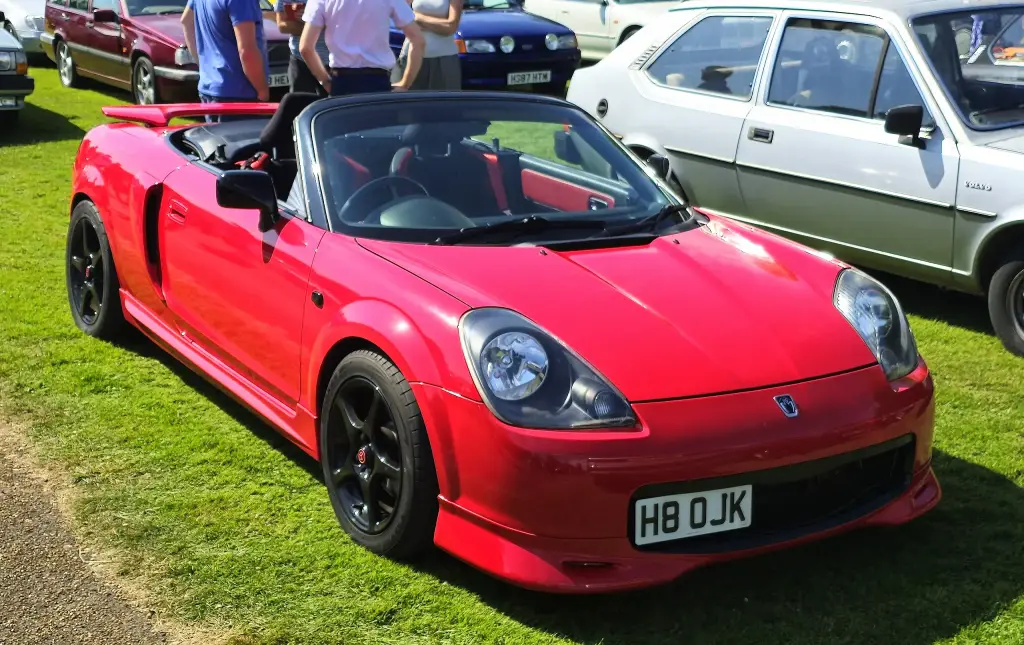
The second generation, the W20, was built from 1989 to 1999 with larger, heavier bodies and 2.0-litre engines. The third, the W30, was sold from 1999 to 2007 and known in Japan as the MR-S; it returned to a lighter, smaller formula with a 1.8-litre engine and a five-speed sequential manual gearbox. All three generations stayed within Japanese regulations on exterior dimensions and engine size, and the MR2 appeared around the same time as the Honda CR-X and Nissan EXA in Japan and the Pontiac Fiero and Ford EXP in America.
Design and features
- Mid-engine layout: a transverse engine ahead of the rear axle for balance.
- Light weight: as little as 950 kg in the first generation.
- Supercharged option: the 4A-GZE of 1986 with a clutch-driven Roots blower.
- Lotus input: handling developed with engineer Roger Becker.
Toyota MR2 versions
- AW10 (1984): Japanese base model with the 1.5-litre 3A-U.
- AW11 (1984): the 1.6-litre 4A-GE version.
- Supercharged (1986): 4A-GZE with 145 hp.
- W20 (1989): second generation with 2.0-litre engines.
- W30 / MR-S (1999): third generation, lighter and smaller.
The MR2 shares its mid-engine layout with no other Toyota, but its engines and spirit connect it to the Celica and Supra. More cars are in the Toyota collection.
Sources
- Toyota MR2, English Wikipedia: origins, first generation, engines