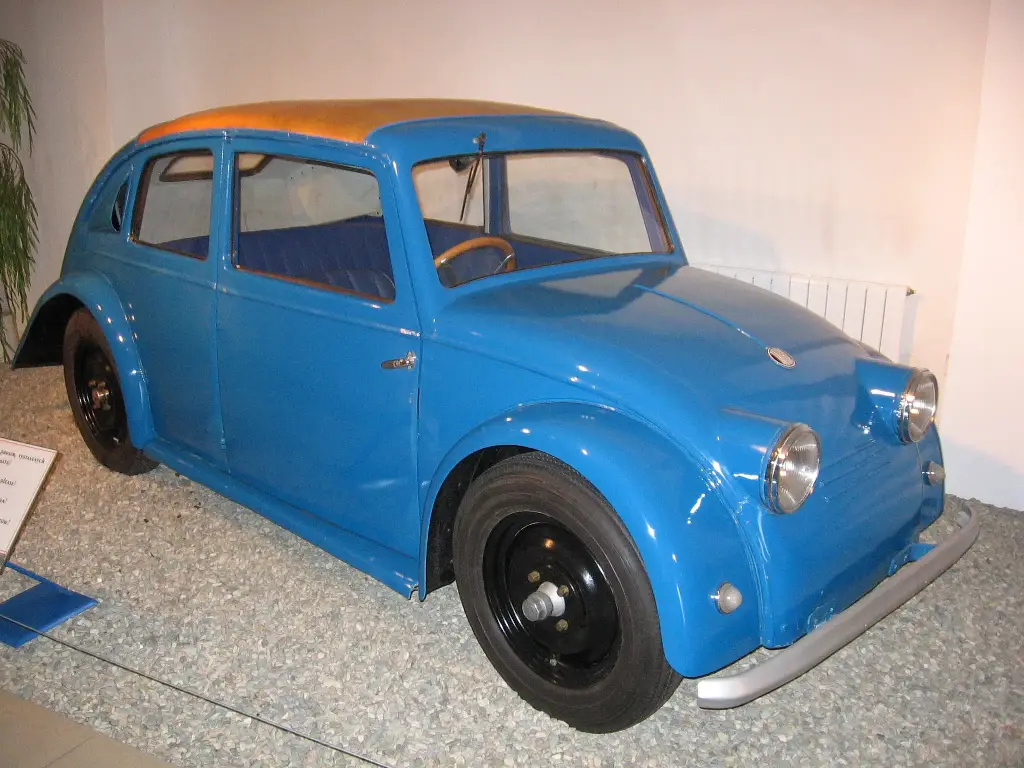
The Tatra V570 was a prototype car developed between 1931 and 1933 by a team led by Hans Ledwinka, with Erich Ledwinka and Erich Übelacker. The aim was a cheap people’s car with an aerodynamic body, but management decided that the revolutionary ideas should first be used on large luxury cars, and the project gave way to the Tatra T77.
Tatra V570 at a glance
| Maker | Tatra, Kopřivnice, Czechoslovakia |
|---|---|
| Developed | 1931–1933 |
| Team | Hans Ledwinka, Erich Ledwinka, Erich Übelacker |
| First prototype | 1931, conventional T57 two-seater body |
| Second prototype | 1933, streamlined four-seater |
| Engine | 854 cc air-cooled two-cylinder boxer |
| Power | 18 hp at 3,500 rpm |
| Top speed | 80 km/h |
| Body | two-door timber frame, flat enclosed floor |
| Influence | Tatra T77 and Tatra T97 |
History of the Tatra V570
The idea
In the early 1930s Tatra engineers under Hans Ledwinka’s son Erich and the design engineer Erich Übelacker began work on a small people’s car with a rear-mounted engine in a backbone frame. Ledwinka believed a rear engine would cut the efficiency loss, noise and vibration of a driveshaft; without a shaft there could be a flat floor with no central tunnel, letting passengers sit lower and further forward, which gave a lower centre of gravity, better weight distribution and a lower body. The engine at the rear shortened the front and allowed a longer tail, which suited aerodynamics, and the noise would not disturb passengers at speeds over 50 km/h. Air cooling was simpler and more effective in Central European winters and summers than the water cooling of the time, and Tatra’s experience with aeroplanes gave it knowledge of aerodynamic laws to apply to the car.
The first prototype
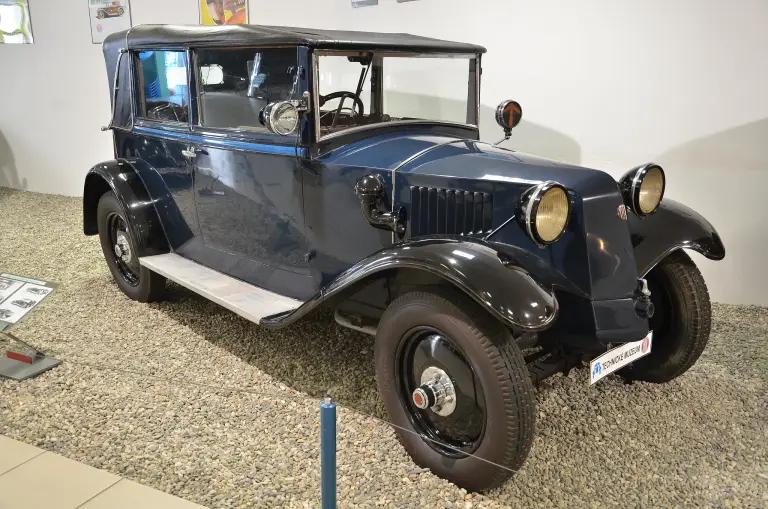
The initial concept was presented by Erich Übelacker, who had worked on the Tatra 57, but Ledwinka strongly criticised it. Facing the prospect of leaving the company, Übelacker finally presented a project with an aerodynamic body and a teardrop rear to house the whole driveline. Paul Jaray, the noted Zeppelin designer, produced a prototype aerodynamic body for the standard Tatra 57. Ledwinka stepped in to finish work that might otherwise have come to nothing. The new design was first tried under a conventional T57 two-seater drophead coupé body, which was not aerodynamic: this was the first T57-V570 prototype, and two pieces of it were made in 1931.
The streamlined second prototype
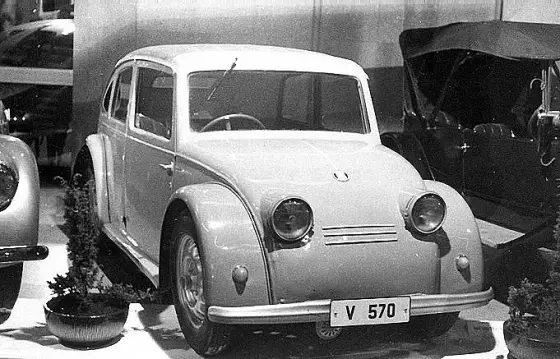
Work on the second prototype’s aerodynamic body began in 1933, based on patents using Paul Jaray’s streamlining principles. The lower part followed the lines of an aeroplane wing while the upper part was like a second wing on top. The rear mudguards were incorporated into the body and the rear wheels covered, the remains of the front mudguards became part of the bonnet, running boards were abandoned and accessories such as door handles were recessed. The floor was flat and enclosed, and the windscreen was inclined at 45 degrees. Placing and cooling the rear engine was difficult, shown by the many patents Tatra registered for airflow to the rear engine compartment.
The final design had four seats. The engine was a two-cylinder air-cooled boxer of 854 cc producing 18 hp at 3,500 rpm, with the engine, gearbox and half-axles built as one unit. The simple two-door body had a timber frame; although it was made purely to test design ideas, it handled well and easily reached 80 km/h. Final construction was entrusted to Erich Ledwinka. Serial production was considered, but the outstanding commercial success of the Tatra 57 prevented it, and the principles of the V570 were later used in the Tatra T77 and Tatra T97. The car was sold and its owner used it daily for 30 years before returning it to the Tatra factory museum.
Design and features
- Rear air-cooled engine: an 854 cc boxer with 18 hp.
- Flat floor: no driveshaft tunnel, so a lower and roomier body.
- Aerodynamic body: wing-shaped sections, covered rear wheels, 45-degree windscreen.
- Test bed for ideas: the principles later used in the T77 and T97.
Tatra V570 versions
- First prototype (1931): V570 running gear under a conventional T57 two-seater body.
- Second prototype (1933): streamlined four-seater with a timber-framed two-door body.
The V570’s ideas went into the Tatra 77 and later the Tatra 97, while its ancestor was the Tatra 57. More cars are in the Tatra collection.
Sources
- Tatra V570, English Wikipedia: development, prototypes, engine