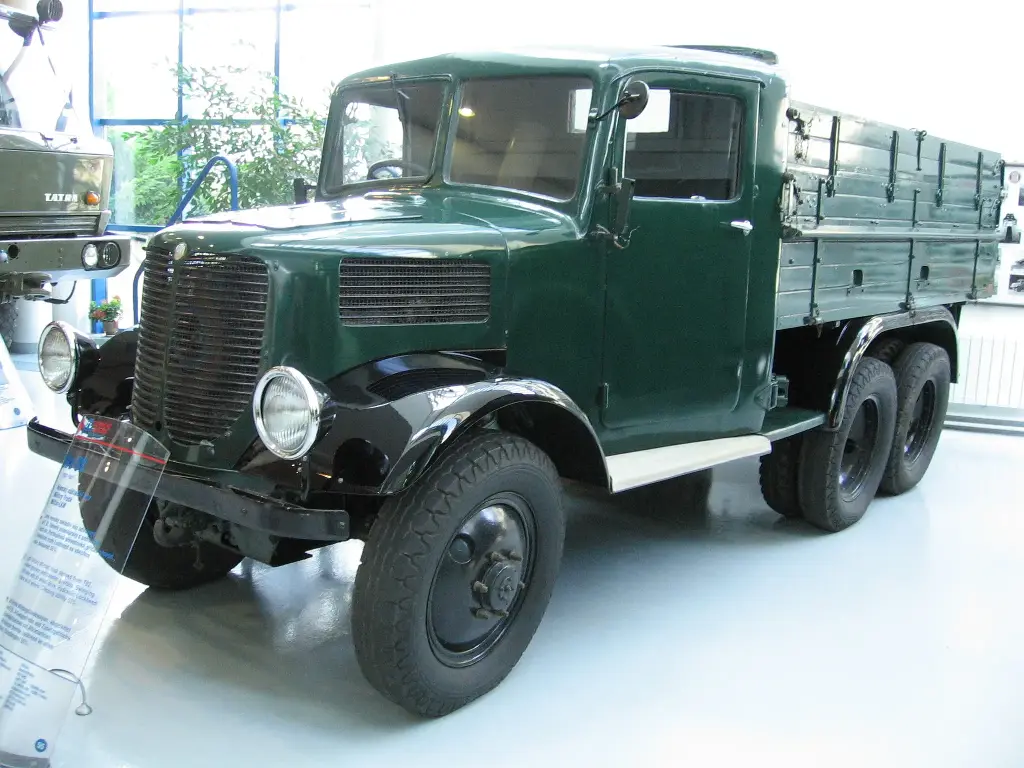
The Tatra 93 was a two-tonne military lorry with a 6×6 axle layout, built by Ringhoffer-Tatra at Kopřivnice. It was created by modifying the Tatra 92, the main change being the addition of front-axle drive, and it was produced almost exclusively for the Romanian army.
Tatra 93 at a glance
| Maker | Ringhoffer-Tatra, Kopřivnice, Czechoslovakia |
|---|---|
| Production | 1938–1939 (some sources 1937–1940) |
| Based on | Tatra 92 |
| Layout | 6×6, three axles, all driven |
| Engine | air-cooled OHC V8, 3,981 cc |
| Power | 74 hp at 3,000 rpm |
| Payload | 2,000 kg |
| Top speed | 65 km/h |
| Fuel consumption | 32–35 litres per 100 km |
| Wheelbase | 2,800 + 940 mm |
| Built | 783 |
| Main customer | Romanian army |
There is no English Wikipedia article on the Tatra 93; the page is based on the Czech article and on the English article about the related Tatra 92. Some sources give 1937–1940 for production.
History of the Tatra 93
The Romanian contract
In July 1937 Ringhoffer-Tatra signed a contract with the MAN company, acting for the Romanian government, for the supply of military vehicles to the Romanian royal army. The main part of the contract was three-axle all-wheel-drive lorries in three versions: 699 flatbeds, 45 reconnaissance cars and 35 command cars, to be delivered during 1938 and 1939.
From the Tatra 92
For this contract Tatra’s designers built a three-axle all-wheel-drive chassis, the V 800, using parts of the Tatra 92. Fitting front-axle drive required moving the oil sump and changing its shape. The vehicle was built as a flatbed visually identical to the Tatra 92 flatbed, and in the similar-looking reconnaissance (T 93R) and command (T 93C) versions. In total 783 were built in 1938–1939, according to other sources 1937–1940, and the Romanian army used them mainly during its advance into the Soviet Union.
Technology
The Tatra 93 was powered by an air-cooled OHC petrol V8 of 3,981 cc with a 90-degree cylinder angle, a bore of 80 mm and a stroke of 99 mm, a compression ratio of 5.5:1 and a Solex 35 JFF double carburettor. It produced 54.5 kW (74 hp) at 3,000 rpm. The engine sat at the front, ahead of the front axle, with pressure lubrication and a dry sump, an axial fan for cooling and a 130-litre fuel tank. Behind it were a dry single-plate clutch, an unsynchronised four-speed gearbox and a two-speed reduction gearbox, with a 12 V electrical system and Bosch dynamo-battery ignition.
The chassis was built on a steel backbone tube with a flange at the front for the engine and gearbox. At the rear were two driven axles with swinging half-axles, each side sprung by a shared semi-elliptic leaf spring; the driven front axle had independent half-axles on inclined quarter-elliptic springs. Front track was 1,500 mm and rear track 1,760 mm with single wheels or 1,330 mm with twin wheels, wheelbase 2,800 + 940 mm and ground clearance 250 mm, with a winch of 3,000 kg. Lockheed hydraulic brakes acted on all wheels and the tyres were 6×20 on 5×20 pressed steel discs. The mixed-construction cab had a wooden frame covered in steel sheet, a two-piece windscreen with two electric wipers and front-hinged doors. The flatbed had wooden sides, a roll-down canvas and five removable cross benches for troops, the command car an open body with a canvas hood and celluloid windows, and the reconnaissance car an open body with two longitudinal folding benches and spare wheels on the sides.
Design and features
- Three driven axles: the Tatra 92 chassis adapted to 6×6.
- Air-cooled V8: 3,981 cc and 74 hp with a dry sump.
- Romanian service: almost the whole production went to Romania.
- Three bodies: flatbed, command car and reconnaissance car.
Tatra 93 versions
- T93 flatbed: wooden sides, canvas and benches for troops, 699 ordered.
- T93 C (comandă): command car with a working table and two folding seats.
- T93 R (recunoaștere): reconnaissance car with folding benches and side spare wheels.
The 93 was derived from the Tatra 85 generation of army six-wheelers, and the later military trucks are the Tatra 111 and Tatra 805. More trucks are in the Tatra collection.
Sources
- Tatra 93, Czech Wikipedia: history, contract, technology
- Tatra 92, English Wikipedia: the 93 as a 6×6 development