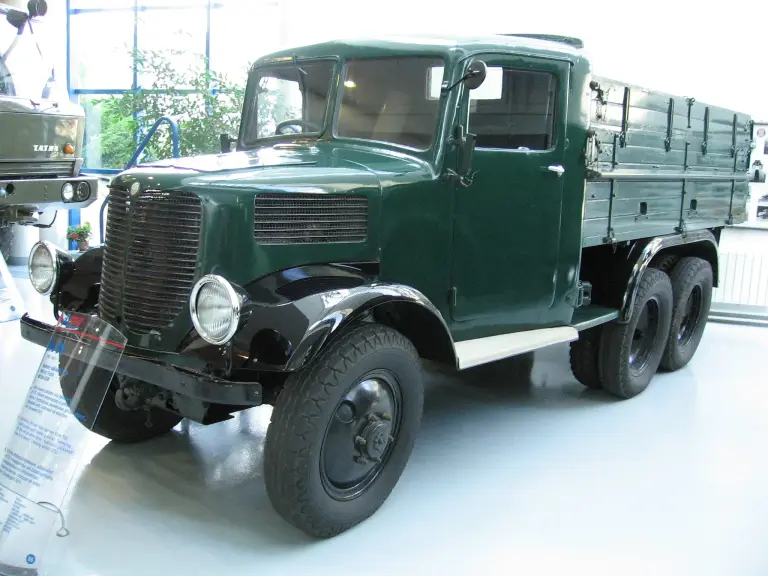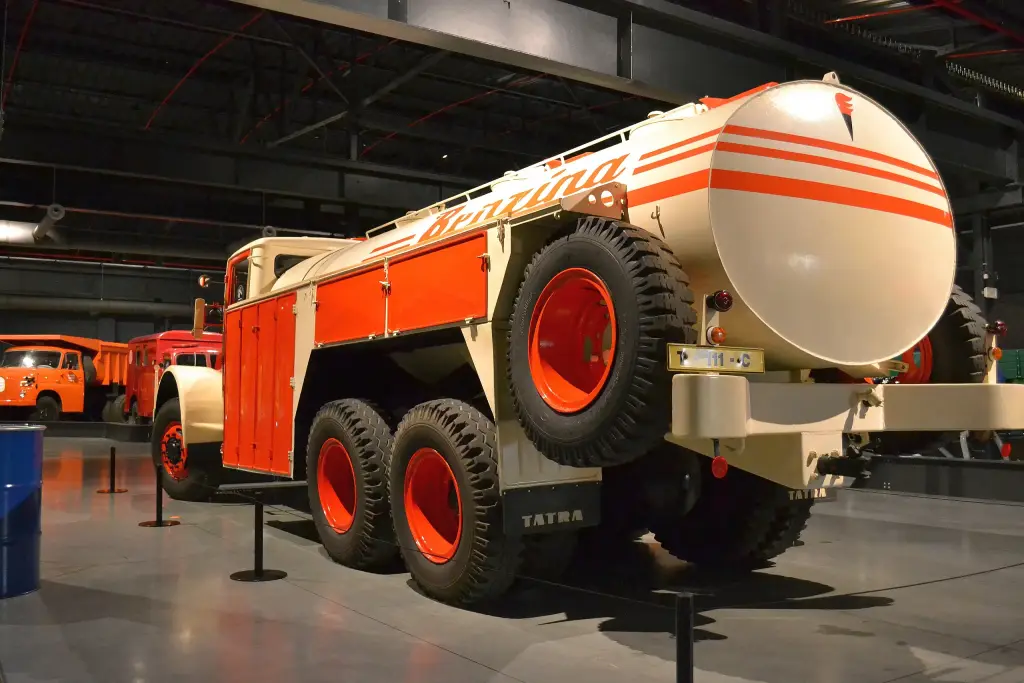
The Tatra 111 was a heavy-duty truck produced by Tatra in Kopřivnice from 1942 to 1962. Developed during the Second World War as a 6×6 for the Wehrmacht, it went on to play a major role in postwar reconstruction, above all in Eastern Europe and the Soviet Union, and its air-cooled V12 was adapted for tractors, railcars and other vehicles.
Tatra 111 at a glance
| Maker | Tatra, Kopřivnice, Czechoslovakia |
|---|---|
| Production | 1942–1962 |
| Replaced by | Tatra 138 |
| Layout | 6×6, central backbone tube |
| Engine | Tatra 103 V12, air-cooled, 75 degrees |
| Power | 210 hp at 2,250 rpm, later 180 hp at 1,800 rpm |
| Payload | 10.3 tonnes |
| Towing capacity | 22 tonnes |
| Wheelbase | 4,175 + 1,200 mm |
| Ground clearance | 300 mm |
| Top speed | about 65 km/h |
| Built | about 34,000 |
History of the Tatra 111
Design and engine
The Tatra 111 followed the proven Tatra concept: a central load-carrying backbone tube with independent swing half axles, a modular gearbox and differential assemblies. The backbone gave the truck great torsional and bending strength and housed the drivetrain, and with differential locks the vehicle had exceptional off-road ability. A cranking handle could be used to start the engine.
The powerplant, the Tatra 103 (model V910), was derived from the Tatra V850 engine intended for the Sd.Kfz. 234 armoured car. It was Tatra’s first air-cooled 75-degree V12, rated at 210 hp at 2,250 rpm; for reliability the output was later reduced to 180 hp at 1,800 rpm. The engine had three camshafts and was cooled at first by two covered chain-driven fans, later by a belt drive. The T111A variant carried this revised arrangement.
Production and war service
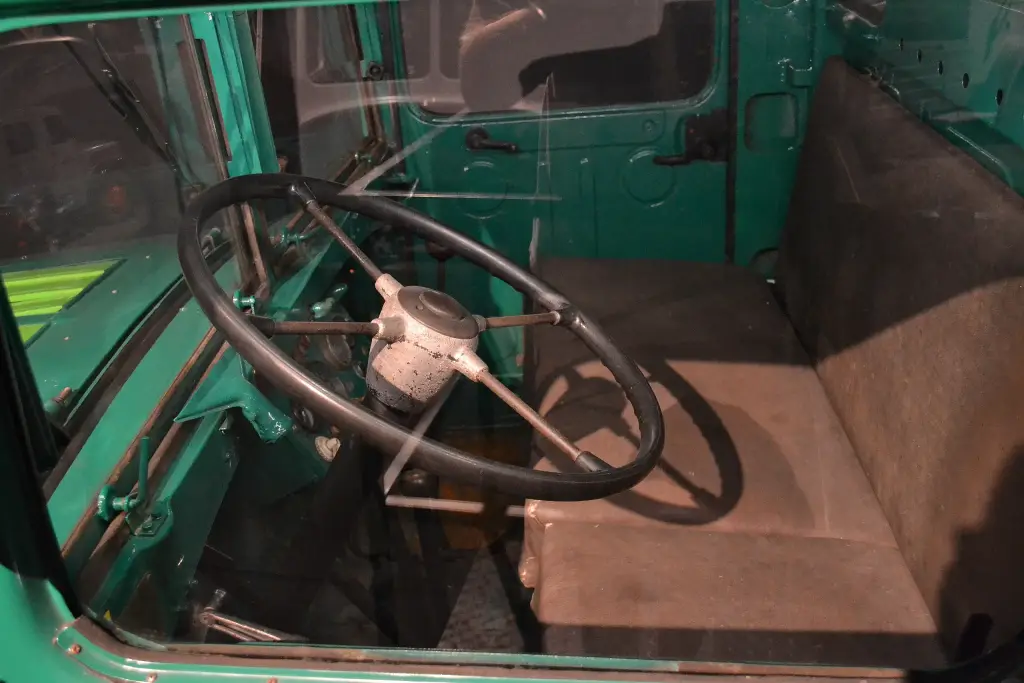
Production started in 1942. The cab was originally built on a wooden frame because steel was scarce in wartime; later the frame became steel and the last models had an all-steel cabin. The six-speed (4+1) main gearbox, two-speed auxiliary gearbox and selectable front-wheel drive gave a top speed of about 65 km/h. The Wehrmacht used the T111 as a heavy truck, and the design’s chief engineer, Hans Ledwinka, was later charged with treason and collaboration and imprisoned after the communist coup in Czechoslovakia.
After the war
The T111 made a significant contribution to rebuilding postwar Eastern Europe and the USSR. Its air-cooled engine eliminated the risk of a frozen or cracked coolant block, which earned the truck a reputation for durability in Siberian conditions; a 1947 model was preserved as a public monument in Susuman, Magadan Oblast, in 1973. Production continued for twenty years and ended in 1962, when the Tatra 138 took over.
Design and features
- Backbone chassis: a central tube carrying the load and enclosing the drivetrain, with swing half axles.
- Air-cooled V12: no radiator or coolant, an advantage in extreme cold.
- 6×6 with locks: selectable front drive and differential locks for heavy going.
- Long service life: twenty years of production and use in tractors, railcars and airport tugs.
Tatra 111 versions
- Flatbed: the most common cargo body.
- Tipper and tanker: construction and fuel transport versions.
- Crane: chassis for crane equipment.
- T141 tractor: a heavy tractor built on T111 technology.
- Engine derivatives: a halved inline-six for the Praga V3S and a V8 for the Tatra 128.
The 111 was replaced by the Tatra 138, and its engine and chassis ideas lived on in the Tatra 141 heavy tractor. More trucks are in the Tatra collection.
Sources
- Tatra 111, English Wikipedia: history, engine, chassis, production