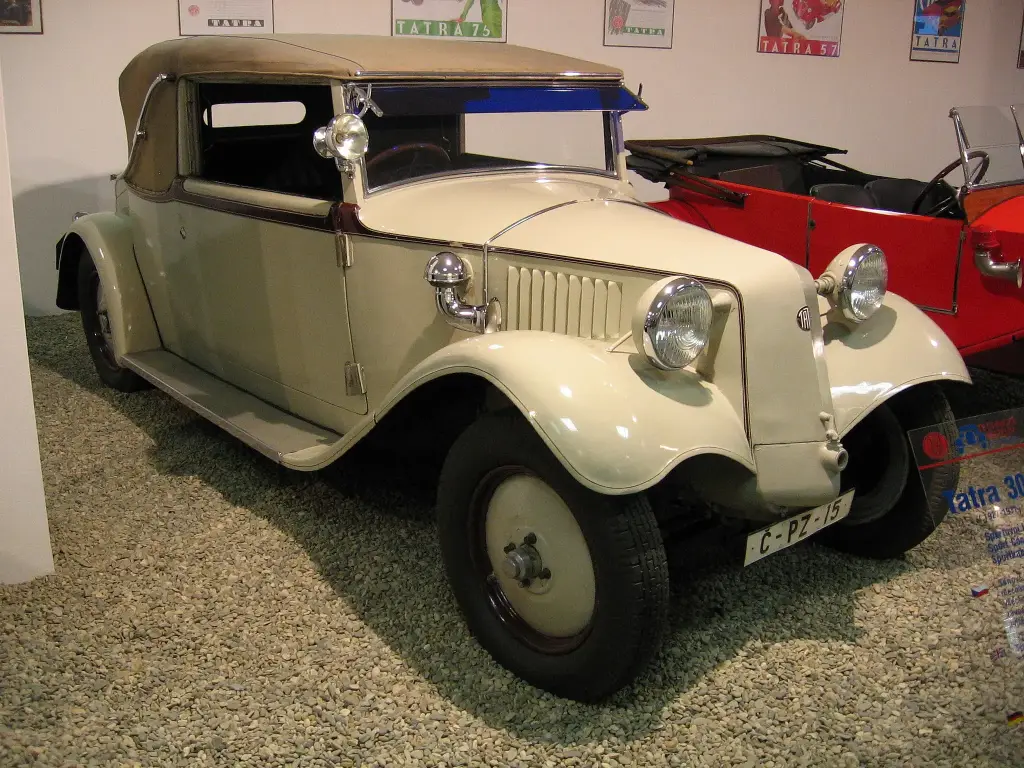
The Tatra 30 was an automobile made by the Czechoslovak manufacturer Tatra. It was built between 1926 and 1928, and from 1928 to 1931 the car received a newer engine and was known as the Tatra 30/52, a transitional model before the Tatra 52.
Tatra 30 at a glance
| Maker | Tatra, Kopřivnice, Czechoslovakia |
|---|---|
| Production | 1926–1928; 30/52 to 1931 |
| Engine | OHV air-cooled flat four, 1,679 cc |
| Power | 24 PS (17.6 kW) |
| Sport engine | 1,910 cc, 32–35 PS |
| Top speed | about 90 km/h |
| Sport top speed | up to 130 km/h |
| Gearbox | four speeds |
| Chassis | central backbone tube |
| Brakes | mechanical |
| Bodies | four-seat cabriolets to six-seat limousines |
History of the Tatra 30
Design
The Tatra 30 was a middle-class car. Power came from an OHV air-cooled four-cylinder boxer engine of 1,679 cc mounted at the front and rated at 24 PS, giving a maximum speed of around 90 km/h. The Tatra 30 Sport used an engine of similar design enlarged to 1,910 cc, producing 32–35 PS and capable of up to 130 km/h.
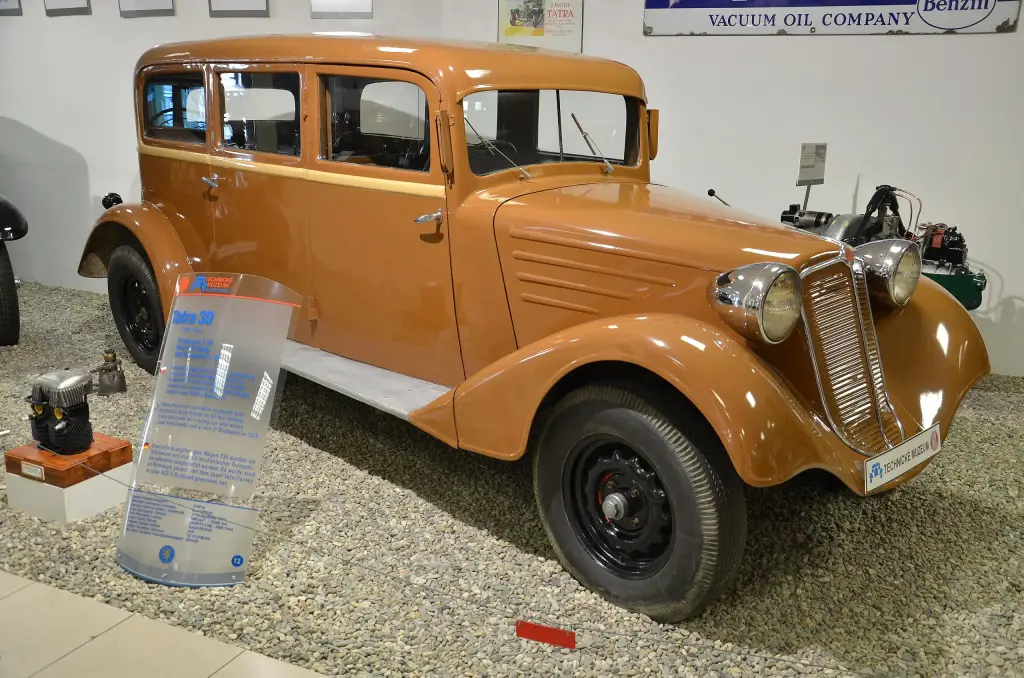
The car followed chief designer Hans Ledwinka’s hallmark layout. Power reached the rear wheels through a four-speed gearbox and a central backbone chassis: the front axle was supported by a transverse leaf spring and a second transverse leaf spring supported the swing rear half-axle. The driveshaft ran inside the backbone tube, with the gearbox and engine mounted in front of the tube and the differential at the rear.
Versions and the 30/52
Many different bodies were made, from four-seat cabriolets to six-seat limousines. During the modernisation process the “52” engine of 1,911 cc and 30 PS was fitted, creating the Tatra 30/52, a transitory mid-version built for about a year before production of the successor began in earnest. The Tatra 30 was gradually modernised until it was replaced by the Tatra 52. The Tatra 30 has mechanical brakes, while the Tatra 52 has hydraulic ones; the 30 is also more angular, especially in its wings, although during the 1940s to 1960s many cars were rebuilt, for example by fitting a hydraulic-brake undercarriage.
Design and features
- Backbone tube: the driveshaft runs inside the central chassis tube.
- Air-cooled flat four: 1,679 cc and 24 PS in the standard car.
- Sport version: 1,910 cc, 32–35 PS and up to 130 km/h.
- Mechanical brakes: one of the visible differences from the later Tatra 52.
Tatra 30 versions
- Tatra 30: standard model of 1926–1928.
- Tatra 30 Sport: 1,910 cc engine and higher top speed.
- Tatra 30/52: transitional version with the 1,911 cc, 30 PS engine.
- Coachbuilt bodies: cabriolets and limousines in several styles.
The 30 was gradually replaced by the Tatra 52, and the smaller Tatra 12 shared its backbone-tube principle. More cars are in the Tatra collection.
Video: Veterán Tatra 30 v Alpách
Video by MsPetr89 on YouTube.
Sources
- Tatra 30, English Wikipedia: engines, chassis, versions