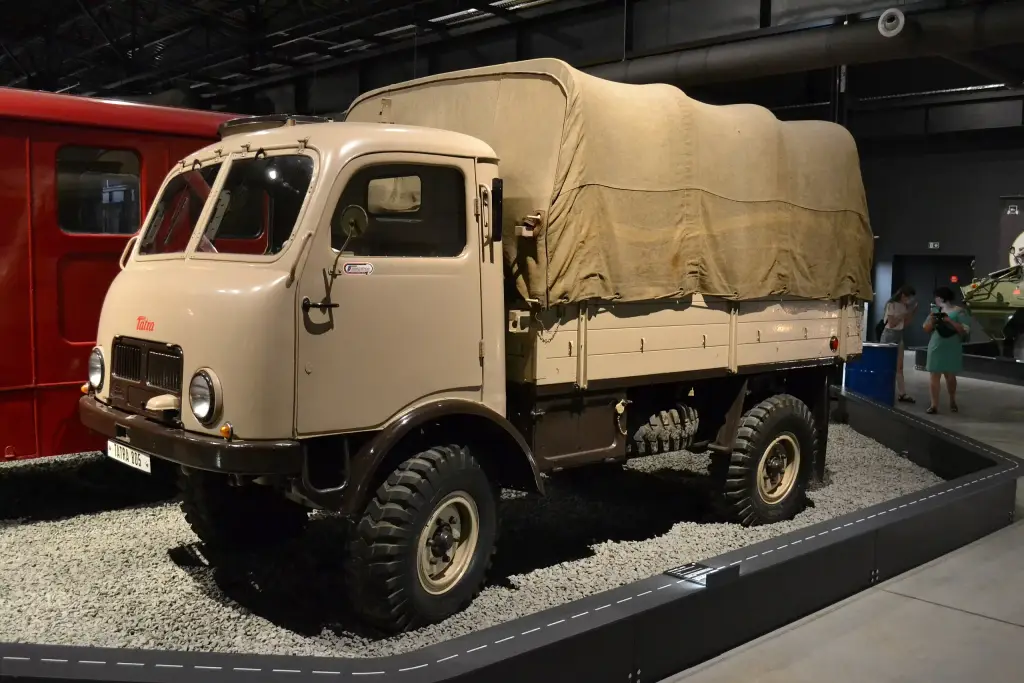
The Tatra 805 is a light all-wheel-drive lorry with a cab-over-engine body. It was developed at the request of the Czechoslovak army and drew on experience with the Tatra 803 and Tatra 804 off-road prototypes, using the Tatra backbone frame and swing axles with hub reductions.
Tatra 805 at a glance
| Maker | Tatra, later AZNP Mladá Boleslav, Plzeň and Avia |
|---|---|
| Production | 1952–1960 |
| Layout | 4×4, backbone frame, swing axles |
| Engine | 2,545 cc air-cooled V8, type T 603A |
| Power | 75 hp at 4,000 rpm |
| Bore and stroke | 75 x 72 mm |
| Gearbox | four speeds plus two-speed auxiliary |
| Wheelbase | 2,700 mm |
| Ground clearance | 400 mm |
| Top speed | 75–80 km/h |
| Fuel consumption | 20–25 litres per 100 km |
| Built | 13,624 |
There is no English Wikipedia article on the Tatra 805; the page is based on the German and Czech articles.
History of the Tatra 805
Origins
The Tatra 805 was developed mainly for the army, which wanted a vehicle able to drive in difficult terrain with high traction. Its chassis followed the earlier Tatra 803 and Tatra 804 special off-road prototypes and used all their advantages, the main difference being the cab-over-engine body, which required a change in the driver’s position. Sources differ about the start of production; originally the 805 was to begin a new family of light lorries of 1.5 to 2.5 tonnes, but in 1952 the Czechoslovak Ministry of Mechanical Engineering decided to specialise Tatra in trucks of 7 to 10 tonnes. Production was therefore moved to the Škoda works at Mladá Boleslav and Plzeň, and later Avia in Prague, and it ended in 1960 after 13,624 vehicles.
Engine and transmission
The 805 was powered by a petrol air-cooled V8 of the T 603A type, one of many variants of Tatra’s most versatile engine, adapted for this use. It had 2,545 cc (75 mm bore, 72 mm stroke) and output limited to 75 hp at 4,000 rpm. Unlike the passenger-car versions it used a single carburettor, a lower compression ratio, pusher cooling fans (with the dynamo in the axis of the right fan, or both on some versions) and a dry crankcase with a double oil pump drawing from a separate tank, which let the vehicle climb very steep slopes without risking loss of lubrication. The specific sound of the cooling fans earned the truck its nicknames, including Píšťala (whistle).
The gearbox had four speeds and was combined with a two-speed auxiliary gearbox. The rear axle was permanently driven and the front axle could be engaged with a separate lever; all-wheel drive had to be engaged before the reduced ratios could be selected. The drivetrain also had differential locks, and the gearbox allowed two outputs to drive other equipment, most often a compressor for inflating tyres. A hand throttle made driving in terrain easier.
Chassis and use
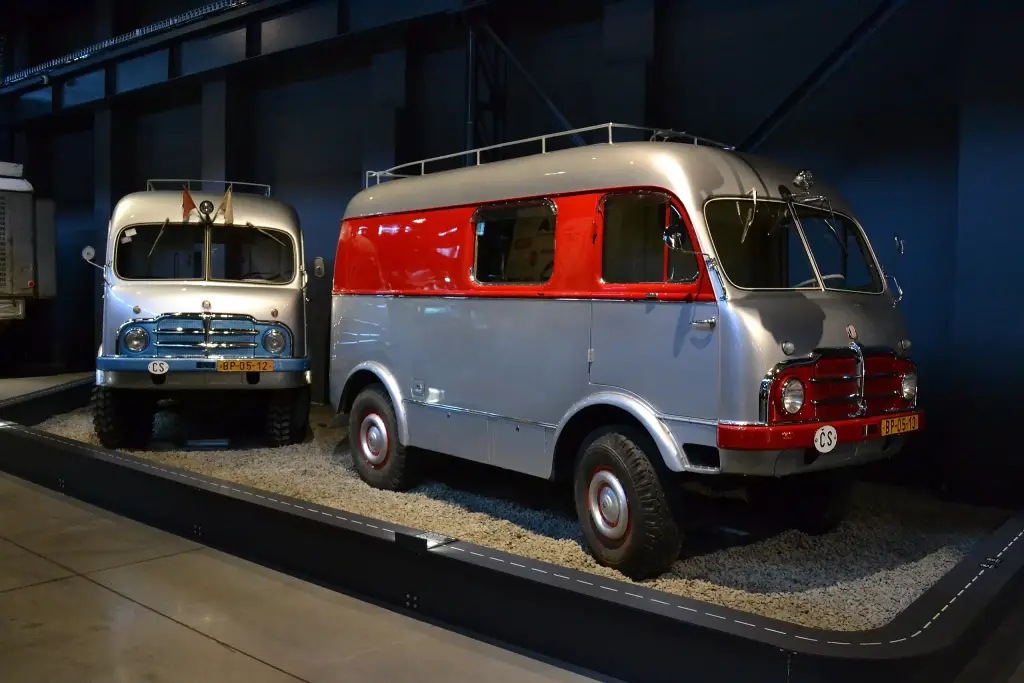
The backbone frame carried front and rear axle drives, and the axles were swinging with hub reductions, which reduced loads on the half-shafts, increased ground clearance and raised the overall gear ratio and thus the maximum traction. The wheelbase was 2,700 mm and ground clearance 400 mm. Both axles were sprung by torsion bars, which gave comfortable road behaviour at higher speeds; the combination of torsion bars, short axle spacing and hub reductions gave the truck a rolling motion off-road that produced the nickname Kačena (duck). It reached about 75–80 km/h on the road and used 20 to 25 litres of petrol per 100 km. Its weak point was the single-circuit hydraulic drum brakes without a servo, whose effect was insufficient when braking a loaded vehicle from higher speeds or on long descents. The 805 was a typical lorry of the Czechoslovak army, most often as a flatbed but also as a radio van, ambulance, fire vehicle, tanker and a light airborne version with a canvas cab of which about 25 were made; the travellers Jiří Hanzelka and Miroslav Zikmund used specially equipped 805s for their journeys.
Design and features
- Cab-over-engine body: a flat-fronted cab, closed or open with a folding roof.
- Air-cooled V8: the T 603A engine, limited to 75 hp.
- Backbone chassis: swing axles with hub reductions and 400 mm of clearance.
- Army workhorse: flatbed, radio, ambulance, fire and tanker bodies.
Tatra 805 versions
- Flatbed: the most widespread version.
- Box bodies: radio van, ambulance and the DVS 8 fire body.
- Tankers: fuel transport bodies.
- Airborne version: light canvas-cab truck, about 25 built.
- Hanzelka and Zikmund cars: expedition vehicles with special equipment.
The 805 shared its V8 family with the Tatra 603, and its off-road role was later taken by the Tatra 813. More trucks are in the Tatra collection.
Video: Tatra 805 / heavy offroading in the forest #1
Video by Zombie Apocalypse Ready on YouTube.
Sources
- Tatra 805, German Wikipedia: origins, production, bodies
- Tatra 805, Czech Wikipedia: engine, chassis, versions